Additional Mathematics notes, chapter 9
Solution of Triangles
Textbook Additional Mathematics Form 4 KSSM (DLP), pages 240–269
What this chapter covers
- Make and verify the relationship between the sides of a triangle and the sines of the opposite angles, and use the sine rule to solve triangles (9.1)
- Determine whether the ambiguous case exists and solve triangles in it (9.1)
- Use the cosine rule to find a side or an angle (9.2)
- Find the area of a triangle with the formula using two sides and the included angle, and with Heron's formula (9.3)
- Solve real-life problems by choosing the sine rule, cosine rule and area formulae (9.4)
9.1Sine rule
In triangle ABC, the side opposite angle A is a, opposite B is b and opposite C is c. The sine rule links each side to the sine of its opposite angle. It works for any triangle, acute or obtuse, where Pythagoras does not.
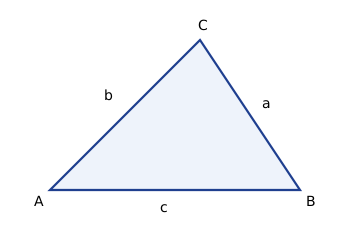
The rule
asin A = bsin B = csin C or sin Aa = sin Bb = sin Cc| You know | Use the sine rule? |
|---|---|
| Two angles and any one side (AAS or ASA) | Yes. Find the third angle first by 180° minus the other two. |
| Two sides and an angle opposite one of them | Yes, and check for the ambiguous case. |
| Two sides and the included angle, or three sides | No. Use the cosine rule. |
A = 40°, B = 65° and a = 12 cm. Find b.
bsin 65° = 12sin 40°, so b = 12 sin 65°sin 40° = 16.92 cm. Reading the answer: the larger angle is opposite the longer side, and 65° > 40°, so b > 12 makes sense.Put the unknown on top. To find a side use asin A = bsin B. To find an angle turn it over: sin Aa = sin Bb. Keep your calculator in degree mode.
The ambiguous case
When two sides and a non-included angle are given, two different triangles can sometimes be drawn from the same data. This is the ambiguous case.
Let the given angle be A (acute), the side next to it c, and the side opposite it a. Let h = c sin A be the height of the triangle.
| Condition | Triangles |
|---|---|
| a < h | None. The side is too short to reach. |
| a = h | One (right-angled). |
| h < a < c | Two: the ambiguous case. |
| a ≥ c | One. |
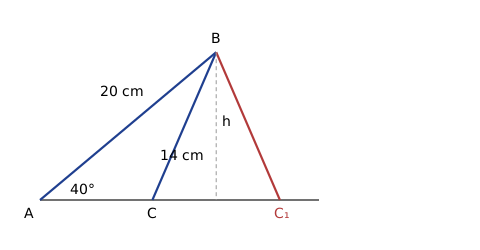
Conditions as in textbook p. 246 to 247; figure redrawn.
Solve for angle C when A = 40°, AB = 20 cm, BC = 14 cm
sin C = 20 sin 40°14 = 0.9183, so C = 66.7° or C = 180° − 66.7° = 113.3°. Both are valid because each leaves a positive angle for B.A calculator gives only the acute value of sin−1. In the ambiguous case always also try 180° minus that angle, and keep it only if the three angles can still add to 180°.
In triangle PQR, ∠P = 30°, PQ = 10 cm and QR = 6 cm. (a) Find the height from Q. (b) Is the case ambiguous?
Show answerHide answer
(a) h = 10 sin 30° = 5 cm
(b) h < QR < PQ, since 5 < 6 < 10, so two triangles exist.
(b) h < QR < PQ, since 5 < 6 < 10, so two triangles exist.
9.2Cosine rule
The cosine rule is used when the sine rule cannot start: two sides with their included angle, or all three sides.
| Find | Form |
|---|---|
| A side | a2 = b2 + c2 − 2bc cos A (likewise for b2 and c2) |
| An angle | cos A = b2 + c2 − a22bc |
b = 7 cm, c = 9 cm and A = 60°. Find a.
a2 = 72 + 92 − 2(7)(9) cos 60° = 49 + 81 − 63 = 67, so a = 8.19 cm.The sides are 5 cm, 7 cm and 8 cm. Find the largest angle.
The largest angle is opposite the longest side (8 cm). cos C = 52 + 72 − 822(5)(7) = 1070, so C = 81.8°.If the cosine comes out negative, the angle is obtuse. This is correct and needs no second step, unlike the sine rule, where an obtuse angle can be hidden.
Do the order of operations carefully: 2bc cos A is subtracted after multiplying. Never write (b2 + c2 − 2bc) cos A.
Find the side opposite a 35° angle between sides of 12 cm and 15 cm.
Show answerHide answer
x2 = 144 + 225 − 2(12)(15) cos 35° = 74.11, so x = 8.61 cm
9.3Area of a triangle
With two sides and the included angle, area = 12 ab sin C. With three sides, use Heron's formula: area = √(s(s − a)(s − b)(s − c)) where s = a + b + c2 is the semi-perimeter.
| Known | Formula | Example |
|---|---|---|
| a, b and included C | 12 ab sin C | a = 8, b = 11, C = 42° gives 29.4 cm2 |
| a, b, c | √(s(s − a)(s − b)(s − c)) | 5, 6, 7: s = 9, area = √216 = 14.70 cm2 |
The angle in 12 ab sin C must be the one between the two sides used. Any of 12 ab sin C, 12 bc sin A and 12 ac sin B gives the same area.
Heron's formula needs s, not the perimeter. Forgetting to halve the perimeter is the most common error.
Find the area of a triangle with sides 13 cm, 14 cm and 15 cm.
Show answerHide answer
s = 21; area = √(21 × 8 × 7 × 6) = √7056 = 84 cm2
9.4Application
Real problems (land plots, ships, towers, frames) are solved by choosing the right tool for each triangle. Draw a clear sketch first and mark what is known.
| Given | Find | Tool |
|---|---|---|
| Two angles, one side | Another side | Sine rule |
| Two sides, non-included angle | An angle | Sine rule (check ambiguous case) |
| Two sides, included angle | Third side | Cosine rule |
| Three sides | An angle or the area | Cosine rule or Heron's formula |
Two paths from a gate
Ali walks 12 km on a bearing of 075° and Mei Ling walks 9 km on a bearing of 160°. The angle between the paths is 160° − 75° = 85°. The distance apart is √(122 + 92 − 2(12)(9) cos 85°) = 14.4 km.For an irregular shape, split it into triangles with a diagonal, find the diagonal first, then add the areas.
Which rule finds ∠A if a = 9, b = 7 and B = 40°?
Show answerHide answer
The sine rule, because the given angle is opposite a known side. sin A = 0.8264, so A = 55.7° or 180° − 55.7° = 124.3°. Both fit because h = 9 sin 40° = 5.79 cm and 5.79 < 7 < 9, so this is the ambiguous case.