Additional Mathematics notes, chapter 8
Vectors
Textbook Additional Mathematics Form 4 KSSM (DLP), pages 210–239
What this chapter covers
- Tell vector and scalar quantities apart, represent vectors with directed line segments and notation, and use scalar multiplication, parallel vectors and collinear points (8.1)
- Add and subtract vectors with the triangle, parallelogram and polygon laws, and solve problems on resultant vectors, velocity and collinearity (8.2)
- Express vectors in the Cartesian plane as xi + yj or column vectors, find magnitudes and unit vectors, compute with them and solve motion problems (8.3)
8.1Vectors
A vector has magnitude (size) and direction. A scalar has magnitude only.
| Scalar | Vector |
|---|---|
| Distance: the whole length travelled | Displacement: the shortest line from start to end, with direction |
| Speed | Velocity (negative when the object turns back) |
| Mass: does not change with place | Weight: the pull of gravity, changes with place |
Example 1 (textbook p. 214): vector or scalar?
(a) A car moves at 90 km h−¹ to the south: vector (magnitude and direction).(b) Body temperature 38°C: scalar (magnitude only).
Notation, magnitude and special vectors
- A directed line segment from A to B is written →AB or a (handwritten as a with a wavy line under it). Its magnitude is |→AB| or |a|.
- Equal vectors have the same magnitude and direction.
- Negative vector: same magnitude, opposite direction, →BA = −→AB.
- Zero vector 0: magnitude 0, no direction (for example, a car back at its start has displacement 0).
Scalar multiplication and parallel vectors
The vector ka has magnitude |k| × |a|. It points the same way as a if k > 0 and the opposite way if k < 0.
- a and b are parallel if and only if a = kb for a constant k.
- If a and b are non-zero and not parallel, and ha = kb, then h = 0 and k = 0. This lets you compare coefficients.
- Points A, B, C are collinear if →AB = k→BC: parallel vectors with the common point B.
Example 7 (textbook p. 219): show P, Q, R are collinear
→PQ = u and →QR = 5u, so →QR = 5→PQ.The vectors are parallel and Q is common, so P, Q and R are collinear.
Example 8 (textbook p. 219): find h and k
(h − 1)a = (k + 5)b with a, b not parallel.h − 1 = 0 and k + 5 = 0, so h = 1 and k = −5.
Two vectors that share a direction are parallel, but three points are collinear only when the vectors also share a point, as in →AB and →BC both containing B.
Quick check. Given →LM = 6x and →MN = 18x, are L, M, N collinear?
Show answer
→MN = 3→LM, so they are parallel. M is common, so L, M and N are collinear.
8.2Addition and subtraction of vectors
A resultant vector is the single vector produced by adding vectors. Subtraction is adding the negative: a − b = a + (−b).
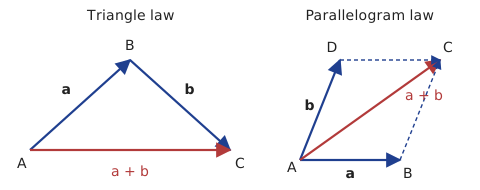
| Law | Use when | Rule |
|---|---|---|
| Triangle | vectors join head to tail | →AB + →BC = →AC |
| Parallelogram | vectors start from the same point | →AB + →AD = →AC |
| Polygon | a chain of vectors | →AB + →BC + →CD + →DE = →AE |
To find a vector between two points, go via a route you know: →AB = →AO + →OB = −→OA + →OB. Reversing a step changes its sign.
Example 10 (textbook p. 223): pentagon
→BC = 13→AE, →ED = 12→AB, →AB = a and →AE = b. Find →CD.→CD = →CB + →BA + →AE + →ED = −13b − a + b + 12a = 23b − 12a
Velocity problems (river and wind)
The real velocity is the resultant of the velocity of the boat (or plane) and of the stream (or wind). When the two are at right angles, use Pythagoras for the speed and tan for the angle.
Example 11 (textbook p. 223): boat and river
Boat 5 km h−¹ north, stream 10 km h−¹ east. Speed = √(5² + 10²) = 11.18 km h−¹.tan θ = 10 ÷ 5, so θ = 63.43° from north: bearing 063.43°.
Collinear points with unknown constants
- Write two vectors with a common point, such as →AB and →AC, using triangle law.
- Write →AC = k→AB.
- Compare the coefficients of a and of b to get h and k.
Example 12 (textbook p. 224)
→OA = a + b, →OB = 3a − 2b, →OC = ha + 7b. A, B, C collinear.→AB = 2a − 3b; →AC = (h − 1)a + 6b = k(2a − 3b).
b: 6 = −3k, so k = −2. a: h − 1 = 2k = −4, so h = −3.
Quick check. A boat heads north at 3 m s−¹ and the stream flows east at 4 m s−¹. What is the speed of the boat over the ground?
Show answer
√(3² + 4²) = 5 m s−¹.
8.3Vectors in the Cartesian plane
i = 10 and j = 01 are the unit vectors along the x-axis and y-axis. The position vector of B(x, y) is →OB = xi + yj = xy, with magnitude √(x² + y²).
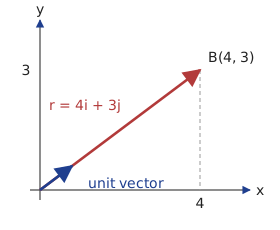
| Idea | Rule | Example |
|---|---|---|
| Magnitude | |xi + yj| = √(x² + y²) | |−4i + 3j| = 5 |
| Unit vector | r̂ = r ÷ |r| | for 4i + 3j: 0.8i + 0.6j |
| Add or subtract | add or subtract the same components | 41 + 0−3 = 4−2 |
| Scalar multiple | multiply both components | −32−1 = −63 |
Example 16 (textbook p. 231): unit vector
−13i + kj is a unit vector, so 19 + k² = 1, k² = 89 and k = ±0.9428.A unit vector has magnitude 1 unit, not components equal to 1. Always divide both components by the magnitude, and remember that k can be positive or negative.
Motion with a position vector
Example 21 (textbook p. 234): particle from A(5, 10)
Velocity v = 3i − j m s−¹, so position after t seconds is 5 + 3t10 − t.Speed = |v| = √10 m s−¹. After 4 s the particle is at (17, 6). It is on the x-axis (y = 0) when 10 − t = 0, so t = 10 s.
Two moving objects meet when their position vectors are equal at the same time t: equate the i parts and the j parts, then check both give the same t.
Quick check. Find the unit vector in the direction of r = 3i − 4j.
Show answer
|r| = √(9 + 16) = 5, so the unit vector is 15(3i − 4j) = 0.6i − 0.8j.
Quick check. Given p = 25 and q = 4−1, find 2p − q.
Show answer
4 − 410 + 1 = 011.