Additional Mathematics questions, chapter 8
Nama / NameKelas / ClassTarikh / Date
Vectors
43 marks. Use Practice to check each answer as you go, or Exam to answer everything first. Show your working for Section B. Write vectors with a wavy line under the letter, or an arrow over AB, as in class.
Section A: objective questions
12 marksChoose the correct answer. Each question carries 1 mark.
1
Question 1
Which of the following is a vector quantity?
Show answerHide answer
C
A vector has magnitude and direction. Velocity with a direction (due north) is a vector; mass, temperature and area have magnitude only.
2
Question 2
Given |a| = 4 and →CD = −2a. Which statement about →CD is correct?
Show answerHide answer
B
|k a| = |k| × |a| = 2 × 4 = 8. k = −2 is negative, so the direction is opposite to a. A magnitude can never be negative.
3
Question 3
Given that a and b are non-zero and not parallel, and (h − 3)a = (k + 4)b, find h + k.
Show answerHide answer
A
Since a and b are not parallel, both coefficients are zero: h − 3 = 0 and k + 4 = 0. So h = 3, k = −4 and h + k = −1.
4
Question 4
PQRS is a parallelogram with →PQ = a and →PS = b. Find →QS.
Show answerHide answer
D
Triangle law: QS = QP + PS = −a + b = b − a. The option a − b is the vector SQ, the negative of the correct one.
5
Question 5
Find the magnitude of the vector −5i + 12j.
Show answerHide answer
C
√((−5)² + 12²) = √169 = 13. Adding the components gives 7, and 169 is the value before taking the square root.
6
Question 6
What is the unit vector in the direction of 3i − 4j?
Show answerHide answer
B
Magnitude = √(9 + 16) = 5. Divide the vector by 5. Dividing by 25 uses the square of the magnitude.
7
Question 7
Given p = 3−1 and q = 14, find 2p − q.
Show answerHide answer
A
2p = (6, −2). Then (6 − 1, −2 − 4) = (5, −6).
8
Question 8
Vector 4i − 6j is parallel to 6i + kj. Find k.
Show answerHide answer
C
Parallel means 6 = m × 4 for some m, so m = 3⁄2 and k = m × (−6) = −9. Equivalent: 4 ÷ 6 = −6 ÷ k.
9
Question 9
Given →PQ = 2a + 3b and →QR = 6a + hb. If P, Q and R are collinear, find h.
Show answerHide answer
B
Collinear with common point Q: QR = k PQ. a: 6 = 2k so k = 3. b: h = 3k = 9.
10
Question 10
A boat heads north at 5 m s−1 in a stream flowing east at 12 m s−1. What is the speed of the boat relative to the ground?
Show answerHide answer
D
The two velocities are at right angles, so speed = √(5² + 12²) = √169 = 13 m s−1. Adding the speeds (17) only works for the same direction.
11
Question 11
Which of the following is a unit vector?
Show answerHide answer
D
A unit vector has magnitude 1. √((−0.6)² + 0.8²) = √1 = 1. The others have magnitudes √2, about 0.85 and about 0.75.
12
Question 12
Given |a| = 7, find |−3a|.
Show answerHide answer
A
|−3a| = 3 × 7 = 21. The negative sign changes the direction only, not the magnitude.
Section B: structured questions
31 marksAnswer all questions. Show your working.
13
Question 13
Vectors a and b are non-zero and not parallel.
[2 marks]
(a)Given →AB = 4a + 6b and →BC = 10a + 15b, show that A, B and C are collinear.
Show answerHide answer
Tick each point you got.
[2 marks]
(b)Given (2h − 1)a = (k + 3)b, find h and k.
Show answerHide answer
Tick each point you got.
14
Question 14
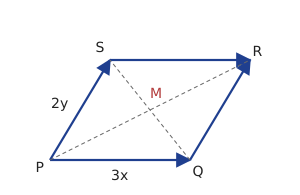
Diagram 1 shows a parallelogram PQRS with →PQ = 3x and →PS = 2y. M is the midpoint of PR.
[2 marks]
(a)Express →PR and →QS in terms of x and y.
Show answerHide answer
Tick each point you got.
[2 marks]
(b)Express →QM in terms of x and y.
Show answerHide answer
Tick each point you got.
[1 mark]
(c)Show that Q, M and S are collinear.
Show answerHide answer
Tick each point you got.
15
Question 15
Given →OA = 2a + b, →OB = 4a − b and →OC = ha + 5b, where h is a constant. A, B and C are collinear.
[1 mark]
(a)Express →AB in terms of a and b.
Show answerHide answer
Tick each point you got.
[1 mark]
(b)Express →AC in terms of h, a and b.
Show answerHide answer
Tick each point you got.
[3 marks]
(c)Find the value of h.
Show answerHide answer
Tick each point you got.
16
Question 16
A swimmer heads straight across a river (north) at 1.5 m s−1. The stream flows east at 2.0 m s−1. The river is 60 m wide.
[2 marks]
(a)Find the speed of the swimmer relative to the river bank.
Show answerHide answer
Tick each point you got.
[2 marks]
(b)Find the bearing of the swimmer's path.
Show answerHide answer
Tick each point you got.
[1 mark]
(c)How long does the swimmer take to cross?
Show answerHide answer
Tick each point you got.
17
Question 17
Given p = 3−4 and q = −25.
[1 mark]
(a)Find 2p + q as a column vector.
Show answerHide answer
Tick each point you got.
[1 mark]
(b)Find |2p + q|.
Show answerHide answer
Tick each point you got.
[1 mark]
(c)Find the unit vector in the direction of 2p + q, in the form xi + yj.
Show answerHide answer
Tick each point you got.
[1 mark]
(d)Express p − 3q in the form xi + yj.
Show answerHide answer
Tick each point you got.
[2 marks]
(e)Find k if p + kq is parallel to the x-axis.
Show answerHide answer
Tick each point you got.
18
Question 18
A particle leaves A(2, 9) with constant velocity (3i − 2j) m s−1. After t seconds its position vector is →OS = 2 + 3t9 − 2t. A second particle leaves B(20, 0) with velocity (−3i + j) m s−1.
[1 mark]
(a)Find the speed of the first particle.
Show answerHide answer
Tick each point you got.
[1 mark]
(b)Find the position of the first particle after 3 seconds.
Show answerHide answer
Tick each point you got.
[1 mark]
(c)When is the first particle on the x-axis?
Show answerHide answer
Tick each point you got.
[3 marks]
(d)Write the position vector of the second particle after t seconds and show that the two particles meet. State when and where.
Show answerHide answer
Tick each point you got.