Coordinate Geometry
What this chapter covers
- {'Relate the position of a point on a line segment to the ratio m': 'n, derive the formula for the point that divides a segment, and use it to find coordinates and ratios (7.1.1, 7.1.2)'}
- Solve problems involving the divisor of a line segment (7.1.3)
- Make and verify conjectures about the gradients of parallel lines (m1 = m2) and perpendicular lines (m1m2 = −1), and use them to find equations and unknown values (7.2.1, 7.2.2)
- Derive and use the formula for the area of a triangle, quadrilateral and polygon from the coordinates of its vertices, including collinear points (7.3.1, 7.3.2, 7.3.3, 7.3.4)
- Solve problems involving areas of polygons (7.3.5)
- Find the equation of a locus that is a fixed distance from a point, in a fixed ratio of distances from two points, or equidistant from two points (7.4.1)
- Solve problems involving equations of loci (7.4.2)
7.1Divisor of a line segment
The position of P decides the ratio, and the ratio decides the position. Read the ratio in the order of the letters: AP : PB.
The formula on a Cartesian plane
If A(x1, y1) and B(x2, y2) and P divides AB in the ratio m : n, then
For the midpoint (m = n): M = ( (x1 + x2)/2 , (y1 + y2)/2 )
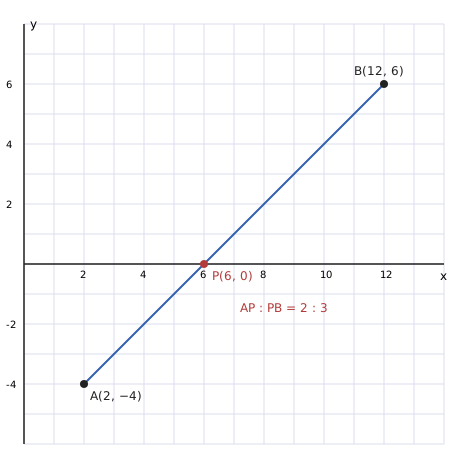
x = (2(−3) + 1(9)) / 3 = 3/3 = 1
y = (2(5) + 1(−1)) / 3 = 9/3 = 3
P = (1, 3)
x: (n(1) + m(9)) / (m + n) = 3, so n + 9m = 3m + 3n, so 6m = 2n, so m : n = 1 : 3.
Check with y: (n(0) + m(8)) / (m + n) = 8/4 = 2.
Show answerHide answer
Problems with moving objects (textbook p. 181): if something moves at a steady speed, the ratio of distances equals the ratio of times. After 18 s of a 60 s journey, EP : EG = 18 : 60 = 3 : 10, so EP : PG = 3 : 7.
7.2Parallel and perpendicular lines
| Lines | Condition | Why |
|---|---|---|
| Parallel | m1 = m2 | Corresponding angles are equal, so tan θ1 = tan θ2 |
| Perpendicular | m1m2 = −1 | θ2 = 90° + θ1, so tan θ2 = −1/tan θ1 |
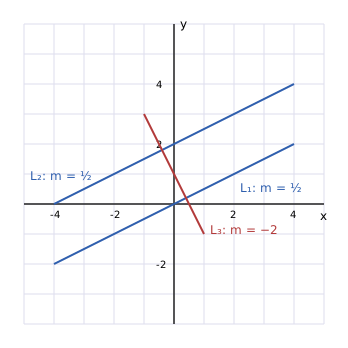
(b) 3y = x + 5 and y = −3x + 1: gradients 1/3 and −3. Product = −1, so they are perpendicular.
(c − 9)/(11 − 5) = −1/2, so c − 9 = −3, so c = 6.
Show answerHide answer
Equation of a line through (x1, y1) with gradient m: y − y1 = m(x − x1). For the perpendicular bisector of AB use the midpoint of AB and the gradient −1/mAB. To find where two lines meet, solve their equations simultaneously (textbook p. 188-189).
7.3Areas of polygons
Area = ½ | (x1y2 + x2y3 + … + xny1) − (x2y1 + x3y2 + … + x1yn) |
- Write the vertices in a row, in order, and repeat the first at the end.
- Multiply downwards to the right and add (first sum).
- Multiply downwards to the left and add (second sum).
- Subtract, take the absolute value and halve.
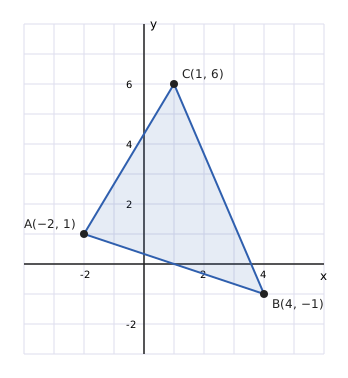
First sum: (−2)(−1) + 4(6) + 1(1) = 2 + 24 + 1 = 27
Second sum: 4(1) + 1(−1) + (−2)(6) = 4 − 1 − 12 = −9
Area = ½ |27 − (−9)| = ½ × 36 = 18 units²
Show answerHide answer
The same method works for a quadrilateral, pentagon or any polygon, as long as the vertices are listed in order (textbook p. 195-197). For a parallelogram, the diagonals share a midpoint, so use the midpoint formula to find a missing vertex.
7.4Equations of loci
| Rule for P | Shape | Equation |
|---|---|---|
| Fixed distance r from A(x1, y1) | Circle | (x − x1)² + (y − y1)² = r² |
| PA : PB = m : n | Circle | n²[(x − x1)² + (y − y1)²] = m²[(x − x2)² + (y − y2)²] |
| PA = PB | Straight line (perpendicular bisector of AB) | (x − x1)² + (y − y1)² = (x − x2)² + (y − y2)² |
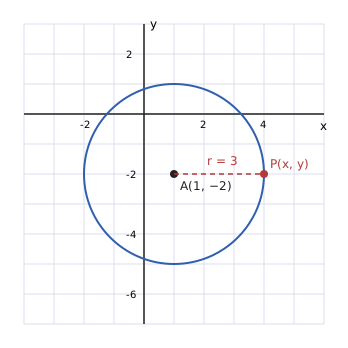
(x − 1)² + (y + 2)² = 9
x² − 2x + 1 + y² + 4y + 4 = 9
x² + y² − 2x + 4y − 4 = 0
Show answerHide answer
When the question gives a diagram, check your final equation by substituting a point you can see on the locus (textbook p. 204).