Additional Mathematics questions, chapter 7
Nama / NameKelas / ClassTarikh / Date
Coordinate Geometry
44 marks. Use Practice to check each answer as you go, or Exam to answer everything first. Show your working for Section B.
Section A: objective questions
12 marksChoose the correct answer. Each question carries 1 mark.
1
Question 1
A(−3, 1) and B(7, −4). Point P divides AB in the ratio AP : PB = 2 : 3. The coordinates of P are
Show answerHide answer
A
x = (3(−3) + 2(7))/5 = 1 and y = (3(1) + 2(−4))/5 = −1. (3, −2) comes from swapping m and n.
2
Question 2
The midpoint of the line joining A(h, 1) and B(7, k) is M(2, 3). Find h + k.
Show answerHide answer
C
(h + 7)/2 = 2 gives h = −3. (1 + k)/2 = 3 gives k = 5. h + k = 2.
3
Question 3
Point P(3, −1) lies on the line joining A(−3, 2) and B(13, −6). The ratio AP : PB is
Show answerHide answer
B
Let AP : PB = m : n. (n(−3) + m(13))/(m + n) = 3 gives 10m = 6n, so m : n = 3 : 5. Check with y: (2(5) + (−6)(3))/8 = −1. 5 : 3 swaps the ratio; 3 : 8 is AP : AB.
4
Question 4
The straight line 2x + 5y = 10 is perpendicular to the line y = kx + 3. Find the value of k.
Show answerHide answer
D
2x + 5y = 10 gives y = −(2/5)x + 2, so m = −2/5. Perpendicular means k × (−2/5) = −1, so k = 5/2. −5/2 only changes the sign.
5
Question 5
The line 4x − 2y = 9 is parallel to y = (p + 1)x − 3. Find the value of p.
Show answerHide answer
A
4x − 2y = 9 gives y = 2x − 9/2, so m = 2. Parallel means p + 1 = 2, so p = 1. p = 2 forgets the +1.
6
Question 6
The vertices of triangle ABC are A(0, 1), B(4, 3) and C(6, c). Given ∠ABC = 90°, find c.
Show answerHide answer
C
mAB = 2/4 = 1/2, so mBC = −2. (c − 3)/(6 − 4) = −2, so c − 3 = −4 and c = −1. c = 4 uses mBC = 1/2 (parallel instead of perpendicular); c = 7 drops the minus sign.
7
Question 7
Find the area of triangle ABC with vertices A(−1, 2), B(4, −1) and C(2, 5).
Show answerHide answer
B
First sum = 1 + 20 + 4 = 25. Second sum = 8 − 2 − 5 = 1. Area = ½|25 − 1| = 12. 24 forgets ½.
8
Question 8
The points (2, −1), (4, p) and (8, 11) lie on a straight line. Find p.
Show answerHide answer
D
The gradient from (2, −1) to (8, 11) is 12/6 = 2. From (2, −1) to (4, p): (p + 1)/2 = 2, so p = 3. Setting the area of the triangle to 0 gives the same answer.
9
Question 9
The distance of a point P(x, y) from Q(−2, 1) is always 5 units. The equation of the locus of P is
Show answerHide answer
A
(x + 2)² + (y − 1)² = 25 gives x² + y² + 4x − 2y + 5 = 25, so the constant is −20. The second option has the signs of the centre reversed; the third uses r instead of r².
10
Question 10
Point P moves so that it is always the same distance from A(0, 2) and B(4, 6). The equation of the locus of P is
Show answerHide answer
C
x² + (y − 2)² = (x − 4)² + (y − 6)² gives 8x + 8y = 48, so x + y = 6. y = x + 2 is the line AB itself. The locus is perpendicular to AB through the midpoint (2, 4).
11
Question 11
Point P(x, y) moves so that its distance from A(1, 0) is twice its distance from the origin O. The equation of the locus is
Show answerHide answer
B
PA = 2PO, so PA² = 4PO². (x − 1)² + y² = 4x² + 4y² gives 3x² + 3y² + 2x − 1 = 0. The first option wrote 2PO² instead of 4PO².
12
Question 12
Point P is on the line segment AB and AP : PB = 1 : 1. Point P is
Show answerHide answer
D
m = n means the two parts are equal, so P is the midpoint. Its coordinates are the averages of the coordinates of A and B.
Section B: structured questions
32 marksAnswer all questions. Show your working.
13
Question 13
A robot moves in a straight line from E(−2, 1) to F(18, 11) at a steady speed. The journey takes 50 seconds.
[3 marks]
(a)Find the coordinates of the robot after 20 seconds.
Show answerHide answer
Tick each point you got.
[3 marks]
(b)The robot is at Q(14, 9). Find the ratio EQ : QF and the time taken to reach Q.
Show answerHide answer
Tick each point you got.
14
Question 14
Diagram 1 shows points A(2, 1), B(8, 5) and C(7, 0). The line L passes through C and is perpendicular to AB. L meets AB at F.
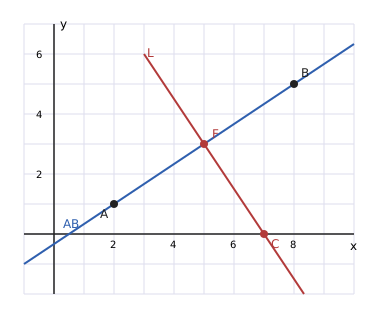
[1 mark]
(a)Find the gradient of AB.
Show answerHide answer
Tick each point you got.
[3 marks]
(b)Find the equation of L.
Show answerHide answer
Tick each point you got.
[3 marks]
(c)Find the coordinates of F.
Show answerHide answer
Tick each point you got.
15
Question 15
The vertices of triangle ABC are A(−2, −3), B(6, −1) and C(2, 5).
[3 marks]
(a)Find the area of triangle ABC.
Show answerHide answer
Tick each point you got.
[2 marks]
(b)E(10, k) lies on the straight line AB. Find k.
Show answerHide answer
Tick each point you got.
16
Question 16
Diagram 2 shows quadrilateral PQRS with P(1, 1), Q(7, 2), R(6, 6) and S(0, 5).
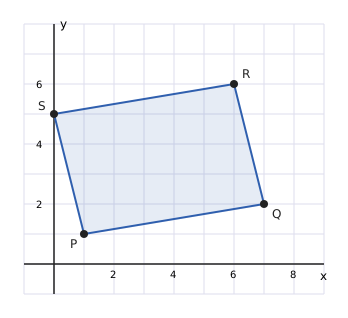
[3 marks]
(a)Find the area of PQRS.
Show answerHide answer
Tick each point you got.
[2 marks]
(b)Show that PQRS is a parallelogram.
Show answerHide answer
Tick each point you got.
[1 mark]
(c)Hence, state the area of triangle PQR.
Show answerHide answer
Tick each point you got.
17
Question 17
Point P(x, y) moves so that PA : PB = 1 : 2, where A is (−1, 0) and B is (5, 0).
[4 marks]
(a)Show that the equation of the locus of P is x² + y² + 6x − 7 = 0.
Show answerHide answer
Tick each point you got.
[2 marks]
(b)Write the equation as (x − a)² + (y − b)² = r² and state the centre and radius.
Show answerHide answer
Tick each point you got.
[2 marks]
(c)Amir says (1, 0) is on the locus. Is he correct? Check with the ratio PA : PB.
Show answerHide answer
Tick each point you got.