Introduction to Biology and Laboratory Rules
What this chapter covers
- State the meaning of biology, list its fields and careers, and give examples of how biology helps people (1.1)
- Explain personal protective equipment and laboratory safety equipment and their functions (1.2.1)
- Decide which substances can and cannot be disposed of into the sink (1.2.2, 1.2.3)
- Describe how biological waste and laboratory accidents are managed (1.2.4, 1.2.5)
- Conclude safe practices in a biology laboratory (1.2.6)
- Construct tables, plot graphs and make biological drawings; identify planes, sections and directional terms (1.3)
- Plan a scientific investigation in biology and write a report (1.4)
1.1Fields and careers in biology
| Field | Study of |
|---|---|
| Botany | Plant life |
| Physiology | Functions and mechanisms in organisms |
| Ecology | Interactions between organisms and their environment |
| Genetics | Inheritance and genetic variation |
| Microbiology | Microorganisms |
How biology helps in daily life
| Area | Examples |
|---|---|
| Medical | In vitro fertilisation, family planning, plastic surgery, gene therapy |
| Pharmaceutical | Synthetic vitamins, vaccines, insulin, synthetic enzymes |
| Food production | Microorganisms used to make cheese, soy sauce, tapai and tempe |
| Agriculture | Transgenic crops and animals, hydroponic and aeroponic technology |
3D bioprinting prints artificial tissues for modern medicine. A Malaysian innovation is a biological scaffold made from shellfish for dental treatment.
Show answerHide answer
1.2Safety and rules in the biology laboratory
Safety equipment and protective gear
| Equipment | Function |
|---|---|
| Emergency shower | Used when chemicals or hazardous substances touch the skin |
| Eye wash station | Washes the eyes after exposure to chemicals |
| Fume hood | Avoids breathing in hazardous gases such as chlorine, bromine and nitrogen dioxide |
| Laminar flow cabinet | Gives a flow of filtered air for a clean work area |
| Biological safety cabinet | Enclosed space for materials that are (or may be) contaminated by pathogens |
| Goggles | Protect the eyes from hazardous chemicals |
| Face mask | Protects the respiratory system from smoke, vapour and dust |
| Gloves | For handling biological samples |
| Lab coat | Protects skin and clothes from chemical splashes |
| Lab shoes | Prevent injury from glass shards and chemical spills |
| Handwash | Removes germs from hands |
Disposal into the sink
Chemicals with pH 5 to 9; harmless low-concentration solutions such as sucrose solution, dye solution and distilled water
Organic solvents (acetone, alcohol, benzene); pH below 5 or above 9; acids, greases and oils; solid waste (chemicals, glass, rubber); heavy metals such as mercury; volatile, toxic, reactive and radioactive substances; organic waste (microorganisms, carcases)
Managing biological waste
| Category | Waste | Management |
|---|---|---|
| A: sharp | Syringes, needles, glass, scalpels | Special sharps bin; does not need to be sterilised |
| B: non-sharp solids | Gloves, tissue paper, petri dishes, plastic culture containers, hardened agar | Pack in autoclave-resistant biohazard bags, sterilise in an autoclave, then place in a biohazard bin |
| C: animal carcases | Carcases, organs, tissues | Wrap in absorbent material, pack in a biohazard bag and freeze |
| D: liquids | Broth culture, liquid medium, blood | Decontaminate by autoclaving, then dispose immediately |
Handling accidents
- Inform your teacher
- Declare a restricted zone
- Stop the spread with sand
- Scoop up with suitable equipment
- Dispose of it safely
- Inform your teacher
- Declare a restricted zone
- Sprinkle sulphur over the mercury
- Call the fire and rescue department
Fire: stop work, switch off power sources and unplug appliances, leave by the emergency exit without collecting belongings, stay calm, assemble at the assembly point and call the fire and rescue department.
General rules: do not work alone without supervision, do not eat or drink, wash hands after experiments, clean the workstation with disinfectant, do not touch, taste or smell chemicals directly, keep flammable chemicals away from fire, report damaged glassware, and read safety symbols before use. Harmless dissected specimens are buried or frozen.
In an accident: inform the teacher, call the fire and rescue emergency number, remove the victim from the scene, give emergency treatment and make the place a restricted area.
Show answerHide answer
1.3Communicating in biology
Tables and graphs
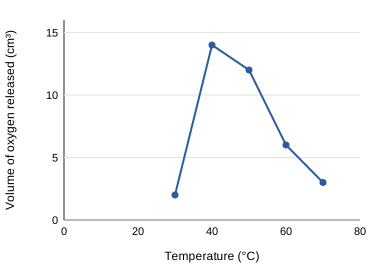
- In a table, the manipulated variable is in the left column and the responding variable in the right column, each with its unit.
- In a graph, the responding variable is on the vertical (y) axis and the manipulated variable on the horizontal (x) axis. Use uniform scales, mark points with a symbol such as x, and title it "Graph of (responding variable) versus (manipulated variable)".
- A bar chart has separate bars of equal width for categories. A histogram has touching bars for grouped (range) data; the vertical axis is frequency.
Biological drawings
- Large, drawn with a sharp pencil, clear continuous lines, no shading, no ruler for outlines.
- Labelled with straight, non-crossing label lines without arrowheads; has a title; parts in correct proportion.
- A plan drawing shows outlines only; a detailed drawing shows cells.
Planes, sections and directions
| Term | Meaning |
|---|---|
| Sagittal plane | Divides the body into right and left parts |
| Frontal plane | Divides the body into front and back parts |
| Horizontal plane | Divides the body into upper and lower parts |
| Cross section | Cuts across, giving upper and lower portions |
| Longitudinal section | Cuts lengthwise, giving left and right portions |
| Anterior / posterior | Towards the front / towards the back |
| Dorsal / ventral | Upper (back) side / lower (belly) side |
| Superior / inferior | Above, towards the head / below, towards the feet |
| Lateral | At the side, far from the midline |
Show answerHide answer
1.4Scientific investigation in biology
- Identify a problem that can be tested
- Form a hypothesis
- Identify and control variables; choose the data collection method
- Plan and carry out the investigation
- Collect data
- Interpret data through scientific reasoning
- Form a conclusion
- Write a report
Content based on Biology Form 4 (DLP) textbook, Chapter 1, pp. 4-16.