Biology questions, chapter 1
Nama / NameKelas / ClassTarikh / Date
Introduction to Biology and Laboratory Rules
47 marks. Use Practice to check each answer as you go, or Exam to answer everything against the clock first.
Section A: objective questions
12 marksChoose the best answer for each question.
1
Question 1
The word biology comes from the Greek words bios and logos. What do they mean?
Show answerHide answer
B
Bios means life and logos means study.
2
Question 2
Which field of biology studies microorganisms?
Show answerHide answer
D
Microbiology is the study of microorganisms. Botany is plants, genetics is inheritance, ecology is interactions with the environment.
3
Question 3
Which is an example of the contribution of biology to agriculture?
Show answerHide answer
A
Hydroponic and aeroponic technology and transgenic crops belong to agriculture. Insulin is pharmaceutical, gene therapy is medical, tempe is food production.
4
Question 4
What is the function of a fume hood?
Show answerHide answer
C
A fume hood prevents inhaling hazardous gases such as chlorine, bromine and nitrogen dioxide.
5
Question 5
A pupil sees a solution with pH 12 in a beaker. What should be done with it after the experiment?
Show answerHide answer
A
Only pH 5 to 9 can be poured into the sink; pH 12 cannot.
6
Question 6
Used needles and scalpels after an experiment should be placed in
Show answerHide answer
B
Category A sharp waste goes into a special sharps bin which does not need to be sterilised.
7
Question 7
At what conditions are biological wastes decontaminated in an autoclave?
Show answerHide answer
C
The textbook states 121 °C, 15 psi, 20 minutes.
8
Question 8
Mercury is spilt on the laboratory floor. After informing the teacher and restricting the area, what should be sprinkled over it?
Show answerHide answer
D
Sulphur is used to cover mercury spills; sand is used for general chemical spills.
9
Question 9
Which action is correct if a fire breaks out?
Show answerHide answer
B
Stop work, switch off power sources and exit by the emergency exit without collecting belongings.
10
Question 10
In a table of results, where is the manipulated variable placed?
Show answerHide answer
D
The manipulated variable is placed in the left column, the responding variable in the right.
11
Question 11
Which graph has bars of equal width touching each other, used for data grouped into ranges?
Show answerHide answer
A
A histogram uses touching bars for grouped data. A bar chart has separate bars.
12
Question 12
A specimen is 1.2 cm long and its drawing is 3.6 cm long. What is the magnification?
Show answerHide answer
C
3.6 / 1.2 = 3x.
Section B: structured questions
35 marksAnswer all questions. Write your answers in the spaces provided.
13
Question 13
State the function of each laboratory safety item.
[1 mark]
(a)Goggles
Show answerHide answer
Tick each point you got.
[1 mark]
(b)Lab shoes
Show answerHide answer
Tick each point you got.
[1 mark]
(c)Emergency shower
Show answerHide answer
Tick each point you got.
[1 mark]
(d)Laboratory gloves
Show answerHide answer
Tick each point you got.
14
Question 14
Biological waste from an experiment is sorted into categories before disposal.
[1 mark]
(a)Name the category of used petri dishes and gloves.
Show answerHide answer
Tick each point you got.
[2 marks]
(b)Describe how this waste is managed before disposal.
Show answerHide answer
Tick each point you got.
[2 marks]
(c)State the autoclave temperature and time.
Show answerHide answer
Tick each point you got.
[1 mark]
(d)Why must biohazard bags not be thrown into ordinary waste baskets?
Show answerHide answer
Tick each point you got.
15
Question 15
A bottle of mercury breaks in the laboratory.
[1 mark]
(a)State the first action a pupil must take.
Show answerHide answer
Tick each point you got.
[2 marks]
(b)Describe two other steps to handle the spill.
Show answerHide answer
Any 2 points
Tick each point you got.
[2 marks]
(c)Explain why mercury cannot be washed into the sink.
Show answerHide answer
Tick each point you got.
16
Question 16
The graph shows the volume of oxygen released by an aquatic plant at different temperatures (30 °C: 2.0 cm³; 40 °C: 14.0 cm³; 50 °C: 12.0 cm³; 60 °C: 6.0 cm³; 70 °C: 3.0 cm³).
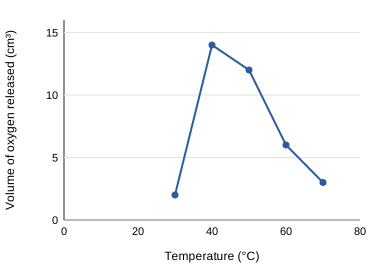
[2 marks]
(a)State the manipulated variable and the responding variable.
Show answerHide answer
Tick each point you got.
[1 mark]
(b)State the temperature at which most oxygen was released.
Show answerHide answer
Tick each point you got.
[2 marks]
(c)State which axis the responding variable is plotted on and suggest a title for the graph.
Show answerHide answer
Tick each point you got.
[1 mark]
(d)Describe the trend of the graph above 40 °C.
Show answerHide answer
Tick each point you got.
17
Question 17
A pupil investigates the effect of vigorous activity on pulse rate.
[1 mark]
(a)State a suitable hypothesis.
Show answerHide answer
Tick each point you got.
[3 marks]
(b)Identify the manipulated, responding and one fixed variable.
Show answerHide answer
Tick each point you got.
[1 mark]
(c)Which instrument is needed to time the pulse count?
Show answerHide answer
Tick each point you got.
[1 mark]
(d)Why must the pupil sit quietly before the first pulse count?
Show answerHide answer
Tick each point you got.
18
Question 18
Diagrams of body parts are described using planes and directions.
[1 mark]
(a)Name the plane that divides the body into right and left parts.
Show answerHide answer
Tick each point you got.
[1 mark]
(b)Name the plane that divides the body into upper and lower parts.
Show answerHide answer
Tick each point you got.
[2 marks]
(c)Is the nose anterior or posterior to the ear? Explain.
Show answerHide answer
Tick each point you got.
19
Question 19
A pupil records data and makes a biological drawing of a cross section of a carrot.
[2 marks]
(a)State two characteristics of a good biological drawing.
Show answerHide answer
Any 2 points
Tick each point you got.
[2 marks]
(b)The carrot is 2.5 cm across and the drawing is 7.5 cm across. Calculate the magnification.
Show answerHide answer
Tick each point you got.