Biology notes, chapter 2
Cell Biology and Organisation
Textbook Biology Form 4 KSSM (DLP), pages 20–43
What this chapter covers
- Prepare and examine slides of plant and animal cells; identify and state the functions of cell components (2.1)
- Compare and contrast animal cells and plant cells (2.1)
- Explain the life processes of unicellular organisms such as Amoeba sp. and Paramecium sp. (2.2)
- Relate specialised cell structures and organelle density to their functions, and describe the effect of organelle failure (2.3)
- Sequence the levels of organisation and state the main functions of the organ systems in multicellular organisms (2.4)
2.1Cell structure and function
Cells are the basic units of all living things. Plant and animal cells can be studied through a light microscope; an electron microscope shows far more detail (the fine structure of organelles).
Preparing a slide (Activities 2.1 and 2.2)
- Plant cells: lay a piece of onion epidermis in a drop of distilled water on a slide. Lower a cover slip at a 45° angle with a mounting needle so that no air bubbles are trapped. This temporary slide is a wet mount.
- Stain with iodine solution by the irrigation technique: put the drop on one side of the cover slip and draw it across with filter paper on the opposite side.
- Animal cells: scrape the inside of the cheek gently with a blunt toothpick, mount in water and stain with methylene blue.
- Observe with the low-power objective first, then the high-power objective. Draw and label what you see, and record the magnification.
Trapped air bubbles can be removed by gently tapping the cover slip with the tip of a sharp pencil. Always lower the cover slip slowly.
Cell components and their functions
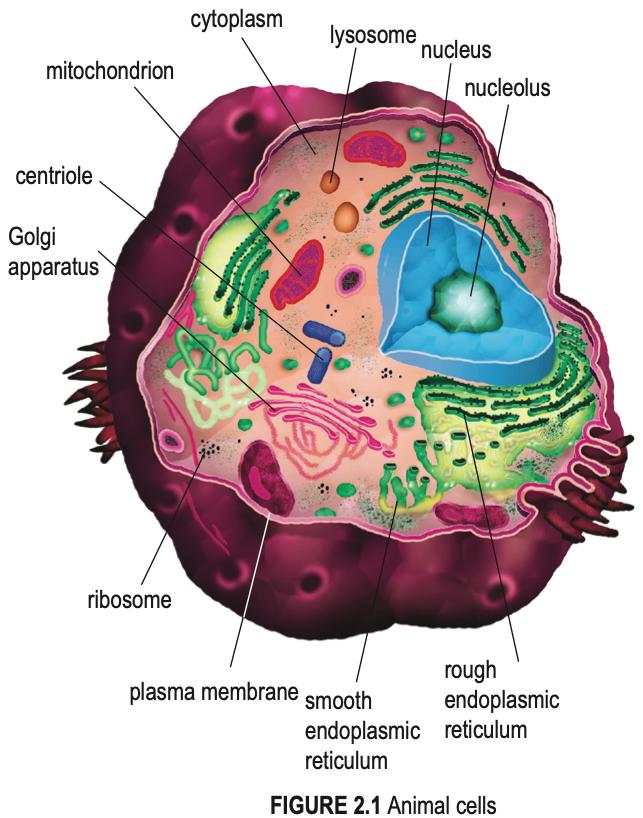
Textbook Figure 2.1, p. 24.
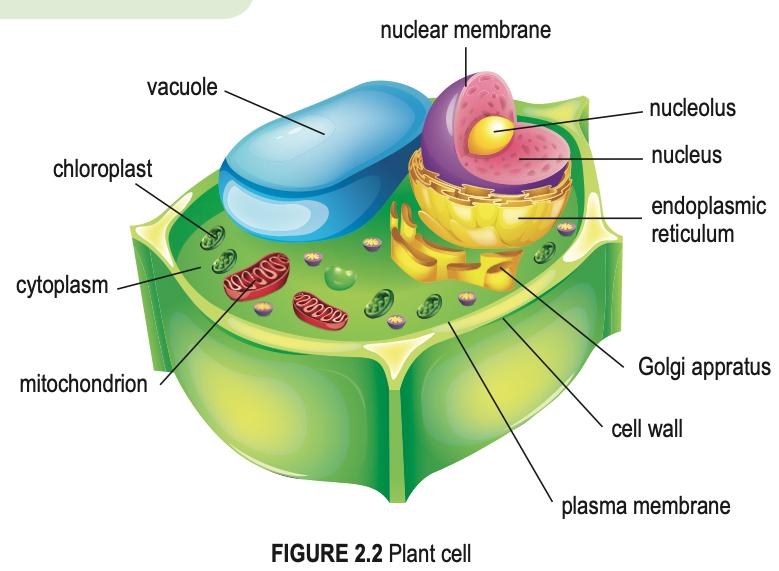
Textbook Figure 2.2, p. 26.
| Component | Structure | Function |
|---|---|---|
| Plasma membrane | Thin, elastic, partially permeable; made of proteins and phospholipids | Separates the cell from its surroundings; controls movement of substances in and out |
| Cytoplasm | Jelly-like medium with organic and inorganic compounds | Medium for biochemical reactions |
| Nucleus | Largest component; nuclear membrane with pores; contains chromosomes (DNA), nucleolus, nucleoplasm | Controls all cell activities; DNA determines the cell's characteristics |
| Mitochondrion | Rod-shaped or spherical; smooth outer and folded inner membrane; enzymes for respiration | Releases energy as ATP by glucose oxidation in cellular respiration |
| Ribosome | Tiny granules of protein and RNA; free in cytoplasm or on rough ER | Site of protein synthesis |
| Rough ER | Folded flattened sacs with ribosomes attached; joined to the nuclear membrane | Transports proteins made by ribosomes |
| Smooth ER | Same, but no ribosomes | Synthesises and transports lipids; detoxifies drugs and by-products |
| Golgi apparatus | Stack of parallel flattened sacs; vesicles bud off one end | Processes, modifies, packs and transports protein, carbohydrate and glycoprotein |
| Lysosome | Small spherical sac with one membrane; hydrolytic enzymes | Digests complex molecules, bacteria and damaged cell parts |
| Centriole | Pair of cylinders made of microtubules (animal cells only) | Forms spindle fibres during cell division |
| Cell wall | Strong, rigid, cellulose, fully permeable (plant cells only) | Keeps the shape and gives mechanical support |
| Chloroplast | Oval; two membranes; chlorophyll in the grana (plant cells) | Absorbs sunlight and changes it to chemical energy in photosynthesis |
| Vacuole | Sac of cell sap bounded by the tonoplast; large in mature plant cells | Keeps the cell turgid; contractile vacuole in unicellular animals does osmoregulation |
Animal cell and plant cell compared
| Feature | Plant cell | Animal cell |
|---|---|---|
| Shape | Fixed | Not fixed |
| Cell wall | Present | Absent |
| Chloroplast | Present | Absent |
| Vacuole | One large vacuole | None, or small |
| Centriole | Absent | Present |
| Food store | Starch | Glycogen |
Both have a nucleus, cytoplasm, plasma membrane, mitochondria, Golgi apparatus, endoplasmic reticulum and ribosomes.
Not every plant cell has chloroplasts. Root cells and other cells that never receive light do not. Do not say "plant cells = green".
Name the organelle that (a) makes ATP and (b) forms spindle fibres in animal cells.
Show answerHide answer
(a) Mitochondrion. (b) Centriole.
2.2Living processes in unicellular organisms
Unicellular organisms such as Amoeba sp. and Paramecium sp. are single cells that carry out all life processes themselves.
| Process | Amoeba sp. / Paramecium sp. |
|---|---|
| Movement | Amoeba extends a pseudopodium (false foot) and cytoplasm flows into it; Paramecium beats its cilia rhythmically |
| Response to stimuli | Moves away from harmful chemicals, touch or bright light |
| Nutrition | Food is trapped (phagocytosis in Amoeba; cilia sweep food into the oral groove in Paramecium), enclosed in a food vacuole, hydrolysed by lysosome enzymes, absorbed; undigested waste is egested |
| Respiration | Oxygen and carbon dioxide diffuse across the plasma membrane |
| Growth | By synthesising new cytoplasm |
| Excretion | Carbon dioxide and ammonia diffuse out; the contractile vacuole removes excess water (osmoregulation) |
| Reproduction | Binary fission (mitosis) in good conditions. In poor conditions Amoeba forms spores; Paramecium reproduces sexually by conjugation |
In fresh water, water enters the cell by osmosis, so the contractile vacuole fills, expands and then contracts to expel the water.
In a concentrated salt solution little water enters the cell, so the contractile vacuole contracts less often (or stops).
Why does Amoeba sp. need a contractile vacuole but a human cheek cell does not?
Show answerHide answer
Fresh water is hypotonic to its cytoplasm, so water keeps entering by osmosis and must be expelled to avoid bursting. A cheek cell is bathed in body fluid of about the same concentration as its cytoplasm.
2.3Living processes in multicellular organisms
Specialised cells have a structure that suits one function. Cells with the same structure and function form a tissue.
| Cell | Adaptation | Function |
|---|---|---|
| Red blood cell | Biconcave disc, no nucleus | Carries as much oxygen as possible |
| White blood cell | Can change shape | Destroys pathogens |
| Nerve cell | Long and thin | Sends nerve impulses |
| Muscle cell | Multinuclear striated fibres | Contracts and relaxes for movement |
| Epithelial cell | Thin and flat | Covers surfaces of organs |
| Sperm cell | Long tail; head holds chromosomes | Swims to the ovum |
| Palisade mesophyll cell | Tall cylinders packed with chloroplasts | Maximum photosynthesis |
| Spongy mesophyll cell | Loose, large air spaces | Gas exchange in the leaf |
| Guard cell | Thicker inner wall | Opens and closes the stoma |
| Root hair cell | Long projection, large surface area | Absorbs water and mineral salts |
| Xylem vessel | Long hollow tubes, lignified wall | Transports water and mineral salts; supports |
| Sieve tube element | Long continuous hollow tube | Transports sucrose from leaves |
Organelle density and function
| Cell | Abundant organelle | Reason |
|---|---|---|
| Sperm, flight muscle, meristem cell | Mitochondria | Need a lot of energy |
| Palisade mesophyll cell | Chloroplasts | Absorb more sunlight |
| Pancreatic cell | Rough ER | Makes and secretes digestive enzymes (protein) |
| Goblet cell | Golgi apparatus | Produces mucus |
| Liver cell | Smooth ER | Metabolises carbohydrate; detoxifies drugs and poisons |
Failure of a single organelle harms the whole organism. Faulty mitochondria cause stunted growth and weak muscles; missing lysosomal enzymes cause Tay-Sachs disease.
Tissues
- Animal: epithelial (covers and protects), muscle (smooth, skeletal, cardiac), nerve (neurons carry impulses) and connective (blood, bone, cartilage, tendon, ligament, adipose, loose tissue).
- Plant: meristem (apical and lateral, dividing) and permanent tissue: dermal, ground (parenchyma stores, collenchyma supports young stems, sclerenchyma gives strength) and vascular (xylem and phloem).
Which organelle is abundant in a cell that secretes an enzyme?
Show answerHide answer
Rough endoplasmic reticulum (with the Golgi apparatus), because enzymes are proteins.
2.4Levels of organisation
Cell → tissue → organ → system → multicellular organism.
An organ is a group of different tissues working together; for example the heart has cardiac muscle, epithelial, connective and nerve tissue. An organ system is several organs with one main function.
| System | Main function |
|---|---|
| Respiratory | Gas exchange between the body and the environment |
| Digestive | Digests food into simple forms to be absorbed |
| Blood circulatory | Transports nutrients, gases and waste |
| Lymphatic | Balances body fluids; prevents infection |
| Nervous | Detects and sends information; coordinates |
| Endocrine | Hormones coordinate body activities |
| Skeletal | Supports, protects, base for muscles |
| Muscular | Contracts and relaxes to produce movement |
| Urinary | Removes urea and uric acid |
| Integumentary | Skin protects against injury, infection and dehydration |
| Reproductive | Produces gametes and sex hormones |
In plants there are two systems. The shoot system (stems, leaves, flowers, fruits) supports the leaves for sunlight, carries out photosynthesis and pollination. The root system absorbs water and mineral salts and anchors the plant.
Is the skin a tissue or an organ? Explain.
Show answerHide answer
An organ, because it is made of several different tissues (epithelial, connective, nerve) working together.