Biology questions, chapter 5
Nama / NameKelas / ClassTarikh / Date
Metabolism and Enzymes
45 marks. Use Practice to check each answer as you go, or Exam to answer everything against the clock first.
Section A: objective questions
12 marksChoose the best answer for each question.
1
Question 1
What is metabolism?
Show answerHide answer
B
Metabolism is all the chemical reactions in a living organism, including the conversion of food to ATP and the formation of carbohydrate, protein, lipid and nucleic acid.
2
Question 2
Which process is an example of anabolism?
Show answerHide answer
D
Anabolism builds complex molecules from simple ones and uses energy. Glucose is made from carbon dioxide and water in photosynthesis. The other three are catabolic.
3
Question 3
Which enzyme catalyses the hydrolysis of lactose?
Show answerHide answer
A
Enzymes are named by adding -ase to the substrate: lactose gives lactase.
4
Question 4
Which enzyme does NOT follow the naming system of adding -ase to the substrate?
Show answerHide answer
C
Pepsin, trypsin and renin were named before the system was introduced and kept their names.
5
Question 5
The substrate binds with an enzyme at a specific site. What is this site called?
Show answerHide answer
B
The substrate binds at the active site to form an enzyme-substrate complex.
6
Question 6
Which sequence shows the production of an extracellular enzyme?
Show answerHide answer
D
The protein is made at the ribosome, passes through the rough ER in transport vesicles to the Golgi apparatus, then leaves in secretory vesicles through the plasma membrane.
7
Question 7
Which enzyme is an intracellular enzyme?
Show answerHide answer
A
Hexokinase works inside the cell that makes it. The other three are secreted out of the cell.
8
Question 8
In the lock and key hypothesis, what does the key represent?
Show answerHide answer
C
The enzyme is the lock (with the active site) and the substrate is the key that fits it.
9
Question 9
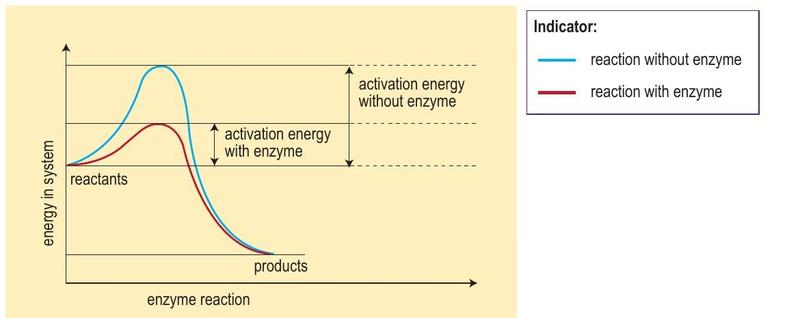
Diagram 1 shows the energy changes of a reaction with and without an enzyme. What does the graph show?
Show answerHide answer
B
The curve with enzyme has a lower peak, so less activation energy is needed. Reactants and products are at the same levels in both curves.
10
Question 10
Why does enzyme activity stop at about 60 °C?
Show answerHide answer
D
At high temperature the bonds in the enzyme break, the three-dimensional shape is lost and the substrate no longer fits the active site.
11
Question 11
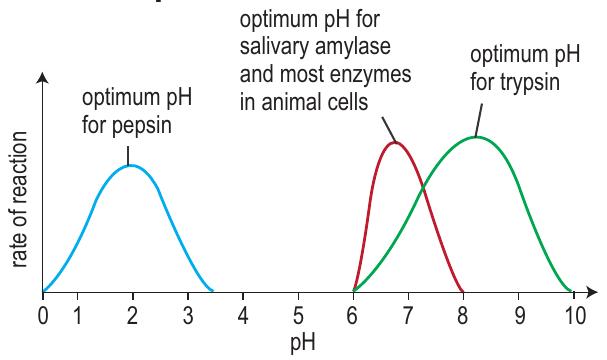
Diagram 2 shows the effect of pH on three enzymes. What is the optimum pH of pepsin?
Show answerHide answer
A
The pepsin curve peaks at about pH 2, an acidic condition like the stomach. 6.8 is amylase and 8.5 is trypsin.
12
Question 12
The rate of an enzyme reaction stops increasing when more substrate is added, although the enzyme concentration is fixed. What is the reason?
Show answerHide answer
C
At the maximum rate every active site is saturated with substrate. Only more enzyme can raise the rate further.
Section B: structured questions
33 marksAnswer all questions.
13
Question 13
Trypsin is an enzyme made by pancreatic cells and secreted into the duodenum.
[2 marks]
(a)Is trypsin an intracellular or extracellular enzyme? Give a reason.
Show answerHide answer
Tick each point you got.
[1 mark]
(b)Which organelle makes the protein of the enzyme?
Show answerHide answer
Tick each point you got.
[2 marks]
(c)State the role of the Golgi apparatus in the production of the enzyme.
Show answerHide answer
Tick each point you got.
14
Question 14
A student studied the effect of temperature on amylase. Starch and amylase were mixed at each temperature and tested with iodine at regular intervals. Table 1 shows the time for starch to disappear.
Table 1
| Temperature (°C) | 20 | 30 | 40 | 50 | 60 |
|---|---|---|---|---|---|
| Time for starch hydrolysis (minutes) | 12 | 8 | 4 | 5 | No hydrolysis |
[1 mark]
(a)State the manipulated variable.
Show answerHide answer
Tick each point you got.
[2 marks]
(b)Calculate the rate of reaction at 20 °C. Rate = 1 ÷ time.
Show answerHide answer
1 ÷ 12 = 0.0833.
Tick each point you got.
[2 marks]
(c)At which of the temperatures tested is the enzyme most active? Give a reason.
Show answerHide answer
Tick each point you got.
[2 marks]
(d)Explain why there is no hydrolysis at 60 °C.
Show answerHide answer
Tick each point you got.
15
Question 15
Three test tubes each contain albumen suspension (cloudy) and pepsin. Hydrochloric acid is added to P, distilled water to Q and sodium hydroxide to R. All are kept in a 37 °C water bath for 20 minutes. Only tube P becomes clear.
[1 mark]
(a)Why are the tubes kept in a water bath at 37 °C?
Show answerHide answer
Tick each point you got.
[2 marks]
(b)Explain why tube P becomes clear.
Show answerHide answer
Tick each point you got.
[2 marks]
(c)Explain why tubes Q and R stay cloudy.
Show answerHide answer
Tick each point you got.
[1 mark]
(d)State the responding variable.
Show answerHide answer
Tick each point you got.
16
Question 16
Explain the mechanism of enzyme action.
[1 mark]
(a)Name the hypothesis used to explain how enzymes act.
Show answerHide answer
Tick each point you got.
[2 marks]
(b)In this hypothesis, what represents the structure of the enzyme and the structure of the substrate?
Show answerHide answer
Tick each point you got.
[2 marks]
(c)Explain why only certain substrates can combine with an enzyme.
Show answerHide answer
Tick each point you got.
17
Question 17
Enzymes are used in food preparation and industry.
[2 marks]
(a)Some chefs wrap meat in papaya leaves before cooking. Explain the purpose.
Show answerHide answer
Tick each point you got.
[2 marks]
(b)A peeled apple that has been boiled does not turn brown. Explain why.
Show answerHide answer
Tick each point you got.
[2 marks]
(c)Give two advantages of using an immobilised enzyme in industry.
Show answerHide answer
Tick each point you got.
18
Question 18
A cell carries out two types of metabolism.
[2 marks]
(a)Define catabolism and give one example.
Show answerHide answer
Tick each point you got.
[2 marks]
(b)Define anabolism and give one example.
Show answerHide answer
Tick each point you got.