Metabolism and Enzymes
What this chapter covers
- Define metabolism and distinguish anabolism from catabolism (5.1)
- Define enzymes, explain why they are needed and how they are named (5.2.1–5.2.3)
- State the general properties of enzymes (5.2.4)
- Describe how intracellular and extracellular enzymes are made (5.2.5)
- Explain enzyme action with the lock and key hypothesis and energy diagrams (5.2.6–5.2.7)
- Explain how temperature, pH, enzyme concentration and substrate concentration affect enzyme activity (5.2.8)
- Plan and interpret experiments on amylase and pepsin (5.2.9)
- Give examples of enzymes used in daily life and industry (5.3)
5.1Metabolism
| Type | What happens | Energy | Example | General reaction |
|---|---|---|---|---|
| Catabolism | Complex substances are broken down into simple substances | Released | Breakdown of glucose in cellular respiration | A → B + C |
| Anabolism | Complex molecules are built from simple molecules | Used (absorbed) | Formation of glucose in photosynthesis | A + B → C |
Show answerHide answer
5.2Enzymes
Without enzymes, reactions in a cell would be too slow to keep an organism alive. Enzymes make them fast enough at body temperature.
Naming of enzymes
The IUBMB system names an enzyme by adding -ase to the name of its substrate, for example lactose + lactase, or maltose + maltase. Lactase breaks lactose into glucose and galactose by hydrolysis. Some enzymes found before this system keep their old names: pepsin, trypsin and renin.
General properties of enzymes
- They are biological catalysts: they speed up reactions and work rapidly.
- Needed in small amounts; they are not used up and can be reused.
- They are specific: only a substrate that fits the active site can bind.
- Most reactions they catalyse are reversible.
- Some need a cofactor (for example vitamin B or magnesium ions).
- Their activity can be slowed or stopped by inhibitors (for example lead or mercury).
Intracellular and extracellular enzymes
| Type | Where used | Example |
|---|---|---|
| Intracellular | Made and used inside the same cell | Hexokinase in glycolysis |
| Extracellular | Secreted out of the cell | Trypsin from the pancreas into the duodenum |
How an extracellular enzyme is made:
- Ribosomes make the protein.
- The protein enters the rough endoplasmic reticulum (RER) and moves through it.
- Transport vesicles bud off from the end of the RER.
- The vesicles fuse with the Golgi apparatus.
- The Golgi apparatus modifies the protein into an enzyme and packs it in secretory vesicles.
- Secretory vesicles fuse with the plasma membrane and release the enzyme.
Mechanism: the lock and key hypothesis
The enzyme is the lock and the substrate is the key. The active site has a shape that fits one substrate only. The substrate fits, a reaction happens, and the products leave the active site. The enzyme is unchanged. (Most enzymes are proteins, but not all.)
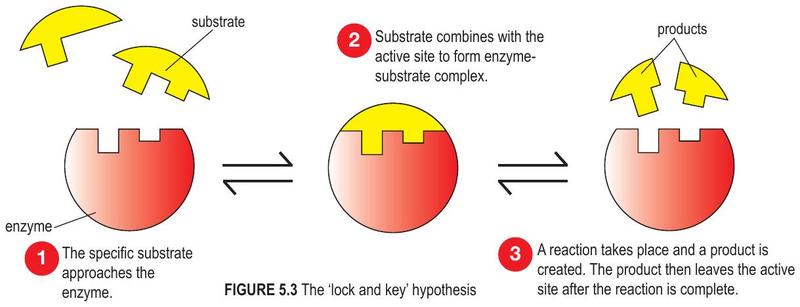
Textbook figure: Biology Form 4 KSSM (DLP), p. 89.
Energy diagram
Activation energy is the energy needed to break the bonds in the substrate before a reaction can happen. Enzymes lower the activation energy, so the reaction is faster. The reactants and products stay at the same energy levels; only the energy hill is lower.
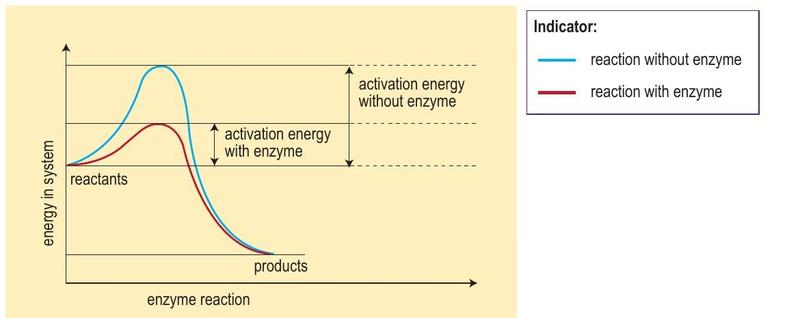
Show answerHide answer
Factors that affect enzyme activity
| Factor | Effect |
|---|---|
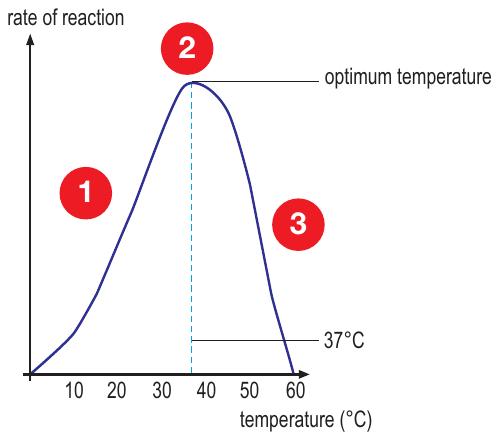
| Temperature | Low temperature: slow. Rate roughly doubles for every 10 °C rise (more effective collisions) up to the optimum (about 37 °C in humans). Above it the rate falls quickly and stops at about 60 °C because the enzyme is denatured: the bonds break and the active site changes shape. |
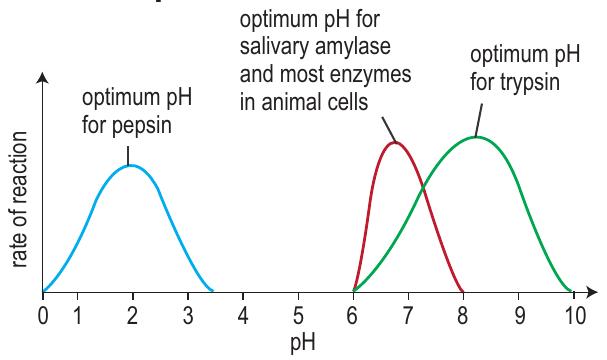
| pH | Each enzyme has an optimum pH. Pepsin: pH 1.5 to 2.5. Salivary amylase: about pH 6.8. Trypsin: about pH 8.5. Extreme pH changes the charge and shape of the active site, so the complex cannot form. |
| Substrate concentration | Rate rises as substrate increases, then levels off at a maximum because all active sites are in use. Enzyme concentration is then the limiting factor. |
| Enzyme concentration | Rate rises in proportion to enzyme concentration while substrate is in excess. At the maximum rate substrate becomes the limiting factor. |
Experiments (5.2.9)
| Temperature and amylase | pH and pepsin | |
|---|---|---|
| Manipulated | Temperature (20 to 60 °C) | pH (acid, water, alkali) |
| Responding | Time for starch to be hydrolysed (rate = 1 ÷ time) | Clarity of the albumen mixture |
| Fixed | Amylase and starch concentration, pH | Albumen and pepsin concentration, temperature (37 °C) |
| Test | Iodine solution: blue-black while starch remains, brownish yellow when it is gone | Albumen turns from cloudy to clear when digested |
Each pair of tubes is first kept at its temperature for 5 minutes so that the enzyme and substrate reach that temperature before they are mixed.
5.3Enzymes in daily life
| Enzyme | Use |
|---|---|
| Amylase, lipase, protease, cellulase | Bio detergent removes stains |
| Pectinase and cellulase | Extract more fruit juice |
| Lactase | Lactose-free milk |
| Trypsin | Removes fur from animal hide for leather |
| Protease | Separates fish skin; tenderises meat |
| Digestive enzymes | Medicine for digestion problems |
Immobilised enzymes are attached to an inert, insoluble material. They resist changes in pH and temperature better, stay in place and are easily separated from the product, so they can be reused.
Summary
| Remember | Key fact |
|---|---|
| Catabolism and anabolism | Break down and release energy; build up and use energy |
| Enzyme | Protein catalyst, specific, reusable, lowers activation energy |
| Extracellular enzyme route | Ribosome, RER, transport vesicle, Golgi, secretory vesicle, plasma membrane |
| Temperature | Rate rises to the optimum (37 °C), then denatured |
| pH | Pepsin 2, amylase 6.8, trypsin 8.5 |
| Concentration | Rate rises then plateaus (limiting factor) |