Chemical Compositions in a Cell
What this chapter covers
- Describe the properties of the water molecule (polarity, hydrogen bonds, universal solvent, cohesion and adhesion, high specific heat capacity) and link them to the importance of water in the cell (4.1)
- List the elements in carbohydrates; explain monosaccharides, disaccharides and polysaccharides; describe condensation and hydrolysis and write word equations; justify the importance of carbohydrates (4.2)
- List the elements in proteins; describe the formation and breakdown of dipeptides and polypeptides; justify the importance of proteins (4.3)
- List the elements in lipids; explain the types of lipids; describe the formation and breakdown of a triglyceride; compare saturated and unsaturated fats; justify the importance of lipids (4.4)
- List the elements in nucleic acids; describe the nucleotide and the structures of DNA and RNA; justify their importance; describe how chromosomes are formed from DNA and histone proteins (4.5)
4.1Water
| Property | Explanation | Importance in the cell |
|---|---|---|
| Polarity and hydrogen bonds | Shared electrons are pulled towards oxygen (δ−), so hydrogen is slightly positive (δ+). Water is a polar molecule and forms hydrogen bonds with other water molecules. | Acts as a universal solvent: glucose and electrolytes dissolve and are transported across plasma membranes for biochemical reactions. |
| Cohesive force | Water molecules attract each other. | Together with adhesion it causes capillary action, so water moves up narrow xylem tubes. |
| Adhesive force | Water molecules are attracted to other surfaces (such as the xylem wall). | As above. |
| High specific heat capacity | 4.2 kJ kg−1 °C−1: 4.2 kJ of heat raises 1 kg of water by 1 °C. | Water absorbs much heat with a small temperature rise, so body temperature stays stable. Aquatic life survives temperature changes. |
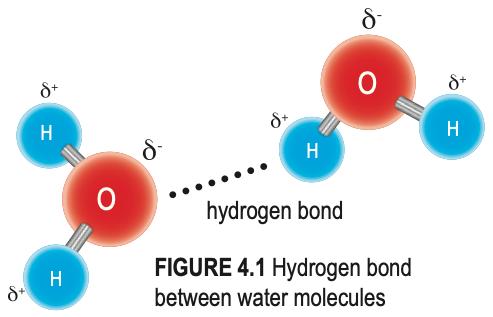
Textbook Figure 4.1, p. 72.
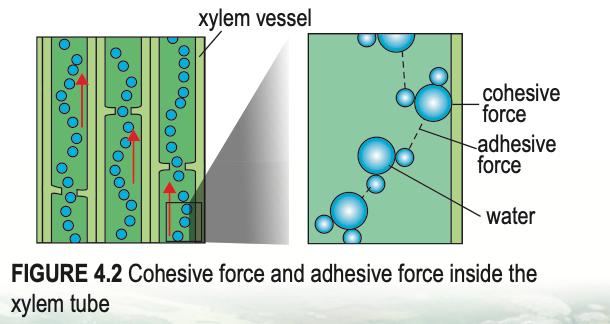
Textbook Figure 4.2, p. 72.
Show answerHide answer
4.2Carbohydrates
Carbohydrates contain carbon, hydrogen and oxygen in the ratio 1 : 2 : 1, general formula (CH2O)n.
| Type | Examples (source) | Features |
|---|---|---|
| Monosaccharide | Glucose (grapes, rice), fructose (honey), galactose (milk) | Monomer; sweet; crystals; soluble; reducing sugars |
| Disaccharide | Maltose (grains), sucrose (sugar cane), lactose (milk) | Two monosaccharides; maltose and lactose reduce, sucrose does not |
| Polysaccharide | Starch, glycogen, cellulose | Hundreds of monosaccharides; insoluble; not sweet; no crystals |
Condensation and hydrolysis
Glucose + fructose → sucrose + water
Glucose + galactose → lactose + water
(condensation, one water molecule removed; the reverse is hydrolysis, one water molecule added)
Benedict's test
Heat the sample with Benedict's solution. A reducing sugar reduces blue copper(II) sulphate to a brick-red precipitate of copper(I) oxide. Sucrose gives no change, but after it is hydrolysed into glucose and fructose the test becomes positive.
Importance of carbohydrates
- Source of energy: glucose.
- Food reserve: starch in plant cells, glycogen in animal muscle and liver cells.
- Support structure: cellulose in the plant cell wall.
Show answerHide answer
4.3Proteins
Proteins contain carbon, hydrogen, oxygen and nitrogen; most also have sulphur and phosphorus. A protein is made of one or more polypeptides, and each polypeptide is a chain of 50 to thousands of amino acids (monomers).
Dipeptide + water → amino acid + amino acid (hydrolysis)
About 20 amino acids occur naturally. Different proteins have a different sequence of amino acids.
Importance of proteins
- Build new cells and repair damaged tissues.
- Make enzymes, hormones, antibodies and haemoglobin.
- Structural proteins: keratin (skin), collagen (bone), myosin (muscle).
- Broken down to give energy; amino acids are reused to make new proteins.
Show answerHide answer
4.4Lipids
Lipids contain carbon, hydrogen and oxygen, with a much higher ratio of hydrogen to oxygen than carbohydrates. They are hydrophobic: insoluble in water, soluble in alcohol, ether and chloroform. Test: ethanol emulsion test (white emulsion = lipid present).
Triglyceride + 3 H2O → glycerol + 3 fatty acids (hydrolysis)
| Type of lipid | Structure | Importance |
|---|---|---|
| Fat or oil (triglyceride) | 1 glycerol + 3 fatty acids | Reserve energy, protects organs, heat insulator |
| Wax | Alcohol + fatty acid; waterproof | Cuticle of leaves, fruit skin, sebum of skin |
| Phospholipid | 1 glycerol + 2 fatty acids + 1 phosphate group | Major component of plasma membranes |
| Steroid | No fatty acids | Cholesterol; steroid hormones (testosterone, oestrogen, progesterone) |
Saturated and unsaturated fats
| Saturated fat | Unsaturated fat | |
|---|---|---|
| Bonds between carbons | Single bonds only | At least one double bond |
| Extra hydrogen | Cannot take more (saturated) | Can take more hydrogen |
| At room temperature | Solid | Liquid |
| Source | Butter, animal fat | Olive oil, fish oil |
| Health | Raises LDL cholesterol; risk of heart attack and diabetes | Healthier |
Both contain C, H, O, glycerol and fatty acids, and are non-polar.
Show answerHide answer
4.5Nucleic acids
Nucleic acids contain C, H, O, N and P. They are polymers of nucleotides. A nucleotide = a pentose sugar + a nitrogenous base + a phosphate group, joined by condensation.
| DNA | RNA | |
|---|---|---|
| Sugar | Deoxyribose | Ribose |
| Strands | Two polynucleotide chains, double helix | One chain, shorter |
| Bases | A, G, C, T | A, G, C, U (uracil replaces thymine) |
| Types | - | mRNA, rRNA, tRNA |
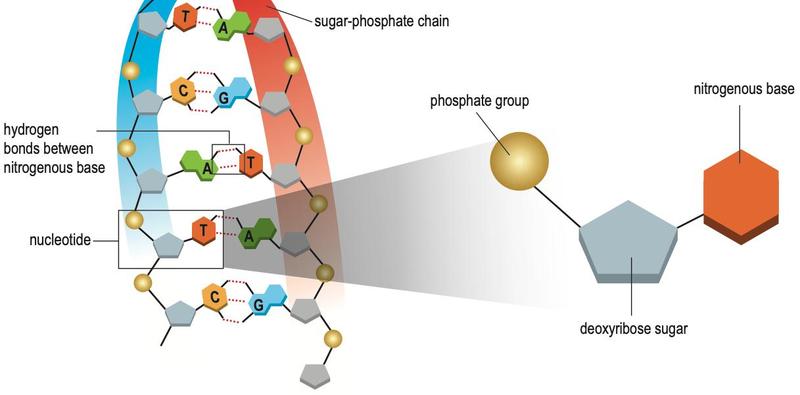
Textbook Figure 4.3, p. 79.
Importance
- DNA carries hereditary information and determines characteristics.
- The base sequence is a genetic code: three bases form a codon for one amino acid (AUG on mRNA codes for methionine). DNA is transcribed to mRNA, which is translated to a polypeptide.
Chromosome formation
DNA winds around histone proteins to make nucleosomes; nucleosomes coil and fold to form a chromosome in the nucleus. Histones do not carry genetic information.
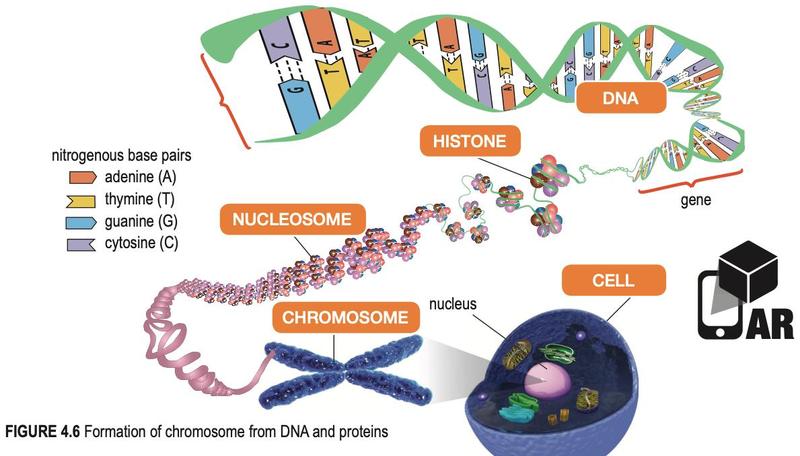
Textbook Figure 4.6, p. 81.
Show answerHide answer
Summary
| Compound | Elements | Monomer | Key fact |
|---|---|---|---|
| Water | H, O | - | Polar, universal solvent, high specific heat capacity |
| Carbohydrate | C, H, O (1:2:1) | Monosaccharide | Energy, store, cell wall |
| Protein | C, H, O, N | Amino acid | Peptide bond; enzymes, hormones, structure |
| Lipid | C, H, O | Glycerol + fatty acids | Triglyceride, wax, phospholipid, steroid |
| Nucleic acid | C, H, O, N, P | Nucleotide | DNA, RNA; heredity and protein synthesis |