Movement of Substances across a Plasma Membrane
What this chapter covers
- Explain why substances must move across the plasma membrane (3.1.1)
- Describe the components of the plasma membrane and their functions based on the fluid mosaic model; explain permeability (3.1.2, 3.1.4)
- State how molecule size, polarity and ionic charge affect movement across the membrane (3.2.1)
- Describe the Visking tubing and simple osmometer experiments (3.2.2)
- Describe simple diffusion, osmosis, facilitated diffusion and active transport, and compare passive and active transport (3.2.3, 3.2.4)
- Give examples of passive and active transport in organisms (3.3.1, 3.3.2)
- Define hypotonic, hypertonic and isotonic solutions and explain their effects on animal and plant cells (3.3.3, 3.3.5)
- Explain plant wilting, food preservation, rehydration, liposomes and reverse osmosis as applications (3.4.2, 3.4.3, 3.4.4)
3.1Structure of the plasma membrane
Cells take in the substances they need (oxygen, glucose, amino acids, ions) and get rid of wastes made by metabolism. The plasma membrane regulates this movement into and out of the cell.
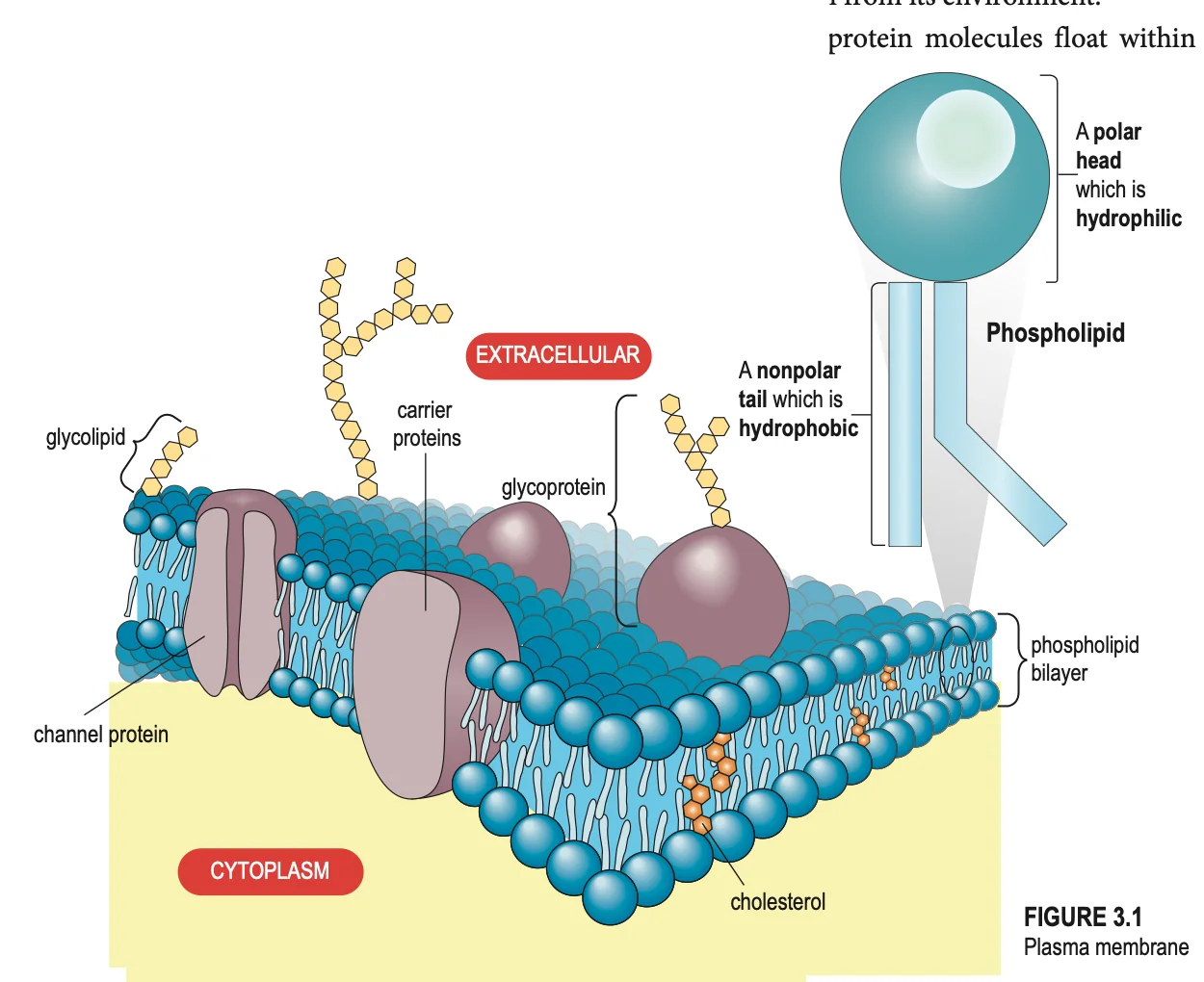
Figure: Biology Form 4 (DLP) textbook, Figure 3.1, p. 46.
| Component | Function |
|---|---|
| Phospholipid bilayer | Basic framework. Polar head is hydrophilic (faces the watery outside and the cytoplasm); nonpolar tails are hydrophobic (face each other inside). |
| Channel protein | Has a channel; lets small solutes and specific ions through |
| Carrier protein | Binds one specific molecule and carries it across |
| Glycoprotein and glycolipid | Carbohydrate chains that act as receptors (e.g. for insulin), stabilise the membrane by hydrogen bonds with water, and act as antigens for cell identification |
| Cholesterol | Between phospholipids; makes the bilayer stronger and more flexible, and less permeable to water-soluble substances such as ions |
Permeability
A membrane is permeable to a substance if it lets it through freely, and impermeable if it does not. The plasma membrane is selectively permeable: it lets certain molecules through and prevents or limits others. The phospholipid bilayer and the proteins decide which.
Show answerHide answer
3.2Concept of movement of substances across a plasma membrane
Which substances can cross?
Three factors decide: size of the molecule, polarity and ionic charge.
| Group | Examples | How they cross |
|---|---|---|
| Lipid-soluble (nonpolar) molecules | Fatty acids, glycerol, vitamins A, D, E, K, steroids | Dissolve in and pass through the phospholipid bilayer |
| Small molecules | Water, oxygen, carbon dioxide | Pass directly through the bilayer |
| Ions (charged) | K+, Na+, Ca2+, Mg2+ | Cannot cross the bilayer; use channel or carrier proteins |
| Large, lipid-insoluble molecules | Glucose, amino acids | Need carrier proteins |
Experiments with a selectively permeable membrane
- Visking tubing (Activity 3.1): glucose and starch are put in the tubing, which stands in distilled water for 30 minutes. Benedict's test on the water outside is positive (glucose, a small molecule, left the tubing). Iodine test outside is negative, and inside it is blue-black (starch, a large molecule, stayed). So movement depends on molecule size.
- Simple osmometer (Activity 3.2): Visking tubing with 30% sucrose solution is attached to a capillary tube and put in distilled water. The level in the capillary tube rises with time because water moves in by osmosis; sucrose cannot move out.
Passive transport
Passive transport needs no energy. Substances move down the concentration gradient until a dynamic equilibrium is reached.
| Process | What moves | Details |
|---|---|---|
| Simple diffusion | Oxygen, carbon dioxide, fatty acids, glycerol | High to low concentration, directly through the phospholipid bilayer |
| Osmosis | Water only | Net movement from high water potential (low solute concentration) to low water potential (high solute concentration) through a selectively permeable membrane |
| Facilitated diffusion | Ions, glucose, amino acids | Through channel or carrier proteins; no energy; down the gradient |
Active transport
- Moves ions or molecules against the concentration gradient (low to high).
- Needs energy from ATP made in cellular respiration.
- Needs specific carrier proteins (called pumps) with a binding site for the substance and for ATP.
- ATP breaks down to ADP and a phosphate group; the phosphate attaches to the carrier protein and changes its shape, so the substance is moved across.
- Result: substances accumulate in, or are removed from, the cell.
Proton pump: in the stomach lining, ATP energy pumps H+ out of the cells into the stomach cavity, making the contents acidic.
| Passive transport | Active transport | |
|---|---|---|
| Energy | Not needed | Needed (ATP) |
| Direction | Down the concentration gradient | Against the concentration gradient |
| End point | Dynamic equilibrium | Accumulation or removal of substances |
| Proteins | Channel or carrier (facilitated diffusion only) | Specific carrier proteins (pumps) |
Show answerHide answer
3.3Movement of substances in living organisms
| Passive transport | Active transport |
|---|---|
| Gaseous exchange at the alveolus (simple diffusion) | Absorption of glucose and amino acids in the villus |
| Reabsorption of water in the renal tubule (osmosis) | Reabsorption of glucose in the renal tubule |
| Absorption of water by root hair cells (osmosis) | Transport of sucrose from leaf to phloem |
| Absorption of fructose in the villus (facilitated diffusion) | Absorption of mineral ions by root hair cells |
Isotonic, hypotonic and hypertonic solutions
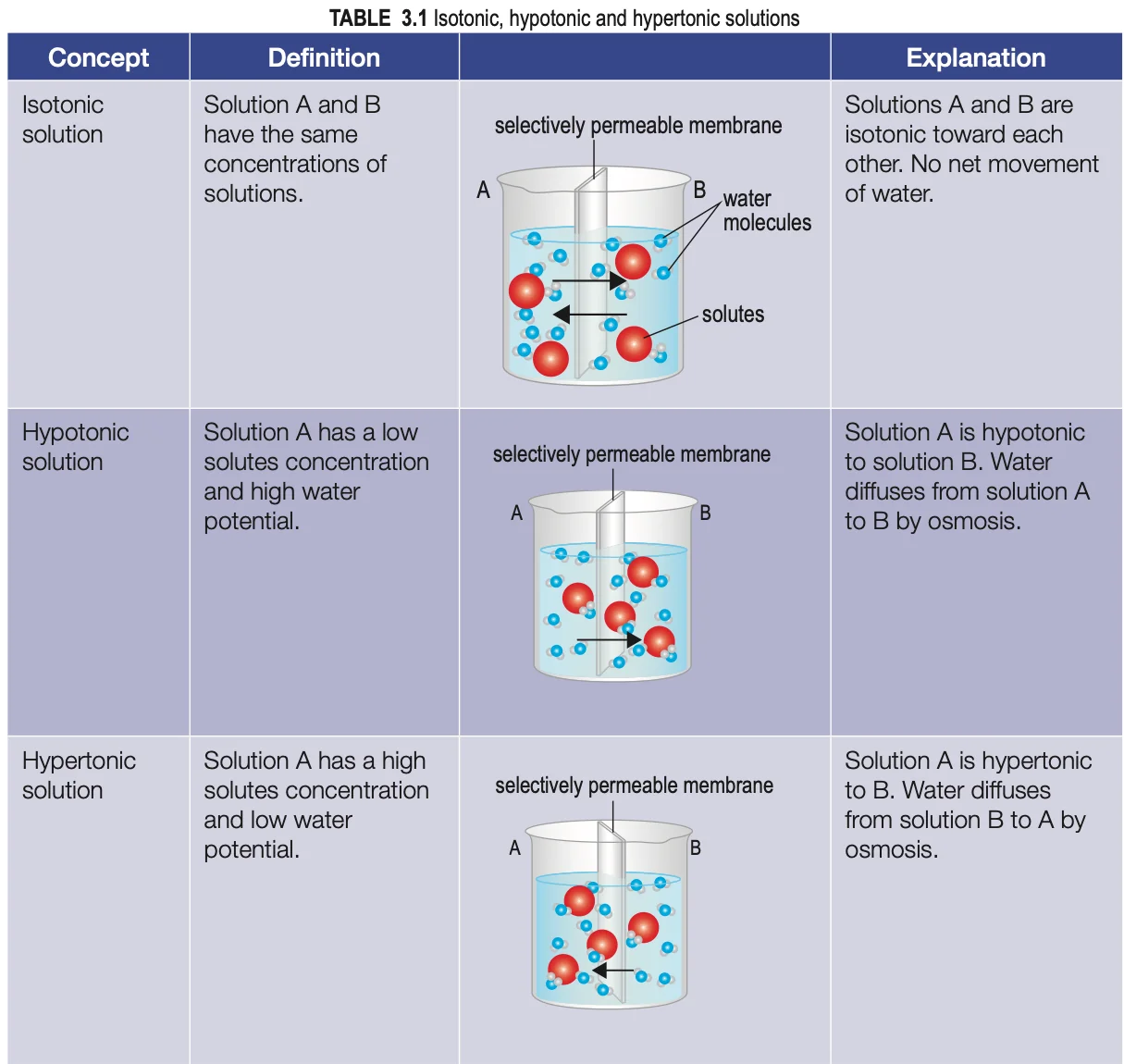
Figure: Biology Form 4 (DLP) textbook, Table 3.1, p. 58.
| Term | Solute concentration | Water potential | Water movement |
|---|---|---|---|
| Isotonic | Same on both sides | Same | No net movement |
| Hypotonic (A to B) | A lower than B | A higher | A to B |
| Hypertonic (A to B) | A higher than B | A lower | B to A |
Effects on cells
| Solution | Animal cell (red blood cell) | Plant cell |
|---|---|---|
| Hypotonic | Water enters, cell swells and bursts: haemolysis (membrane too thin to resist the pressure) | Vacuole expands and pushes cytoplasm against the cell wall: turgid. Does not burst because the wall is rigid. Turgor gives support, and keeps guard cells swollen so stomata stay open. |
| Hypertonic | Water leaves, cell shrinks: crenation | Vacuole and cytoplasm shrink and the membrane pulls away from the wall: plasmolysis; leaves wilt. Returning to a hypotonic solution: deplasmolysis. |
| Isotonic | No net movement; normal shape | No net movement; cell is flaccid |
Experiments
- Red blood cells (Activity 3.3): 0.15 M NaCl is isotonic, distilled water is hypotonic and 0.50 M NaCl is hypertonic to chicken red blood cells.
- Onion epidermis (Activity 3.4): in distilled water the cells are turgid; in 1.0 M sucrose the membrane pulls away from the wall (plasmolysis); adding excess water reverses it.
- Potato strips (Activity 3.5): strips are soaked in 0 to 0.6 M sucrose for 30 min. Plot % change in mass against concentration. The concentration where the line crosses 0% (no change in mass) is isotonic to the potato cell sap.
Percentage change = 0.6 ÷ 5.0 × 100 = +12% (gain: the strip was in a hypotonic solution).
Show answerHide answer
3.4Applications in daily life
- Plant wilting: too much fertiliser makes the soil water hypertonic to the root cell sap. Water leaves the root cells by osmosis, cells are plasmolysed and the plant wilts. Watering helps recovery; prolonged plasmolysis kills the plant.
- Food preservation: thick sugar, salt or vinegar solutions are hypertonic to microorganisms, so water leaves their cells and they cannot grow (pickles, salted fish, preserved fruits).
- Rehydration: oral rehydration salts replace water and electrolytes lost in diarrhoea. Isotonic drinks help athletes recover water and ions lost in sweat. Saline for medical use is isotonic to blood plasma (0.85–0.90 g NaCl per 100 ml).
- Liposomes: vesicles with a phospholipid bilayer. Water-soluble drugs are carried in the watery centre and water-insoluble drugs in the hydrophobic part of the bilayer. They protect drugs from gastric juice so the drug reaches the target cells.
- Reverse osmosis: pressure pushes seawater against a semi-permeable membrane. Water molecules pass through; salt, foreign particles and microorganisms do not. Pure fresh water is obtained (desalination).