Biology questions, chapter 3
Nama / NameKelas / ClassTarikh / Date
Movement of Substances across a Plasma Membrane
45 marks. Use Practice to check each answer as you go, or Exam to answer everything against the clock first.
Section A: objective questions
12 marksChoose the best answer for each question.
1
Question 1
Which of the following are the two main components of the plasma membrane?
Show answerHide answer
B
The plasma membrane is a phospholipid bilayer with protein molecules floating in it (fluid mosaic model, p. 46).
2
Question 2
Which part of a phospholipid molecule is hydrophobic?
Show answerHide answer
C
The nonpolar tail repels water (hydrophobic). The polar head is hydrophilic.
3
Question 3
What is the function of cholesterol in the plasma membrane?
Show answerHide answer
D
Cholesterol strengthens and adds flexibility to the bilayer and makes it less permeable to water-soluble substances such as ions. Receptors and antigens are glycoproteins and glycolipids.
4
Question 4
What does it mean when the plasma membrane is said to be selectively permeable?
Show answerHide answer
A
A selectively permeable membrane allows free movement of certain molecules and prevents or limits other substances.
5
Question 5
Which substance can diffuse directly through the phospholipid bilayer?
Show answerHide answer
C
Oxygen is a small nonpolar molecule. Glucose and amino acids are large and need carrier proteins; ions are charged and need proteins.
6
Question 6
Which statement about facilitated diffusion is correct?
Show answerHide answer
B
Facilitated diffusion uses channel or carrier proteins and moves substances down the concentration gradient, so no energy is needed.
7
Question 7
Which is a characteristic of active transport?
Show answerHide answer
D
Active transport moves substances against the gradient using ATP and carrier proteins (pumps).
8
Question 8
Which process in the human body involves active transport?
Show answerHide answer
A
Glucose and amino acids are absorbed in the villus by active transport. The other three are passive (diffusion or osmosis).
9
Question 9
Solution X (0.1 M sucrose) and solution Y (0.5 M sucrose) are separated by a selectively permeable membrane that is impermeable to sucrose. What happens?
Show answerHide answer
B
X has the lower solute concentration (higher water potential), so water moves from X to Y by osmosis. X is hypotonic to Y.
10
Question 10
Red blood cells are placed in a hypertonic solution. What happens to them?
Show answerHide answer
C
Water leaves the cells by osmosis so they shrink; this is crenation. Haemolysis is for hypotonic solutions.
11
Question 11
Onion epidermal cells are put in a 1.0 M sucrose solution. The plasma membrane is seen pulling away from the cell wall. Which statement explains this?
Show answerHide answer
A
A hypertonic solution has lower water potential than the cell sap, so water leaves the vacuole by osmosis and the cell is plasmolysed.
12
Question 12
A farmer applied a large amount of fertiliser and his plants wilted. Which is the best explanation?
Show answerHide answer
D
Dissolved fertiliser makes the soil water hypertonic to the root cell sap. Water leaves by osmosis, the cells are plasmolysed and the plant wilts.
Section B: structured questions
33 marksAnswer all questions. Write your answers in the spaces provided.
13
Question 13
Diagram 1 shows the structure of the plasma membrane.
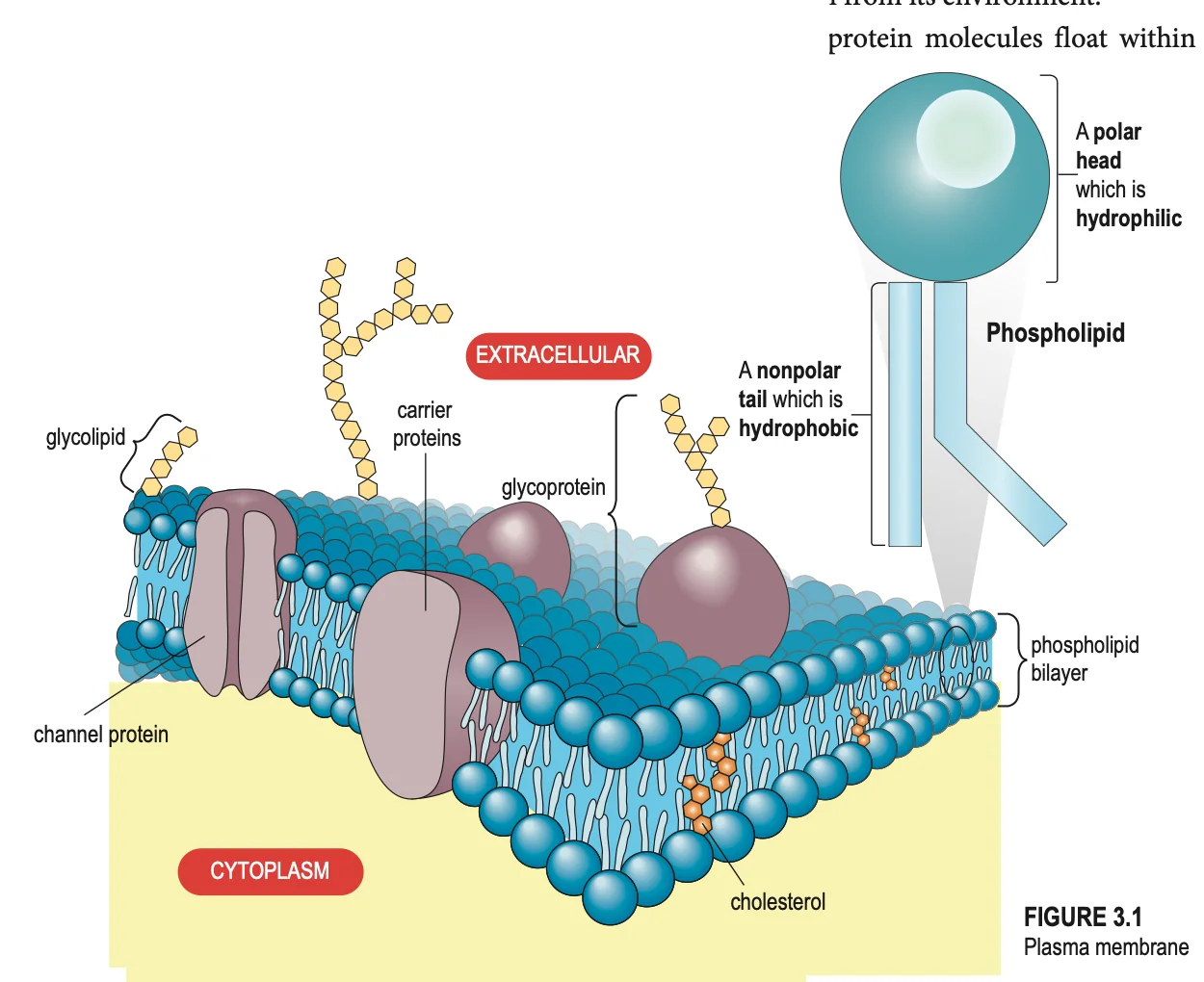
[1 mark]
(a)Name the model of the plasma membrane shown.
Show answerHide answer
Tick each point you got.
[1 mark]
(b)State one function of glycoprotein.
Show answerHide answer
Any 1 points
Tick each point you got.
[2 marks]
(c)Explain why the model is described as fluid and mosaic.
Show answerHide answer
Tick each point you got.
14
Question 14
Choose how each substance crosses the plasma membrane.
[1 mark]
(a)Oxygen moving into a cell
Show answerHide answer
Simple diffusion
[1 mark]
(b)Glucose moving into a cell down its concentration gradient
Show answerHide answer
Facilitated diffusion
[1 mark]
(c)Sodium ions moving out of an animal cell against their gradient
Show answerHide answer
Active transport
[1 mark]
(d)State why glucose cannot pass through the phospholipid bilayer on its own.
Show answerHide answer
Tick each point you got.
15
Question 15
The sodium-potassium pump moves three sodium ions out of an animal cell and two potassium ions into the cell.
[1 mark]
(a)State the type of transport involved.
Show answerHide answer
Tick each point you got.
[1 mark]
(b)What is the source of energy for the pump?
Show answerHide answer
Tick each point you got.
[2 marks]
(c)Explain how the carrier protein is able to move the sodium ions across the membrane.
Show answerHide answer
Tick each point you got.
[2 marks]
(d)Cellular respiration in the cell is stopped by a poison. Predict what happens to the pump and explain.
Show answerHide answer
Tick each point you got.
16
Question 16
Potato strips of equal length were soaked in sucrose solutions for 30 minutes. Diagram 2 shows the percentage change in mass of the strips.
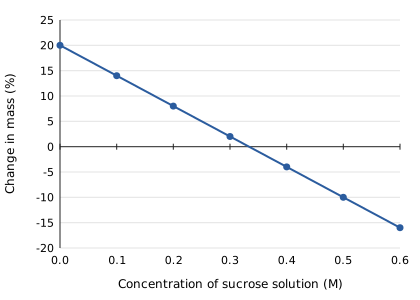
[1 mark]
(a)State the percentage change in mass of the strip in 0.2 M sucrose solution.
Show answerHide answer
Tick each point you got.
[1 mark]
(b)Determine the concentration of sucrose solution that is isotonic to the potato cell sap.
Show answerHide answer
Tick each point you got.
[2 marks]
(c)Explain why the strip in 0.5 M sucrose solution decreased in mass.
Show answerHide answer
Tick each point you got.
[1 mark]
(d)State the condition of the cells in the strip placed in distilled water.
Show answerHide answer
Tick each point you got.
17
Question 17
A drop of blood is added to each of three test tubes: A (4.5% sodium chloride), B (distilled water) and C (0.85% sodium chloride).
[2 marks]
(a)Describe what happens to the red blood cells in test tube A.
Show answerHide answer
Tick each point you got.
[2 marks]
(b)Describe what happens to the red blood cells in test tube B.
Show answerHide answer
Tick each point you got.
[1 mark]
(c)Which test tube is suitable for keeping red blood cells? Give a reason.
Show answerHide answer
Tick each point you got.
18
Question 18
A housewife soaks vegetables in a strong salt solution to remove pesticides. After a long time the vegetables become limp.
[3 marks]
(a)Explain why the vegetables become limp.
Show answerHide answer
Tick each point you got.
[1 mark]
(b)Suggest how the vegetables can be made crisp again.
Show answerHide answer
Tick each point you got.
19
Question 19
A school in an island wants to obtain drinking water from seawater by reverse osmosis.
[1 mark]
(a)State the property of the membrane that allows this process.
Show answerHide answer
Tick each point you got.
[2 marks]
(b)Explain why pressure must be applied to the seawater.
Show answerHide answer
Tick each point you got.
[2 marks]
(c)A child with diarrhoea is given an isotonic rehydration drink. Explain why.
Show answerHide answer
Tick each point you got.