Biology questions, chapter 4
Nama / NameKelas / ClassTarikh / Date
Chemical Compositions in a Cell
44 marks. Use Practice to check each answer as you go, or Exam to answer everything against the clock first.
Section A: objective questions
12 marksChoose the best answer for each question.
1
Question 1
Which property of water makes it a universal solvent?
Show answerHide answer
A
Water is polar, so it can dissolve polar solutes and ionic substances such as glucose and electrolytes.
2
Question 2
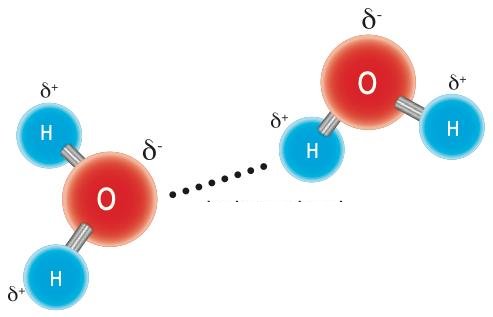
Diagram 1 shows two water molecules. What does the dotted line represent?
Show answerHide answer
A
The attraction between δ+ hydrogen of one molecule and δ- oxygen of another is a hydrogen bond.
3
Question 3
Water moves up the narrow xylem tubes of a plant mainly because of
Show answerHide answer
B
Water molecules attract each other (cohesion) and the xylem wall (adhesion), producing capillary action.
4
Question 4
What is the ratio of carbon : hydrogen : oxygen in carbohydrates?
Show answerHide answer
A
Carbohydrates have the formula (CH2O)n, so the ratio is 1 : 2 : 1.
5
Question 5
Which disaccharide is NOT a reducing sugar?
Show answerHide answer
C
Sucrose is a non-reducing sugar. Maltose and lactose reduce Benedict's solution; glucose is a monosaccharide.
6
Question 6
Which pair of monosaccharides combine to form sucrose?
Show answerHide answer
D
Glucose + fructose gives sucrose + water by condensation. Glucose + glucose gives maltose; glucose + galactose gives lactose.
7
Question 7
Which polysaccharide is the storage carbohydrate in animal liver and muscle cells?
Show answerHide answer
C
Glycogen stores glucose in muscle and liver cells; starch is the plant store and cellulose forms the plant cell wall.
8
Question 8
What is removed when two amino acids join to form a dipeptide?
Show answerHide answer
C
A peptide bond forms by condensation, in which one water molecule is removed.
9
Question 9
Two proteins have the same number and kinds of amino acids but behave differently. What explains this?
Show answerHide answer
B
The sequence of amino acids in the polypeptide chain differs, giving a different protein.
10
Question 10
A lipid is made of one glycerol, two fatty acids and one phosphate group. This lipid is a
Show answerHide answer
D
Phospholipids have two fatty acids and a phosphate group; they form plasma membranes.
11
Question 11
How many water molecules are produced when one triglyceride is formed?
Show answerHide answer
D
One glycerol + three fatty acids forms a triglyceride and 3 H2O.
12
Question 12
Which statement about RNA is correct?
Show answerHide answer
B
RNA is a single chain with ribose and uracil; DNA has thymine and deoxyribose.
Section B: structured questions
32 marksAnswer all questions. Write your answers in the spaces provided.
13
Question 13
Water has several properties that are important to a cell.
[1 mark]
(a)State the meaning of cohesive force.
Show answerHide answer
Tick each point you got.
[1 mark]
(b)Water has a high specific heat capacity. State one importance of this to living organisms.
Show answerHide answer
Tick each point you got.
[2 marks]
(c)Explain how the polarity of water helps glucose to enter a cell.
Show answerHide answer
Tick each point you got.
14
Question 14
Maltose is formed from two glucose molecules.
[1 mark]
(a)Name the process that forms maltose.
Show answerHide answer
Tick each point you got.
[2 marks]
(b)Write the word equation for the formation of maltose.
Show answerHide answer
Tick each point you got.
[1 mark]
(c)Maltose is heated with Benedict's solution. State the observation.
Show answerHide answer
Tick each point you got.
[2 marks]
(d)A student heats sucrose with Benedict's solution and sees no change. Suggest how to make the test positive.
Show answerHide answer
Tick each point you got.
15
Question 15
Proteins are important in the body.
[1 mark]
(a)State the element that all proteins contain but carbohydrates and lipids do not.
Show answerHide answer
Nitrogen
Tick each point you got.
[2 marks]
(b)State two functions of proteins.
Show answerHide answer
Tick each point you got.
[2 marks]
(c)Explain the effect of a lack of protein in the diet on hair and nails.
Show answerHide answer
Tick each point you got.
16
Question 16
A student compares two fats. Fat X is solid at room temperature and comes from animals. Fat Y is liquid and comes from fish.
[1 mark]
(a)Which fat is saturated?
Show answerHide answer
Tick each point you got.
[2 marks]
(b)Explain your answer to (a) in terms of bonds between carbon atoms.
Show answerHide answer
Tick each point you got.
[2 marks]
(c)Explain why too much of fat X is harmful.
Show answerHide answer
Tick each point you got.
[1 mark]
(d)Name the products when a triglyceride is hydrolysed.
Show answerHide answer
Tick each point you got.
17
Question 17
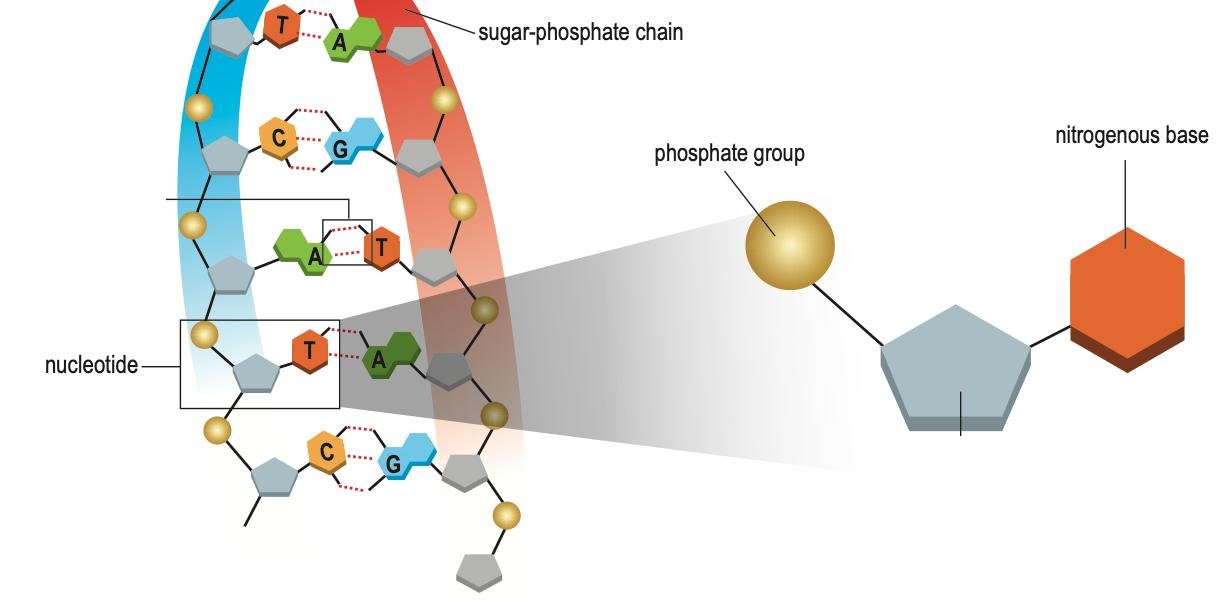
Diagram 2 shows part of a DNA molecule.
[1 mark]
(a)Name the sugar in a DNA nucleotide.
Show answerHide answer
Tick each point you got.
[2 marks]
(b)The base sequence on one chain is A-T-G-C. Write the sequence on the other chain.
Show answerHide answer
A-T, T-A, G-C, C-G.
Tick each point you got.
[1 mark]
(c)What holds the two chains together?
Show answerHide answer
Tick each point you got.
[2 marks]
(d)State two differences between DNA and RNA.
Show answerHide answer
Any 2 points
Tick each point you got.
18
Question 18
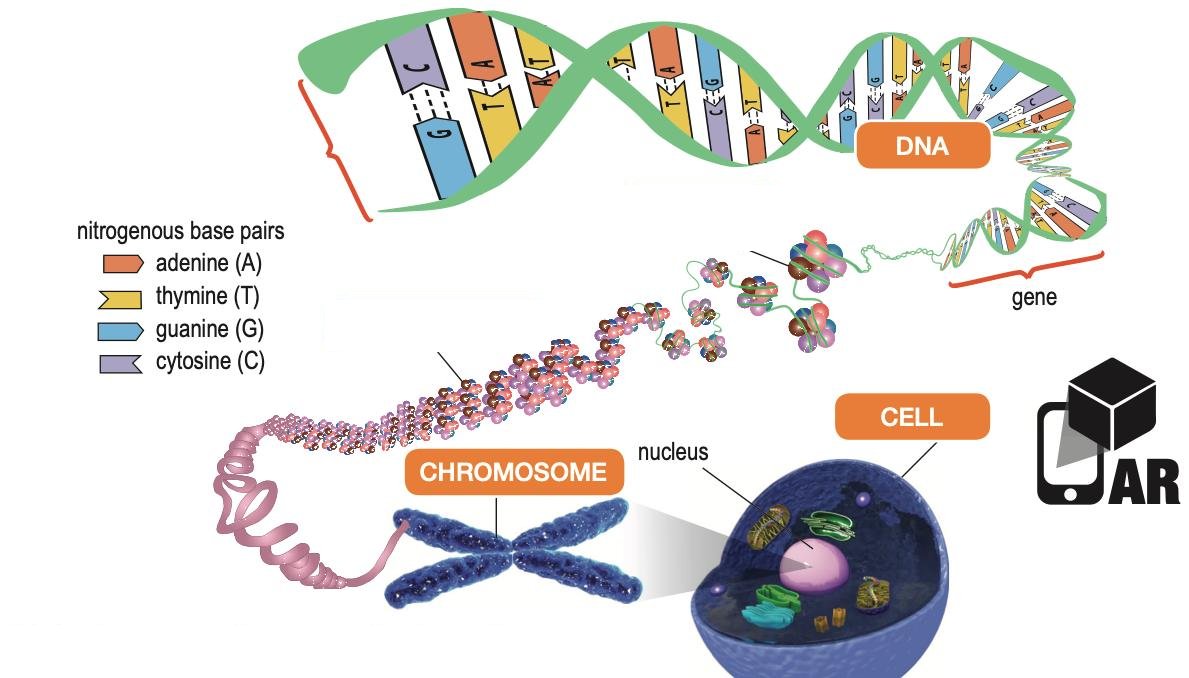
A chromosome is made of DNA and protein.
[1 mark]
(a)Name the protein around which DNA is wound.
Show answerHide answer
Tick each point you got.
[2 marks]
(b)Describe how a chromosome is formed from DNA.
Show answerHide answer
Tick each point you got.
[2 marks]
(c)The AUG codon on mRNA codes for methionine. Explain how the DNA sequence determines the protein made.
Show answerHide answer
Tick each point you got.