Biology questions, chapter 9
Nama / NameKelas / ClassTarikh / Date
Nutrition and the Human Digestive System
46 marks. Use Practice to check each answer as you go, or Exam to answer everything against the clock first.
Section A: objective questions
12 marksChoose the best answer for each question.
1
Question 1
Which organ is part of the digestive system but is NOT part of the alimentary canal?
Show answerHide answer
B
The pancreas, liver and gallbladder add digestive juices but food does not pass through them. The other three are parts of the alimentary canal.
2
Question 2
Which process is an example of chemical digestion?
Show answerHide answer
C
Chemical digestion needs enzymes. Chewing, churning and peristalsis are physical digestion.
3
Question 3
Which cells in the gastric glands secrete hydrochloric acid?
Show answerHide answer
D
Parietal cells secrete hydrochloric acid. Chief cells secrete pepsinogen and mucous cells secrete mucus.
4
Question 4
Which is NOT a function of hydrochloric acid in the stomach?
Show answerHide answer
A
Emulsification of lipids is done by bile in the duodenum, not by hydrochloric acid.
5
Question 5
Bile helps in the digestion of lipids because it
Show answerHide answer
C
Bile has no enzyme. It emulsifies lipids into tiny droplets and makes the medium alkaline, which helps lipase.
6
Question 6
A patient has no pancreas. Which digestion is NOT affected, because the enzyme comes from another organ?
Show answerHide answer
D
Salivary amylase comes from the salivary glands. Pancreatic amylase, trypsin and lipase would be missing.
7
Question 7
Starch is mixed with amylase in tube A and with distilled water in tube B at 37 °C for 10 minutes. Which result is expected with Benedict's solution?
Show answerHide answer
A
Amylase hydrolyses starch to maltose, a reducing sugar, so A gives a brick-red precipitate. Starch is not a reducing sugar, so B stays blue.
8
Question 8
Which structure in a villus absorbs fatty acids and glycerol?
Show answerHide answer
B
Fatty acids and glycerol recombine to lipid droplets and enter the lacteal. Glucose and amino acids enter the blood capillaries.
9
Question 9
Glucose in the ileum is absorbed into the epithelial cells against its concentration gradient. What is this process?
Show answerHide answer
D
Glucose and galactose are absorbed by active transport, which uses energy to move molecules against the gradient.
10
Question 10
In the liver, excess amino acids are converted to urea. What is this process called?
Show answerHide answer
A
Deamination removes the amino group from excess amino acids to form urea.
11
Question 11
0.50 g of groundnut is burnt and heats 20 g of water by 15 °C. What is the energy value of the groundnut? (1 g water needs 4.2 J per °C)
Show answerHide answer
C
(20 × 4.2 × 15) ÷ (0.50 × 1000) = 1260 ÷ 500 = 2.52 kJ g⁻¹.
12
Question 12
A man often has a hard, dry stool and passes it with difficulty. Which advice is best?
Show answerHide answer
A
Fibre stimulates peristalsis and water keeps the faeces soft, so they move easily. This prevents constipation.
Section B: structured questions
34 marksAnswer all questions. Write your answers in the spaces provided.
13
Question 13
Salivary amylase acts on food in the mouth.
[2 marks]
(a)State the substrate and the product of salivary amylase.
Show answerHide answer
Tick each point you got.
[1 mark]
(b)Saliva has pH 6.5 to 7.5. Why is this important?
Show answerHide answer
Tick each point you got.
14
Question 14
Explain how protein is digested in the stomach.
[2 marks]
(a)Name the inactive enzyme and the cells that secrete it.
Show answerHide answer
Tick each point you got.
[1 mark]
(b)Explain how it becomes active.
Show answerHide answer
Tick each point you got.
[1 mark]
(c)State the product of protein digestion in the stomach.
Show answerHide answer
Tick each point you got.
[1 mark]
(d)Why does the stomach wall not get digested?
Show answerHide answer
Tick each point you got.
15
Question 15
A student mixes 5 ml of albumen suspension and 1 ml of 0.1 M hydrochloric acid in each of tubes A and B. He adds 1 ml of 1% pepsin to A and 1 ml of distilled water to B. Both tubes are kept at 37 °C for 20 minutes.
[1 mark]
(a)State the manipulated variable.
Show answerHide answer
Tick each point you got.
[2 marks]
(b)State the observation in each tube after 20 minutes.
Show answerHide answer
Tick each point you got.
[2 marks]
(c)Explain the result in A.
Show answerHide answer
Tick each point you got.
16
Question 16
Diagram 1 shows a villus in the ileum.
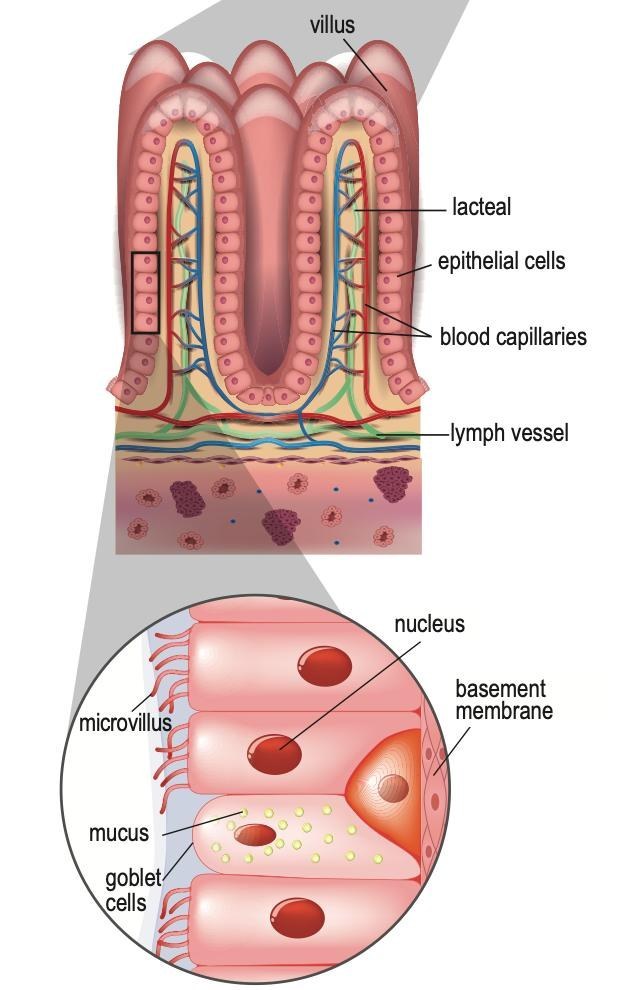
[1 mark]
(a)The epithelium of the villus is one cell thick. Explain why this is an advantage.
Show answerHide answer
Tick each point you got.
[2 marks]
(b)State two other adaptations of the ileum or villus for absorbing nutrients.
Show answerHide answer
Any 2 points
Tick each point you got.
[2 marks]
(c)Name the two substances absorbed into the lacteal, and the vitamins carried by it.
Show answerHide answer
Tick each point you got.
17
Question 17
Blood from the small intestine flows to the liver.
[1 mark]
(a)Name the blood vessel that carries blood from the small intestine to the liver.
Show answerHide answer
Tick each point you got.
[3 marks]
(b)State three functions of the liver in assimilation.
Show answerHide answer
Any 3 points
Tick each point you got.
18
Question 18
A standard 0.1% ascorbic acid solution and three juices (P, Q and R) were each added drop by drop to 1 ml of DCPIP solution. The table shows the volume of each liquid needed to decolourise the DCPIP.
| Liquid | Volume needed (ml) |
|---|---|
| 0.1% ascorbic acid | 2.0 |
| Juice P | 5.0 |
| Juice Q | 2.5 |
| Juice R | 8.0 |
[2 marks]
(a)Which juice has the highest vitamin C content? Give a reason.
Show answerHide answer
Tick each point you got.
[2 marks]
(b)Calculate the percentage of vitamin C in juice P.
Show answerHide answer
Tick each point you got.
[2 marks]
(c)Juice Q is boiled for 30 minutes. Predict the volume needed afterwards and explain.
Show answerHide answer
Tick each point you got.
19
Question 19
Siti eats mostly white rice and fried food with few vegetables. She often has constipation. She was also told her stomach lining is inflamed because she skips meals.
[2 marks]
(a)Explain why her diet causes constipation.
Show answerHide answer
Tick each point you got.
[2 marks]
(b)Name the condition of her stomach lining and state its cause.
Show answerHide answer
Tick each point you got.
[2 marks]
(c)Suggest two changes to her habits.
Show answerHide answer
Any 2 points
Tick each point you got.