Nutrition and the Human Digestive System
What this chapter covers
- Identify the structures of the human digestive system (9.1)
- Describe physical and chemical digestion, and the digestion of carbohydrates, proteins and lipids in the mouth, stomach and small intestine (9.2)
- Explain how the ileum and villus are adapted for absorption of digested food (9.3)
- Describe the roles of the circulatory system and the liver in assimilation (9.4)
- Explain the functions of the large intestine and the formation of faeces (9.5)
- Calculate energy value and vitamin C content of food samples, and justify diet modifications (9.6)
- Relate health issues to the digestive system, defaecation and eating habits (9.7)
9.1Digestive system
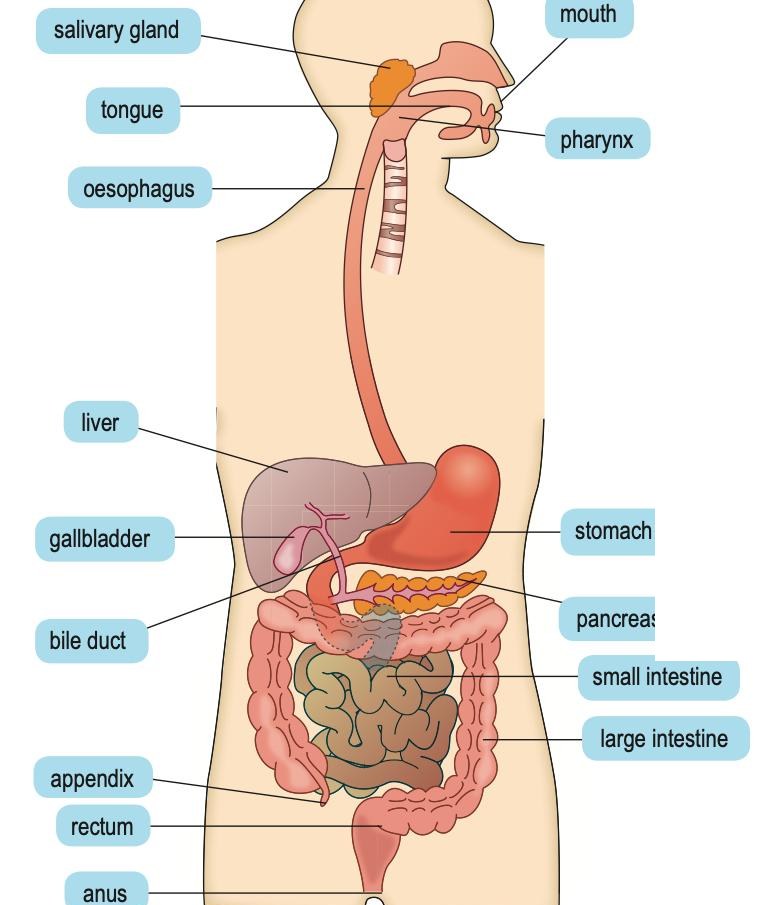
Textbook Figure 9.1, p. 144.
9.2Digestion
| Physical digestion | Chemical digestion | |
|---|---|---|
| What happens | Mechanical breakdown of food into small particles | Complex molecules are broken into simple molecules by enzyme-catalysed hydrolysis |
| Involves | Chewing, peristalsis, churning | Enzymes |
Mouth and oesophagus
- Food in the mouth stimulates the salivary glands. Salivary amylase hydrolyses starch to maltose. Saliva has pH 6.5–7.5, which is optimum for the enzyme.
- Saliva also helps form a bolus. On swallowing, the epiglottis closes the trachea so that food does not enter it.
- Peristalsis is the rhythmic contraction and relaxation of muscles along the alimentary canal. It pushes the bolus to the stomach.
Stomach
| Cell in gastric gland | Secretes |
|---|---|
| Chief cells | Pepsinogen (inactive enzyme) |
| Parietal cells | Hydrochloric acid |
| Mucous cells | Mucus |
- Pepsinogen is activated by hydrochloric acid to pepsin, which hydrolyses protein into polypeptides.
- Hydrochloric acid gives pH 1.5–2.0 for pepsin, stops the action of salivary amylase and kills bacteria in food.
- Mucus protects the stomach wall from the acid and enzymes.
- Churning turns the food into a semifluid called chyme, released slowly into the duodenum when the sphincter muscle relaxes.
Small intestine
The small intestine is made up of the duodenum, jejunum and ileum. The duodenum receives chyme, bile (made by the liver, stored in the gallbladder) and pancreatic juice.
- Bile neutralises acidic chyme, gives an alkaline medium (pH 7.6–8.6) and emulsifies lipids into tiny droplets, which increases the surface area for lipase. Bile has no enzyme.
- Pancreatic juice has pancreatic amylase, trypsin and lipase.
- The ileum wall secretes intestinal juice (maltase, sucrase, lactase, lipase, erepsin) and mucus.
| Food | Enzyme | Reaction |
|---|---|---|
| Carbohydrate | Pancreatic amylase | Starch → maltose |
| Maltase | Maltose → glucose | |
| Sucrase | Sucrose → glucose + fructose | |
| Lactase | Lactose → glucose + galactose | |
| Protein | Trypsin | Polypeptide → shorter peptides |
| Erepsin | Peptides → amino acids | |
| Lipid | Lipase | Lipid → fatty acids + glycerol |
Experiments on digestion (Activities 9.1 to 9.3)
| Experiment | Set-up and what is observed |
|---|---|
| Starch and amylase | Starch + amylase (A) and starch + distilled water (B) at 37 °C for 10 minutes. In A the iodine test is negative (no blue-black) and Benedict's test gives a brick-red precipitate. B stays blue-black with iodine and Benedict's stays blue. |
| Albumen and pepsin | Albumen suspension + dilute HCl + pepsin (A) or + distilled water (B) at 37 °C. A turns from cloudy to clear after 20 minutes. B stays cloudy. |
| Lipid and lipase | Oil + sodium carbonate + dishwashing liquid + phenolphthalein (pink) with lipase (A) or water (B). Fatty acids lower the pH, so A turns colourless sooner. Dishwashing liquid emulsifies the oil, as bile does. |
Show answerHide answer
9.3Absorption
Digested food is absorbed in the ileum. Its inner layer is folded and covered by finger-like villi.
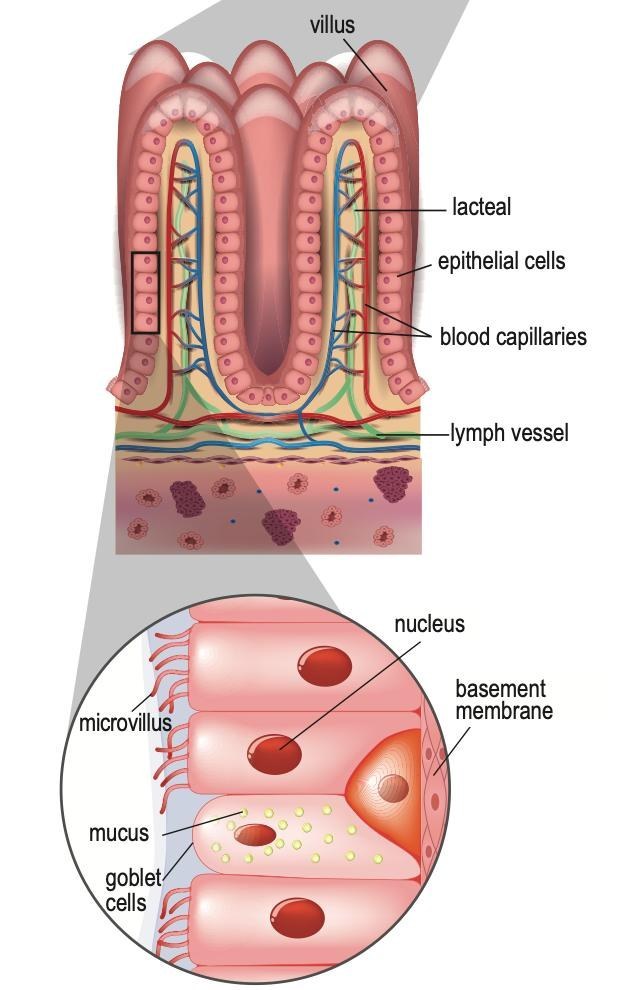
Textbook Figure 9.5, p. 151.
| Feature | Adaptation for absorption |
|---|---|
| Folded ileum with villi | Large surface area |
| Microvilli on epithelial cells | Even larger surface area |
| Epithelium one cell thick | Short distance, so absorption is fast |
| Network of blood capillaries | Carries digested food away to the whole body; keeps the concentration gradient |
| Lacteal | Carries lipid droplets (fatty acids and glycerol) |
| Goblet cells | Secrete mucus |
| Digested food | Absorbed into | Method |
|---|---|---|
| Glucose, galactose | Blood capillaries | Active transport |
| Fructose | Blood capillaries | Facilitated diffusion |
| Amino acids | Blood capillaries | Active transport |
| Water, vitamins B and C | Blood capillaries | Osmosis (water); absorbed with water |
| Fatty acids, glycerol | Lacteal | Simple diffusion; recombine to lipid droplets in the epithelial cells |
| Vitamins A, D, E, K | Lacteal | Simple diffusion (dissolve in lipid) |
Show answerHide answer
9.4Assimilation
- Blood capillaries of the small intestine join to form the hepatic portal vein, which carries blood to the liver.
- Lacteals join the lymph vessels, which empty through the thoracic duct into the left subclavian vein. Lipids then travel in the blood.
| Function of the liver | Details |
|---|---|
| Metabolism | Glucose is used in cellular respiration. Amino acids make plasma proteins and enzymes. Excess amino acids are deaminated to urea, which is excreted in urine. If glucose is short, amino acids are turned into glucose. |
| Storage | Excess glucose is converted to glycogen and stored. When blood glucose falls, glycogen is converted back to glucose. Once glycogen is at maximum, excess glucose becomes fat. |
| Detoxification | Toxic substances are removed from the blood and excreted in urine. |
Assimilation in cells
- Amino acids: new protoplasm, repair of tissues, hormones and enzymes.
- Glucose: oxidised in cellular respiration to release energy, water and carbon dioxide. Excess is kept as glycogen in muscles.
- Lipids: phospholipid and cholesterol build the plasma membrane. Excess is stored in adipose tissue under the skin. Fat is oxidised when glucose is not enough.
9.5Defaecation
Undigested food, dead cells, fibre and water enter the large intestine by peristalsis. It has two main functions.
- Absorption of water and mineral salts, and vitamins (vitamin B, vitamin K and folic acid) made by bacteria.
- Formation of faeces: the remaining semisolid contains dead cells, bile pigments, bacteria and toxic substances. Mucus lubricates its movement. It takes about 12 to 24 hours to reach the rectum.
Faeces collect in the rectum. When the pressure rises, the rectum muscles contract and expel the faeces through the anus. This is defaecation.
Show answerHide answer
9.6Balanced diet
Energy value
Energy value is the total energy released when 1 g of food is completely oxidised, in kJ g−1. 1 calorie = 4.2 J. It is measured by burning food under a boiling tube of water and measuring the rise in water temperature.
Energy value = (20 × 4.2 × 15) ÷ (0.50 × 1000) = 1260 ÷ 500 = 2.52 kJ g−1
Vitamin C
Vitamin C decolourises blue DCPIP. The less juice needed to decolourise the same volume of DCPIP, the more vitamin C it has. Standard: 0.1% ascorbic acid solution.
Percentage of vitamin C = (volume of ascorbic acid ÷ volume of juice) × 0.1%
Vitamin C in X = (2.0 ÷ 4.0) × 0.1% = 0.05%
Vitamin C is lost by oxidation and by heat. Orange juice kept in ice keeps the most vitamin C; juice boiled loses the most.
Diet modification
| Individual | Advice |
|---|---|
| Obesity (excess fat stored because intake exceeds energy used) | Reduce carbohydrates and fats; eat more vegetables and fruit; exercise |
| Diabetes mellitus, cardiovascular disease | Avoid saturated fats and high cholesterol, which cause atherosclerosis, hypertension, heart attack and stroke; fibre helps to regulate glucose absorption |
| Cancer patient | Enough energy, reduce the risk of infection, quick recovery |
The Pinggan Sihat Malaysia shows the relative amounts of each food class in a balanced meal.
Show answerHide answer
9.7Health issues
Modified digestive organs
Gastric bypass reduces the size of the stomach to treat obesity. Short-term effects: acid reflux, nausea, vomiting, food restrictions, risk of infection. Long-term: dizziness, low blood sugar, malnutrition, stomach ulcer and defaecation problems.
Defaecation
Fibre stimulates peristalsis, absorbs and expels toxins, regulates glucose absorption and increases beneficial bacteria. A low-fibre diet or too little water causes constipation, colon and rectal cancer and haemorrhoids.
Eating habits
| Condition | Description |
|---|---|
| Gastritis | Inflammation of the stomach lining by gastric juice when the stomach is empty; caused by irregular meals, alcohol or painkillers; may lead to gastric ulcer |
| Anorexia nervosa | Avoiding food to reach an ideal body weight; nutrient deficiency and psychological problems |
| Bulimia nervosa | Eating a lot then vomiting or using laxatives; dehydration, nutritional problems, cardiovascular disease, kidney failure |
| Muscle dysmorphia | Believing one is too small; extreme weightlifting and use of steroids or supplements |