Introduction to Chemistry
What this chapter covers
- State the meaning of chemistry, examples of chemicals in daily life, and careers related to chemistry (1.1)
- Describe the development of chemical technology and its contribution to mankind (1.1)
- Follow the steps of the scientific method and design an experiment to test a hypothesis (1.2)
- Investigate the effect of temperature on the solubility of salt in water (1.2)
- Explain the types and functions of personal protective equipment and laboratory safety equipment (1.3)
- Store and dispose of chemicals correctly according to their type (1.3)
- Describe the emergency procedure for a chemical spill and a mercury spill (1.3)
1.1Development in chemistry and its importance in daily life
Chemistry is not only about chemicals in the laboratory. Everything around you is made of chemicals, and daily activities involve chemical reactions, for example salt, soap and the food you cook.
Chemicals in daily life
| Area | Examples of chemicals |
|---|---|
| Food | Preservatives, colouring, flavouring, antioxidants, stabilisers |
| Medicine | Antibiotics, antiseptics, vitamins, analgesics (pain killers), chemotherapy drugs |
| Agriculture | Herbicides, pesticides, fungicides, fertilisers, hormones |
| Industry | Paint, polymers, glass, ceramics, detergents, alloys |
Chemical technology and careers
The need to solve problems drives the development of chemical technology. Technology of the 1960s and 1970s may not suit today. Food preservation is a good example of this progress: salt or sugar, then freezing, then nanotechnology (for example nanocapsules in bread).
| Field | Examples of careers |
|---|---|
| Biotechnology | Researcher, biomedical engineer |
| Pharmaceutical | Doctor, pharmacist |
| Cosmetics | Cosmetic chemist, cosmetic consultant |
| Nanotechnology | Nanotechnology engineer, food scientist |
| Green technology | Green technology chemist, engineer |
Show answerHide answer
1.2Scientific investigation in chemistry
| Step | What you do |
|---|---|
| 1. Making observations | Use your senses to gather information about a phenomenon |
| 2. Making an inference | Use data and past experience to explain what you observed |
| 3. Identifying the problem | Ask a question based on the inference |
| 4. Making a hypothesis | A testable statement about the relationship between the manipulated and responding variables |
| 5. Identifying the variables | Manipulated, responding and fixed variables |
| 6. Controlling the variables | Change only the manipulated variable; keep the fixed variables the same |
| 7. Planning an experiment | Materials, apparatus, procedure, how data are collected and analysed |
| 8. Collecting data | Observe, measure and record systematically |
| 9. Interpreting data | Calculations, tables, graphs or charts to find the relationship |
| 10. Making a conclusion | State whether the hypothesis is accepted or rejected |
| 11. Preparing a report | Share all aspects of the experiment |
Experiment 1.1: temperature and the solubility of salt
Hypothesis: The higher the temperature of the water, the higher the solubility of salt.
Manipulated variable: temperature of the water (10 °C, 30 °C, 80 °C)
Responding variable: solubility of salt (how much dissolves)
Fixed variables: volume of water (50 cm³), mass of salt (40 g), time of stirring (2 minutes)
Procedure: put 50 cm³ distilled water at 10 °C in a beaker, add 40 g salt, stir for 2 minutes, observe. Repeat at 30 °C and 80 °C and record in a table.
Show answerHide answer
1.3Using, managing and handling apparatus and materials
Personal protective equipment
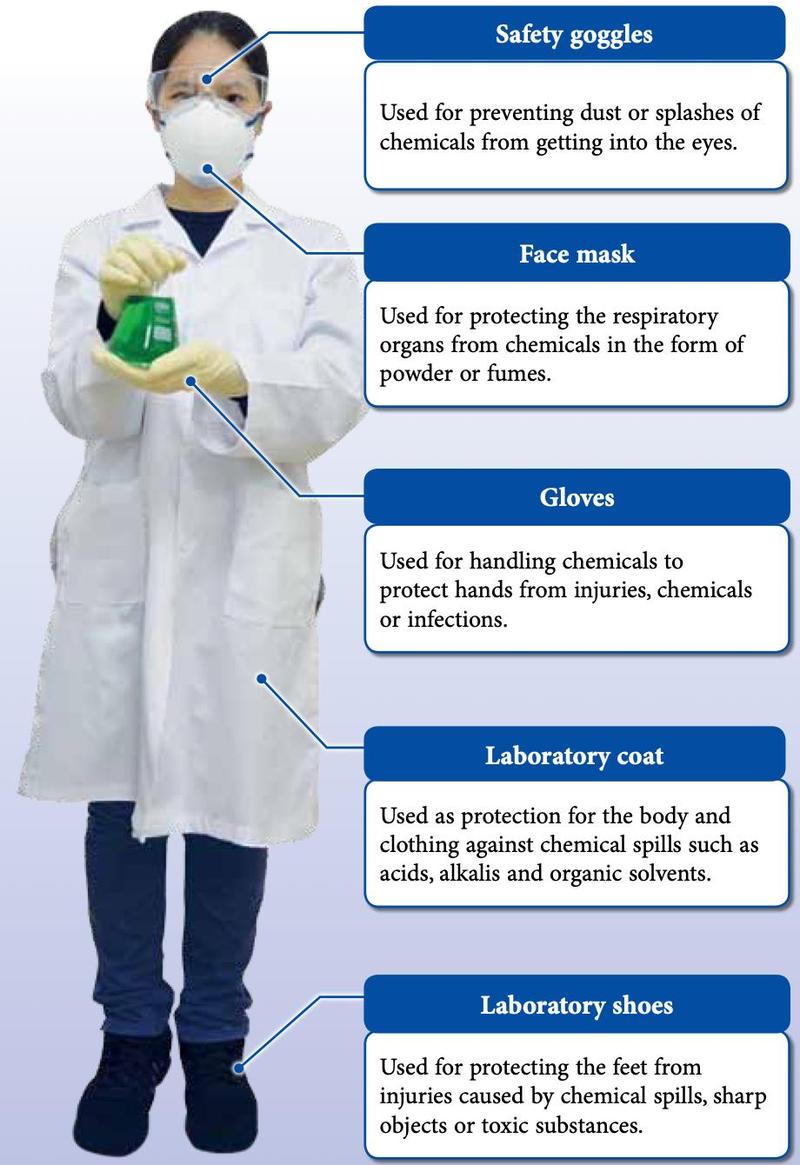
Figure: Chemistry Form 4 KSSM (DLP) textbook, Figure 1.9, p. 12.
| Equipment | Function |
|---|---|
| Safety goggles | Stop dust or chemical splashes entering the eyes |
| Face mask | Protects the respiratory organs from powders and fumes |
| Gloves | Protect hands from injury, chemicals or infection |
| Laboratory coat | Protects body and clothes from spills of acids, alkalis, organic solvents |
| Laboratory shoes | Protect feet from spills, sharp objects and toxic substances |
Safety equipment in the laboratory
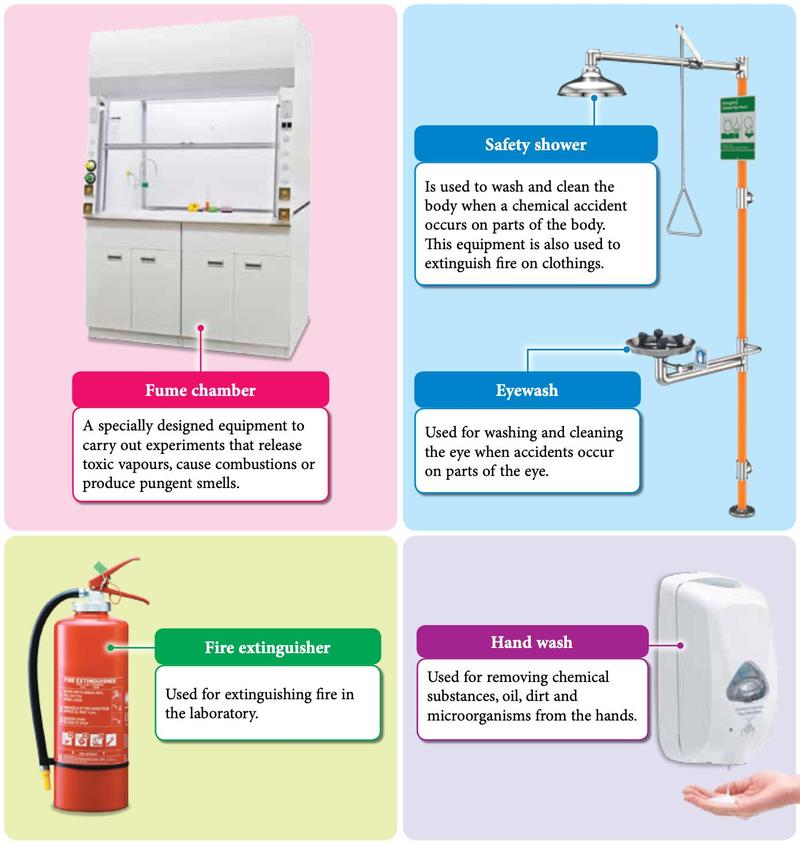
Figure: Chemistry Form 4 KSSM (DLP) textbook, Figure 1.10, p. 13.
| Equipment | Function |
|---|---|
| Fume chamber | For experiments that release toxic vapours, cause combustion or give pungent smells (e.g. concentrated sulphuric acid, chlorine, ammonia, bromine, alcohol, benzene) |
| Safety shower | Washes the body after a chemical accident; also puts out fire on clothing |
| Eyewash | Washes the eye after an accident |
| Fire extinguisher | Puts out fire in the laboratory |
| Hand wash | Removes chemicals, oil, dirt and microorganisms from the hands |
Storage of chemicals
| Type | Examples | How to store |
|---|---|---|
| Reactive substances | Lithium, sodium, potassium | In paraffin oil, to stop reaction with moisture in air |
| Hydrocarbons and organic solvents | Volatile, flammable liquids | Shady place far from sunlight and heat |
| Substances that decompose in light | Concentrated nitric acid, hydrogen peroxide, silver nitrate, liquid bromine | In dark bottles |
| Corrosive (pH < 5 or pH > 9) | Strong acids and alkalis | Locked special cabinet |
| Heavy metals and toxic substances | Mercury, lead compounds | Labelled containers in a locked, heat-free room |
Disposal of chemicals
| Waste | How to dispose |
|---|---|
| Dilute hydrogen peroxide | Pour into the sink. Concentrated: dilute, add sodium sulphite to decompose, then pour into the sink. |
| Solid waste (glass, rubber) | Special containers |
| Organic solvents, hydrocarbons | Toxic, volatile, flammable: never into the sink. Keep in special glass or plastic containers. |
| Strong acids and alkalis | Closed, labelled containers (they damage the sink and release heat and toxic gases) |
| Heavy metals, toxic substances | Put in plastic bags, let the solution evaporate in the fume chamber, tie the bag and put it in the heavy metal waste container |
| Volatile substances (alcohol, ammonia, bromine) | Closed containers away from sun and heat |
Emergency procedure
2. Stop other students from entering the area.
3. Stop the spill spreading, using sand as a border.
4. Clean up the spill.
5. Dispose of it by the correct procedure.
2. Make the spill site a prohibited area.
3. Sprinkle sulphur powder over the spill.
4. Contact the Fire and Rescue Department.
Symptoms of mercury poisoning: nausea, vomiting, diarrhoea, coughing, sore throat, difficulty in breathing, chest pain, headache, eye irritation, vision problems and increased blood pressure.