Chemistry questions, chapter 2
Nama / NameKelas / ClassTarikh / Date
Matter and the Atomic Structure
45 marks. Use Practice to check each answer as you go, or Exam to answer everything against the clock first.
Section A: objective questions
14 marksChoose the best answer for each question.
1
Question 1
Which statement describes matter?
Show answerHide answer
C
Matter is anything that has mass and occupies space. A rainbow can be seen but has neither.
2
Question 2
Which process changes a solid directly into a gas?
Show answerHide answer
A
Sublimation is solid to gas without becoming a liquid. Deposition is the reverse.
3
Question 3
Which statement is correct about the particles of a liquid?
Show answerHide answer
D
In a liquid the particles are close together but not orderly, with higher kinetic energy than a solid.
4
Question 4
The temperature stays constant while naphthalene melts. Why?
Show answerHide answer
B
During melting the heat absorbed overcomes the attraction forces, so the kinetic energy and temperature do not rise.
5
Question 5
What is the relative charge of an electron?
Show answerHide answer
A
An electron has relative charge −1; a proton is +1 and a neutron is 0.
6
Question 6
Who discovered the neutron?
Show answerHide answer
C
James Chadwick discovered the neutral particles, neutrons, in the nucleus.
7
Question 7
Which model describes the atom as a positively charged sphere with electrons in it?
Show answerHide answer
B
Thomson, who discovered the electron, proposed a positive sphere containing electrons.
8
Question 8
An aluminium atom has 13 protons and 14 neutrons. What is its nucleon number?
Show answerHide answer
D
Nucleon number = protons + neutrons = 13 + 14 = 27.
9
Question 9
A potassium atom has nucleon number 39 and 19 protons. How many neutrons does it have?
Show answerHide answer
A
Neutrons = 39 − 19 = 20.
10
Question 10
A chlorine atom has 17 protons and 18 neutrons. How many electrons are in a chloride ion, Cl−?
Show answerHide answer
C
The atom has 17 electrons and gains 1 to form the ion: 17 + 1 = 18.
11
Question 11
Magnesium has proton number 12. What is its electron arrangement?
Show answerHide answer
B
12 electrons: 2 in the first shell, 8 in the second, 2 left in the third: 2.8.2.
12
Question 12
How many valence electrons does an atom with electron arrangement 2.8.7 have?
Show answerHide answer
D
Valence electrons are in the outermost shell: 7.
13
Question 13
Atoms W, X, Y and Z have proton numbers 6, 6, 11 and 12 and nucleon numbers 12, 13, 23 and 24. Which atoms are isotopes?
Show answerHide answer
A
W and X have the same proton number (6) but different nucleon numbers, so different numbers of neutrons.
14
Question 14
Copper has 69% 63Cu and 31% 65Cu. What is the relative atomic mass of copper?
Show answerHide answer
C
(69 × 63 + 31 × 65) ÷ 100 = 6362 ÷ 100 = 63.62, which is 63.6.
Section B: structured questions
31 marksAnswer all questions. Write your answers in the spaces provided.
15
Question 15
Table 1 shows the melting point and boiling point of substances P, Q and R.
| Substance | Melting point (°C) | Boiling point (°C) |
|---|---|---|
| P | −7 | 59 |
| Q | 114 | 184 |
| R | −219 | −183 |
[3 marks]
(a)State the physical state of P, Q and R at room temperature (25 °C).
Show answerHide answer
Tick each point you got.
[1 mark]
(b)Which substance changes from solid to liquid when heated from 100 °C to 150 °C?
Show answerHide answer
Tick each point you got.
16
Question 16
Diagram 1 shows the heating curve of naphthalene.
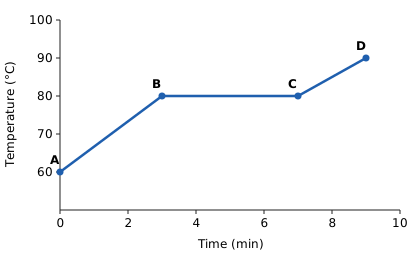
[1 mark]
(a)State the physical state of naphthalene between A and B.
Show answerHide answer
Tick each point you got.
[1 mark]
(b)What is the melting point of naphthalene?
Show answerHide answer
Tick each point you got.
[2 marks]
(c)Explain why the temperature does not change from B to C.
Show answerHide answer
Tick each point you got.
17
Question 17
Table 2 shows the number of protons and neutrons in atoms P and Q (P and Q are not the actual symbols).
| Atom | Protons | Neutrons |
|---|---|---|
| P | 9 | 10 |
| Q | 12 | 12 |
[1 mark]
(a)What is the nucleon number of P?
Show answerHide answer
Tick each point you got.
[1 mark]
(b)Write the standard representation of Q.
Show answerHide answer
Tick each point you got.
[2 marks]
(c)Write the electron arrangement of P and of Q.
Show answerHide answer
Tick each point you got.
[1 mark]
(d)Atom Q donates 2 electrons to form an ion. How many electrons does the ion have?
Show answerHide answer
Tick each point you got.
18
Question 18
Neon (proton number 10) exists naturally as 90% 20Ne and 10% 22Ne.
[1 mark]
(a)What are isotopes?
Show answerHide answer
Tick each point you got.
[2 marks]
(b)Compare the number of protons and neutrons in 20Ne and 22Ne.
Show answerHide answer
Tick each point you got.
[2 marks]
(c)Calculate the relative atomic mass of neon.
Show answerHide answer
Tick each point you got.
19
Question 19
Isotopes are used in many fields.
[1 mark]
(a)Name the isotope used to kill cancer cells in radiotherapy.
Show answerHide answer
Tick each point you got.
[1 mark]
(b)State one use of carbon-14.
Show answerHide answer
Tick each point you got.
[1 mark]
(c)State one use of sodium-24 in engineering.
Show answerHide answer
Tick each point you got.
[1 mark]
(d)Give one negative effect of using radioactive isotopes on society or the environment.
Show answerHide answer
Tick each point you got.
20
Question 20
Choose the scientist who proposed each idea about the atom.
[1 mark]
(a)The atom is a positively charged sphere with electrons in it.
Show answerHide answer
Thomson
[1 mark]
(b)Electrons move in shells around the nucleus.
Show answerHide answer
Bohr
[1 mark]
(c)The nucleus also contains neutral particles.
Show answerHide answer
Chadwick
[1 mark]
(d)The nucleus is the centre of the atom and holds most of its mass.
Show answerHide answer
Rutherford
21
Question 21
Chen Ling wipes her wound with a cotton swab soaked in alcohol. Her skin feels cool. Explain why.
[2 marks]
(a)Explain why the skin feels cool.
Show answerHide answer
Tick each point you got.
22
Question 22
An atom of aluminium has 13 protons and 14 neutrons. You are asked to draw its atomic structure.
[1 mark]
(a)State what you must show in the nucleus.
Show answerHide answer
Tick each point you got.
[1 mark]
(b)Write the electron arrangement and the shells you would draw.
Show answerHide answer
Tick each point you got.
[1 mark]
(c)State the number of valence electrons.
Show answerHide answer
Tick each point you got.