Matter and the Atomic Structure
What this chapter covers
- Describe matter and explain changes in the state of matter using particle arrangement, kinetic energy and attraction force (2.1)
- Determine the melting point and freezing point of naphthalene from heating and cooling curves (2.1)
- Compare the relative mass and relative charge of protons, neutrons and electrons, and sequence the atomic models (2.2)
- Define proton number and nucleon number, write the standard representation and the electron arrangement of an atom (2.3)
- Define isotopes, calculate relative atomic mass from natural abundance and justify the uses of isotopes (2.4)
2.1Basic concepts of matter
A rainbow has no mass and takes up no space, so it is not matter. Matter is made of atoms, molecules or ions: an element has atoms or molecules (carbon, C; oxygen, O2), a compound has molecules or ions (water, H2O; sodium chloride, NaCl).
Changes in the state of matter
| Property | Solid | Liquid | Gas |
|---|---|---|---|
| Arrangement of particles | Closely packed, orderly | Closely packed, not orderly | Far apart |
| Kinetic energy | Low | Higher than solid | Very high |
| Attraction force | Strong | Strong, but less than solid | Weak |
| Change | Name | Heat energy |
|---|---|---|
| Solid to liquid | Melting | Absorbed |
| Liquid to gas | Boiling / evaporation | Absorbed |
| Solid to gas | Sublimation | Absorbed |
| Gas to liquid | Condensation | Released |
| Liquid to solid | Freezing | Released |
| Gas to solid | Deposition | Released |
Textbook Figure 2.2, p. 25
Heating curve of naphthalene (Activity 2.2, pp. 26-28)
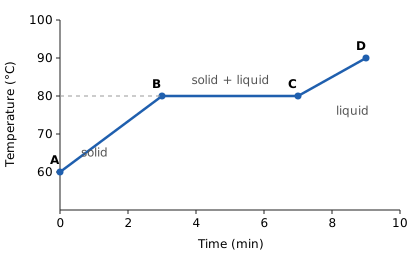
- A to B: solid; particles absorb heat and vibrate faster, so temperature rises.
- B to C: melting; temperature is constant because the heat absorbed is used to overcome the attraction forces between particles, not to raise temperature.
- C to D: liquid; particles absorb heat and move faster.
On cooling, the curve is flat at the freezing point because heat lost to the surroundings is balanced by the heat released when particles attract each other to form a solid. Naphthalene is heated in a water bath (not directly) because it is flammable and the water bath heats it slowly and evenly; it is stirred continuously during cooling so that it cools evenly; if it is not stirred, some of it may solidify before the rest and the thermometer reading will not be accurate. The boiling tube is placed in a conical flask so that it loses heat slowly.
Show answerHide answer
2.2The development of the atomic model
| Subatomic particle | Symbol | Relative charge | Relative mass |
|---|---|---|---|
| Proton | p | +1 | 1 |
| Neutron | n | 0 | 1 |
| Electron | e | −1 | 1/1840 |
| Scientist | Contribution |
|---|---|
| John Dalton | Matter is made of atoms: the smallest spherical body that cannot be created, destroyed or divided |
| J.J. Thomson | Discovered electrons; the atom is a positively charged sphere with electrons in it |
| Ernest Rutherford | Nucleus is the centre of the atom and holds almost all the mass; discovered protons |
| Niels Bohr | Electrons move in shells around the nucleus |
| James Chadwick | Discovered neutrons in the nucleus |
Textbook Figure 2.9, pp. 30-31. Memory order: Dalton, Thomson, Rutherford, Bohr, Chadwick.
2.3Atomic structure
Nucleon number = number of protons + number of neutrons.
A neutral atom has equal numbers of protons and electrons. So neutrons = nucleon number − proton number. An atom is written as AZX with A the nucleon number and Z the proton number; for example 126C has 6 protons, 6 electrons and 6 neutrons.
Electrons = protons = 19. Neutrons = 39 − 19 = 20.
Ions
A chlorine atom (17 p, 18 n, 17 e) gains 1 electron to form Cl− (17 p, 18 n, 18 e). Protons and neutrons never change when an ion forms. Gaining electrons gives an anion; losing electrons gives a cation.
Electron arrangement
Electrons fill the shell nearest the nucleus first. For proton numbers 1 to 20 the maximum is 2, 8, 8. Aluminium (13 electrons) is 2.8.3. Electrons in the outermost (valence) shell are valence electrons; they decide the chemical properties of an element, so elements with the same number of valence electrons behave alike.
| Element | Proton number | Electron arrangement | Valence electrons |
|---|---|---|---|
| Oxygen | 8 | 2.6 | 6 |
| Sodium | 11 | 2.8.1 | 1 |
| Chlorine | 17 | 2.8.7 | 7 |
| Calcium | 20 | 2.8.8.2 | 2 |
Show answerHide answer
2.4Isotopes and their uses
Isotopes have the same chemical properties (same electron arrangement) but different masses. Hydrogen has three isotopes, 11H, 21H and 31H. Chlorine-35 can also be written Cl-35 or 35Cl. Natural abundance is the percentage of each isotope in a natural sample of the element.
RAM = (75 × 35 + 25 × 37) ÷ 100 = 35.5
Uses of isotopes
| Field | Isotope | Use |
|---|---|---|
| Medicine | Cobalt-60 | Radiotherapy to kill cancer cells; sterilising surgical tools |
| Medicine | Iodine-131 | Treating thyroid disorders such as hyperthyroidism and thyroid cancer |
| Agriculture | Phosphorus-32 | Studying plant metabolism |
| Nuclear energy | Uranium-235 | Generating electricity |
| Archaeology | Carbon-14 | Estimating the age of fossils and artefacts |
| Archaeology | Lead-210 | Determining the age of sand and earth layers up to 80 years |
| Industry | Hydrogen-3 | Tracing sewage and liquid waste |
| Engineering | Sodium-24 | Detecting leaks in underground pipes |
Isotopes bring benefits (treating disease, dating fossils, detecting leaks), but radioactive waste and radiation can harm living things and the environment, so they must be handled and disposed of with care.