The Mole Concept, Chemical Formula and Equation
What this chapter covers
- Explain relative atomic mass, relative molecular mass and relative formula mass on the carbon-12 scale, and calculate them (3.1)
- Define the mole and the Avogadro constant, and interrelate moles, particles, mass and volume of gas using molar mass and molar volume (3.2)
- State the meaning of chemical, empirical and molecular formula and determine them from experimental data (3.3)
- Construct formulae and name ionic and simple molecular compounds (3.3)
- Write and balance chemical equations, interpret them and solve stoichiometry problems (3.4)
3.1Relative atomic mass and relative molecular mass
Atoms are far too small to count or weigh one by one, so chemists compare the mass of one atom with a standard atom. Since 1961 the standard is the carbon-12 atom, which is given a mass of exactly 12 units.
RAM = 4 for helium means one helium atom is 4 times as heavy as 1⁄12 of a carbon-12 atom. Relative masses are comparisons, so they have no unit.
Calculating relative masses
- RMM (molecular substances) = sum of the RAMs of all atoms in the molecular formula.
- RFM, relative formula mass (ionic substances) = sum of the RAMs of all atoms in the formula.
RFM = 2(27) + 3[32 + 4(16)] = 54 + 3(96) = 342
Show answerHide answer
3.2The mole concept
| Type of substance | Particles in 1 mol | Example |
|---|---|---|
| Atomic (metals, noble gases) | atoms | 1 mol Cu = 6.02 × 10²³ atoms |
| Molecular | molecules | 1 mol H2O = 6.02 × 10²³ molecules |
| Ionic | formula units | 1 mol NaCl = 6.02 × 10²³ units |
Three conversion factors
| Link | Conversion factor | Formula |
|---|---|---|
| Moles and particles | Avogadro constant, NA | n = number of particles ÷ NA |
| Moles and mass | Molar mass (g mol−1) | n = mass ÷ molar mass |
| Moles and gas volume | Molar volume | n = volume ÷ molar volume |
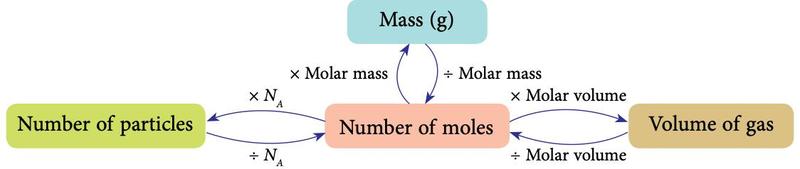
Mole relationship chart: Chemistry Form 4 (DLP) textbook, Figure 3.9, p. 56.
Molar mass = 12 + 2(16) = 44 g mol−1
n = 26.4 ÷ 44 = 0.6 mol
Volume = 0.6 × 24 = 14.4 dm3
672 cm3 = 0.672 dm3; n = 0.672 ÷ 22.4 = 0.03 mol
Molecules = 0.03 × 6.02 × 1023 = 1.806 × 10²²
Show answerHide answer
3.3Chemical formula
A chemical formula uses symbols and subscript numbers to show the atoms in a substance. Two types are used for compounds.
| Formula | Shows | Glucose |
|---|---|---|
| Molecular formula | the actual number of atoms of each element in one molecule | C6H12O6 |
| Empirical formula | the simplest whole-number ratio of atoms | CH2O |
Molecular formula = (empirical formula)n, where n is a whole number, so n = RMM ÷ mass of the empirical formula.
Finding an empirical formula
- Write the mass (or % by mass) of each element.
- Divide by its RAM to get moles of atoms.
- Divide all by the smallest number.
- If needed, multiply by 2 or 3 to get whole numbers.
Moles: Al 1.35 ÷ 27 = 0.05; O 1.2 ÷ 16 = 0.075
Ratio: 1 : 1.5 → ×2 → 2 : 3. Empirical formula = Al2O3
| Oxide | Method | Why |
|---|---|---|
| Magnesium oxide | Heat magnesium ribbon in a crucible with a lid; weigh until the mass is constant | Mg is reactive and burns in air |
| Copper(II) oxide | Heat the oxide in a stream of hydrogen; mass lost = mass of oxygen | Cu is not reactive enough to burn easily; hydrogen removes the oxygen |
Formulae of ionic compounds
Use the cross-change method: swap the charge numbers to give the number of ions, then check that the total charge is zero.
Naming compounds
- Ionic: cation first, then anion (sodium chloride). Use Roman numerals for metals with more than one ion: Fe2+ iron(II), Fe3+ iron(III).
- Simple molecular: the first element keeps its name, the second ends in ‘-ide’, and Greek prefixes give the numbers: mono (1), di (2), tri (3), tetra (4), penta (5), hexa (6). CO is carbon monoxide; SO3 is sulphur trioxide.
Show answerHide answer
3.4Chemical equation
Reactants are on the left, products on the right, and the arrow means ‘produces’. State symbols: (s) solid, (l) liquid, (g) gas, (aq) aqueous solution. A Δ over the arrow means heating.
Writing and balancing
- Write the word equation.
- Replace names with correct formulae.
- Balance by changing the coefficients (numbers in front), never the subscripts.
- Add state symbols.
H2 + O2 → H2O (not balanced: 2 O on the left, 1 on the right)
2H2(g) + O2(g) → 2H2O(l)
Balancing is needed because of the law of conservation of mass: atoms are neither created nor destroyed.
Stoichiometry
The coefficients give the mole ratio. 2Na + Cl2 → 2NaCl means 2 mol Na react with 1 mol Cl2 to give 2 mol NaCl.
n(Al) = 5.4 ÷ 27 = 0.2 mol
Ratio 4 : 2, so n(Al2O3) = 0.1 mol
Mass = 0.1 × 102 = 10.2 g
| Step | What to do |
|---|---|
| 1 | Balanced equation |
| 2 | Convert the given quantity to moles |
| 3 | Use the mole ratio to get moles of the wanted substance |
| 4 | Convert moles to the quantity asked (mass, volume or particles) |