The Periodic Table of Elements
What this chapter covers
- Describe the historical development of the Periodic Table and the basic principle of arrangement of elements (4.1)
- Relate proton number and electron arrangement to the group and period of an element (4.2)
- Explain the inert nature of Group 18, the trend in its physical properties and its uses (4.3)
- Describe the physical and chemical properties of Group 1 and explain why reactivity increases down the group (4.4)
- Describe the physical and chemical properties of Group 17 and explain why reactivity decreases down the group (4.5)
- Describe the trends in physical properties and the nature of the oxides across Period 3, and the uses of metalloids (4.6)
- State the position, special characteristics and uses of transition elements (4.7)
4.1Development of the Periodic Table
| Scientist | Contribution | Weakness or importance |
|---|---|---|
| Antoine Lavoisier | Grouped elements as gases, non-metals, metals and metal oxides | Inaccurate: included light, heat and some compounds as elements |
| Johann Dobereiner | Triads: three elements with similar properties, where the atomic mass of the middle one is about the average of the other two (Ca, Sr, Ba; Cl, Br, I) | Worked for a few elements only, but linked properties to atomic mass |
| John Newlands | Law of Octaves: arranged by increasing atomic mass; properties repeat at every eighth element | Held only for the first 17 elements, but showed a periodic pattern |
| Lothar Meyer | Graph of atomic volume against atomic mass; similar elements sit at equivalent positions on the curve (alkali metals at the peaks) | Confirmed the repeating pattern of properties |
| Dmitri Mendeleev | Increasing atomic mass, similar elements in the same column; left gaps for undiscovered elements and predicted their properties | Predictions made the table convincing |
| Henry Moseley | Used X-ray spectra to find that each element has its own proton number; arranged by increasing proton number | Basis of the modern table; predicted Tc, Pm, Hf and Re |
Show answerHide answer
4.2Arrangement of elements in the table
Groups are the 18 vertical columns. Periods are the 7 horizontal rows. The valence electrons decide the group; the number of shells filled with electrons decides the period.
Groups 13 to 18: group = number of valence electrons + 10.
Period = number of shells filled with electrons.
| Element | Proton number | Electron arrangement | Valence electrons | Group | Period |
|---|---|---|---|---|---|
| Lithium, Li | 3 | 2.1 | 1 | 1 | 2 |
| Calcium, Ca | 20 | 2.8.8.2 | 2 | 2 | 4 |
| Aluminium, Al | 13 | 2.8.3 | 3 | 13 | 3 |
| Oxygen, O | 8 | 2.6 | 6 | 16 | 2 |
| Bromine, Br | 35 | 2.8.18.7 | 7 | 17 | 4 |
| Krypton, Kr | 36 | 2.8.18.8 | 8 | 18 | 4 |
Show answerHide answer
4.3Group 18: the noble gases
Helium, neon, argon, krypton, xenon, radon and oganesson are noble (inert) gases. Their valence shells are full (a stable duplet for helium, an octet for the others), so their atoms do not donate, accept or share electrons. They exist as monoatomic gases.
Trend down the group
| Element | Atomic radius (nm) | Melting point (°C) | Boiling point (°C) | Density (g cm⁻³) |
|---|---|---|---|---|
| Helium | 0.050 | -270 | -269 | 0.00017 |
| Neon | 0.070 | -248 | -246 | 0.00080 |
| Argon | 0.094 | -189 | -186 | 0.00170 |
| Krypton | 0.109 | -156 | -152 | 0.00350 |
| Xenon | 0.130 | -122 | -108 | 0.00550 |
Atomic radius, melting point, boiling point and density all increase down the group. A larger atom means stronger attractive forces between atoms, so more heat energy is needed to overcome them.
| Element | Use |
|---|---|
| Helium | Weather balloons; divers' oxygen tanks |
| Neon | Advertising board lights |
| Argon | Fills electric bulbs; inert atmosphere for high-temperature welding |
| Krypton | Camera flashes; lasers for eye retina treatment; lighthouse lamps |
| Xenon | Anaesthesia |
| Radon | Treating cancer |
Show answerHide answer
4.4Group 1: the alkali metals
Lithium, sodium, potassium, rubidium, caesium and francium. Each atom has one valence electron and donates it to form a +1 ion: M → M⁺ + e⁻.
Physical properties
- Soft, shiny grey metals with low density; Li, Na and K float on water.
- Low melting and boiling points compared with other metals (iron melts at 1 540 °C).
- Down the group: atomic radius increases; melting and boiling points decrease (melting point: Li 186 °C, Na 98 °C, K 64 °C) because weaker attraction between larger atoms needs less heat energy.
Chemical properties (same properties, different reactivity)
| Reacts with | Product | Equation (lithium) |
|---|---|---|
| Water | Alkaline hydroxide solution and hydrogen gas | 2Li + 2H₂O → 2LiOH + H₂ |
| Oxygen | White solid metal oxide (dissolves to give an alkaline solution) | 4Li + O₂ → 2Li₂O |
| Chlorine | White solid metal chloride | 2Na + Cl₂ → 2NaCl (sodium) |
Litmus: the solution from water or from the oxide turns red litmus paper blue.
Rubidium and caesium are very reactive with water and oxygen. Francium is radioactive and unstable.
Show answerHide answer
4.5Group 17: the halogens
Fluorine, chlorine, bromine, iodine, astatine and tennessine exist as diatomic molecules. Each atom has seven valence electrons and receives one electron to form a -1 ion: X + e⁻ → X⁻.
| Element | State | Colour | Melting point (°C) | Boiling point (°C) | Density (g cm⁻³) |
|---|---|---|---|---|---|
| Chlorine | Gas | Greenish yellow | -101 | -34 | 0.003 |
| Bromine | Liquid | Reddish brown | -7 | 59 | 3.119 |
| Iodine | Solid | Purplish black | 114 | 184 | 4.950 |
Down the group the molecules get larger, intermolecular forces get stronger, so melting point, boiling point and density increase and the colour gets darker.
| Reacts with | Product | Example |
|---|---|---|
| Water | Acidic solution | Cl₂ + H₂O → HCl + HOCl |
| Metal | Metal halide | 2Fe + 3Br₂ → 2FeBr₃ |
| Alkali | Metal halide + metal halate + water | I₂ + 2NaOH → NaI + NaOI + H₂O |
Fluorine is a pale yellow, very reactive, corrosive and poisonous gas that explodes with hydrogen. Astatine is rare, radioactive and unstable. Uses: chlorine in bleach, bromine in fire extinguishers, iodine as a disinfectant.
Show answerHide answer
4.6Period 3
Na, Mg, Al, Si, P, S, Cl and Ar all have three shells filled with electrons, so they are in the same period.
| Element | Na | Mg | Al | Si | P | S | Cl | Ar |
|---|---|---|---|---|---|---|---|---|
| Atomic radius (nm) | 0.186 | 0.160 | 0.143 | 0.118 | 0.110 | 0.104 | 0.100 | 0.094 |
| Electronegativity | 0.9 | 1.2 | 1.5 | 1.8 | 2.1 | 2.5 | 3.0 | - |
- Across the period, atomic size decreases: more protons give a higher nuclear charge, which pulls the electrons in more strongly.
- Electronegativity increases for the same reason.
- Na, Mg, Al are metals; Si is a metalloid; P, S, Cl, Ar are non-metals. Physical state changes from solid to gas.
Oxides across Period 3

Figure: Chemistry Form 4 KSSM (DLP) textbook, Figure 4.14, p. 99.
| Type of oxide | From | Behaviour |
|---|---|---|
| Basic | Metals (Na, Mg) | Dissolves to give an alkaline solution; reacts with acid to give salt and water |
| Amphoteric | Aluminium | Reacts with both acids and alkalis to give salt and water |
| Acidic | Non-metals (Si, P, S, Cl) | Dissolves to give an acidic solution; reacts with alkali to give salt and water |
Metalloids (semi-metals) have properties of both metals and non-metals. They are poor conductors at room temperature but good at high temperature, so silicon is used as a semiconductor in microchips for computers and phones.
Show answerHide answer
4.7Transition elements
Transition elements are the block between Group 2 and Group 13 (columns 3 to 12), for example Cr, Mn, Fe, Co, Ni and Cu. Scandium and zinc are not counted as transition elements because they lack the special characteristics.
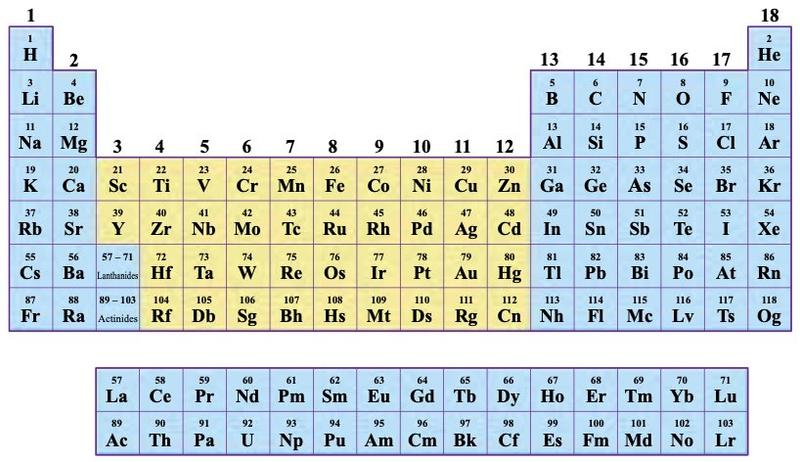
Figure: Chemistry Form 4 KSSM (DLP) textbook, Figure 4.16, p. 101.
All are metals: shiny solids, very hard, high density, high melting and boiling points, malleable and ductile.
| Special characteristic | Example |
|---|---|
| Act as catalysts | Fe in the Haber process |
| Form coloured ions and compounds | Cu²⁺ blue, Fe²⁺ green, Fe³⁺ brown, Mn²⁺ pink, MnO₄⁻ purple, Cr₂O₇²⁻ orange, Cr³⁺ green |
| More than one oxidation number | Fe: +2 and +3; Cu: +1 and +2; Mn: +2, +4, +7 |
| Form complex ions | [Cu(NH₃)₄]²⁺, [Fe(CN)₆]³⁻ |
| Catalyst | Industrial process |
|---|---|
| Iron, Fe | Haber process (ammonia) |
| Vanadium(V) oxide, V₂O₅ | Contact process (sulphuric acid) |
| Platinum, Pt | Ostwald process (nitric acid) |
| Nickel, Ni (or Pt) | Hydrogenation of vegetable oils to margarine |