Mathematics notes, chapter 1
Quadratic Functions and Equations in One Variable
Textbook Mathematics Form 4 KSSM (DLP), pages 2–31
What this chapter covers
- Recognise a quadratic expression in one variable, state the values of a, b and c, and describe a quadratic function as a many-to-one relation (1.1.1, 1.1.2)
- Describe the shape, the maximum or minimum point and the axis of symmetry of the graph of a quadratic function, and explain the effects of changing a, b and c (1.1.2, 1.1.3)
- Form quadratic equations from situations and explain the meaning of roots, including roots read from a graph (1.1.4, 1.1.5)
- Determine the roots of a quadratic equation by factorisation and by the graphical method (1.1.6)
- Sketch graphs of quadratic functions and solve problems involving quadratic equations (1.1.7, 1.1.8)
1.1Quadratic functions and equations
Quadratic expressions
A quadratic expression in one variable is an expression whose highest power of the variable is 2. Its general form is ax² + bx + c, where a, b and c are constants and a ≠ 0.
- a is the coefficient of x², b is the coefficient of x and c is the constant term.
- b or c may be zero, but a may not. If a = 0 the x² term disappears and the expression is no longer quadratic.
- Any letter can be the variable, for example 3y² + y − 4.
| Expression | Quadratic in one variable? | Reason |
|---|---|---|
| 2x² + 5 | Yes | a = 2, b = 0, c = 5 |
| x³ − 6 | No | The highest power is 3 |
| 3x² + 2y + 1 | No | Two variables, x and y |
| 2x² − 3/x² | No | 3/x² = 3x−2, a negative power, so not a quadratic |
| 2r(r − 3) | Yes | Expand: 2r² − 6r, so a = 2, b = −6, c = 0 |
Read a, b and c with their signs. In 1 − x − 2x², the values are a = −2, b = −1, c = 1, not a = 1. Write the expression in the order ax² + bx + c first.
State a, b and c in 5 − 3x² + 2x.
Show answerHide answer
Rearrange: −3x² + 2x + 5. a = −3, b = 2, c = 5.
Quadratic functions are many-to-one
A quadratic function is written f(x) = ax² + bx + c, a ≠ 0. We also write y = f(x). Its graph is a curve called a parabola.
Draw a line parallel to the x-axis across the graph. It meets the curve at two points with the same y-coordinate (the same image) but different x-coordinates (two objects). For example, if f(x) = x² − 3x, then f(4) = 4 and f(−1) = 4.
Type of relation of a quadratic function: many-to-one. Two different objects have the same image.
Shape, maximum or minimum point and axis of symmetry
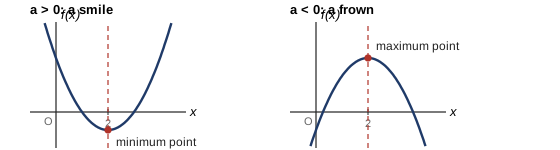
| Value of a | Shape | Turning point |
|---|---|---|
| a > 0 | Opens upward (smile) | Minimum point (lowest y) |
| a < 0 | Opens downward (frown) | Maximum point (highest y) |
- The axis of symmetry is a vertical line x = h that divides the graph into two identical halves. It always passes through the maximum or minimum point.
- The axis has equation x = −b/(2a). If two points on the graph have the same y-coordinate, the axis is halfway between their x-coordinates.
Example: axis of symmetry from two points
Points (−1, 4) and (7, 4) lie on a parabola. They are at the same height, so the axis is halfway: x = (−1 + 7) ÷ 2 = 3. The maximum or minimum point has x-coordinate 3.The axis of symmetry is x = h, not y = h. It is parallel to the y-axis.
State the shape and the type of turning point for f(x) = 4 − 2x² + x.
Show answerHide answer
a = −2 < 0, so the shape is a frown (opens downward) and the turning point is a maximum point.
Effects of changing a, b and c
| Constant | What it controls | Rule |
|---|---|---|
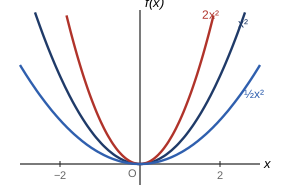
| a | Shape and width | The sign gives the shape. The smaller the value of a (positive values compared), the wider the curve. |
| b | Position of the axis of symmetry | If a > 0: b > 0 axis on the left of the y-axis, b < 0 on the right, b = 0 it is the y-axis. If a < 0 the sides are swapped. |
| c | The y-intercept | The graph crosses the y-axis at (0, c). |
Example 2 (textbook p. 13): finding c
The function f(x) = x² − 3x + c passes through A(−1, 3). Substitute x = −1 and f(x) = 3:3 = (−1)² − 3(−1) + c, so 3 = 1 + 3 + c and c = −1.
If it passes through (0, 4), then c = 4 directly, because (0, c) is the y-intercept.
When the graph is wider the value of a is closer to 0. Compare |a|, not the sign: −½x² is wider than −3x² even though −½ is the larger number.
The graph of f(x) = x² + 6x + c passes through (0, −2). State c, and say whether the axis of symmetry is to the left or right of the y-axis.
Show answerHide answer
c = −2 (the y-intercept). a = 1 > 0 and b = 6 > 0, so the axis is on the left of the y-axis (x = −3).
Forming a quadratic equation
A quadratic equation has the general form ax² + bx + c = 0, a ≠ 0. A quadratic function becomes a quadratic equation when f(x) is set equal to a value and everything is moved to one side.
Example (textbook p. 15 style): area of two cards
Two rectangular cards have sides x by x, and x by (2x + 1), in cm.Total area A = x² + x(2x + 1) = 3x² + x.
If the total area is 114 cm²: 3x² + x = 114, so 3x² + x − 114 = 0.
Steps: 1 write an expression from the diagram or words, 2 set it equal to the given value, 3 expand and move everything to one side so the right side is 0.
Roots of a quadratic equation
The roots of ax² + bx + c = 0 are the values of x that satisfy the equation, that is, make the left side equal to the right side. A quadratic equation has at most two roots.
On the graph: the roots are the x-coordinates of the points where the graph of f(x) = ax² + bx + c meets the x-axis (f(x) = 0). These are the x-intercepts.
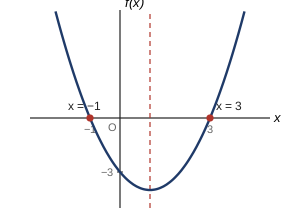
Example 6 (textbook p. 19): is it a root?
Is x = 3 a root of 2x² − 7x + 3 = 0? Substitute: 2(3)² − 7(3) + 3 = 18 − 21 + 3 = 0. Left side = right side, so x = 3 is a root.Is x = 1 a root? 2(1)² − 7(1) + 3 = −2 ≠ 0, so x = 1 is not a root.
Is x = −2 a root of x² + x − 2 = 0?
Show answerHide answer
(−2)² + (−2) − 2 = 4 − 2 − 2 = 0, so yes.
Solving by factorisation
- Write the equation in the form ax² + bx + c = 0.
- Factorise the left side into two brackets.
- Set each bracket equal to 0 and solve.
Example (textbook p. 21): fractions and brackets
(a) x² − 5x + 6 = 0: (x − 3)(x − 2) = 0, so x = 3 or x = 2.(b) x² + 72x = 2: multiply by 2: 2x² + 7x − 4 = 0. (2x − 1)(x + 4) = 0, so x = 12 or x = −4.
(c) (y + 2)(y + 1) = 2(y + 11): y² + 3y + 2 = 2y + 22, so y² + y − 20 = 0. (y + 5)(y − 4) = 0, so y = −5 or y = 4.
Do not write (x − 1)(x + 4) = 6 and then x − 1 = 6 or x + 4 = 6. The right side must be 0 first. Also never divide both sides by x: you lose the root x = 0 (solve x² − 5x = 0 as x(x − 5) = 0).
Special cases: x² − 4 = 0 factorises as (x − 2)(x + 2) = 0. If c = 0, take x out as a common factor. Check each root by substituting it back.
Solve 2x² + 3x − 9 = 0 and x² − 8x + 16 = 0.
Show answerHide answer
2x² + 3x − 9 = (2x − 3)(x + 3) = 0, so x = 32 or x = −3.
(x − 4)² = 0, so x = 4 (one repeated root).
(x − 4)² = 0, so x = 4 (one repeated root).
Sketching the graph of a quadratic function
Show three things: the correct shape (sign of a), the y-intercept (c) and the x-intercepts (solve f(x) = 0) or one other point on the curve.
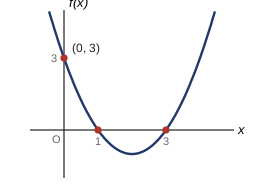
| Case | What to do | Example |
|---|---|---|
| Meets the x-axis | Factorise f(x) = 0 for the x-intercepts | f(x) = −x² + 2x + 15: shape frown, y-intercept 15, roots −3 and 5 |
| One touching point | Repeated root: the curve touches the x-axis | f(x) = x² − 6x + 9 = (x − 3)²: touches at x = 3 |
| Does not meet the x-axis | Find the turning point and one other point on the curve | f(x) = x² + 1: minimum point (0, 1); f(2) = 5 |
If the y-intercept is positive and a > 0 with b = 0, the graph does not reach the x-axis: x² + 1 = 0 has no roots.
Sketch information for f(x) = −2x² + 18: state the shape, y-intercept and x-intercepts.
Show answerHide answer
a = −2 < 0: frown. y-intercept = 18. −2x² + 18 = 0 gives x² = 9, so x-intercepts at −3 and 3. The axis is the y-axis because b = 0.
Problem solving with quadratic equations
Use the four steps: understand the problem, plan (write an expression, form the equation), implement (solve), then check and conclude.
Example 10 (textbook p. 26): the box frame
A box has a square base of side x cm and height (x + 30) cm. Its total surface area is 4 800 cm². The frame is made from rods that cost RM5 per metre.Surface area = 2x² + 4x(x + 30) = 6x² + 120x. So 6x² + 120x = 4 800, giving x² + 20x − 800 = 0 and (x + 40)(x − 20) = 0.
x = −40 or x = 20. A length cannot be negative, so x = 20 cm, and the box is 20 cm × 20 cm × 50 cm.
Total length of the edges = 8(20) + 4(50) = 360 cm = 3.6 m.
Always check whether each root makes sense. A negative length, age or number of items must be rejected, and say so in the working.
Units: edges in cm but the price is per metre, so convert 360 cm to 3.6 m before multiplying by RM5.
A rectangle is (x + 3) cm long and x cm wide. Its area is 40 cm². Form the equation and find x.
Show answerHide answer
x(x + 3) = 40, so x² + 3x − 40 = 0. (x + 8)(x − 5) = 0, x = −8 or 5. Reject −8, so x = 5 cm.