Mathematics questions, chapter 1
Nama / NameKelas / ClassTarikh / Date
Quadratic Functions and Equations in One Variable
45 marks. Use Practice to check each answer as you go, or Exam to answer everything first. Show your working for Section B.
Section A: objective questions
12 marksChoose the correct answer. Each question carries 1 mark.
1
Question 1
Which of the following is a quadratic expression in one variable?
Show answerHide answer
C
The highest power must be 2 and there must be one variable. x³ − 6 has power 3, 3x² + 2y has two variables and 4x − 1 has power 1.
2
Question 2
The quadratic expression 2r(r − 3) is written as ax² + bx + c form in r. What is the value of b?
Show answerHide answer
A
Expand: 2r(r − 3) = 2r² − 6r, so a = 2, b = −6 and c = 0. b = −3 forgets to multiply by 2.
3
Question 3
What type of relation is shown by a quadratic function?
Show answerHide answer
B
Two different values of x give the same value of f(x), for example f(x) = x² gives 4 for both x = 2 and x = −2. This is a many-to-one relation.
4
Question 4
Which function has a graph with a maximum point?
Show answerHide answer
D
A maximum point needs a < 0. In 5 − 2x² the coefficient of x² is −2. The other three have a > 0 and have minimum points.
5
Question 5
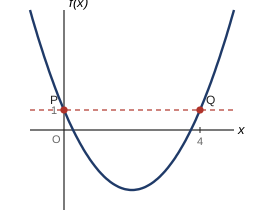
Diagram 1 shows part of the graph of a quadratic function. P and Q are two points at the same height. What is the equation of the axis of symmetry?
Show answerHide answer
B
P is at x = 0 and Q at x = 4, so the axis is halfway: x = (0 + 4) ÷ 2 = 2. y = 1 is the line PQ, not the axis. The axis is vertical, so its equation has the form x = h.
6
Question 6
The graph of f(x) = x² − 3x + c passes through (−1, 3). What is the value of c?
Show answerHide answer
D
Substitute x = −1 and f(x) = 3: 3 = (−1)² − 3(−1) + c = 1 + 3 + c = 4 + c, so c = −1. c = 1 comes from forgetting that −3(−1) = +3.
7
Question 7
Which graph is the widest?
Show answerHide answer
A
For positive a, the smaller the value of a the wider the curve. ½ is the smallest, so ½x² is the widest and 3x² is the narrowest.
8
Question 8
The graph of f(x) = x² − 6x + 5 has axis of symmetry x = 3. Compared with the y-axis, where does the axis lie, and why?
Show answerHide answer
C
Here a = 1 and b = −6. When a > 0 and b < 0 the axis is on the right of the y-axis. x = 3 is positive, which agrees.
9
Question 9
The length of a rectangle is (x + 5) cm and its width is x cm. The area is 84 cm². Which quadratic equation is formed?
Show answerHide answer
D
Area = x(x + 5) = x² + 5x. Set equal to 84: x² + 5x = 84, so x² + 5x − 84 = 0. Move 84 to the left with a sign change. 2x + 10 is the perimeter.
10
Question 10
Which value is a root of 2x² − 7x + 3 = 0?
Show answerHide answer
B
For x = 3: 18 − 21 + 3 = 0. For x = 1: 2 − 7 + 3 = −2. For x = −3: 18 + 21 + 3 = 42. For x = 2: 8 − 14 + 3 = −3. Only x = 3 gives 0.
11
Question 11
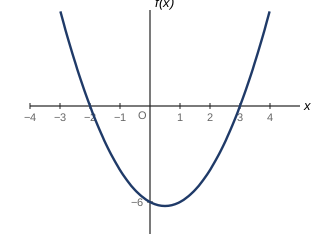
Diagram 2 shows the graph of f(x) = x² − x − 6. What are the roots of the equation x² − x − 6 = 0?
Show answerHide answer
C
The roots are the x-coordinates where the graph meets the x-axis (f(x) = 0): x = −2 and x = 3. −6 is the y-intercept, not a root. 2 and −3 have the signs reversed.
12
Question 12
Solve 2x² + 7x − 4 = 0.
Show answerHide answer
A
2x² + 7x − 4 = (2x − 1)(x + 4) = 0. So 2x − 1 = 0 gives x = ½ and x + 4 = 0 gives x = −4. Check: 2(¼) + 3.5 − 4 = 0.
Section B: structured questions
33 marksAnswer all questions. Show your working.
13
Question 13
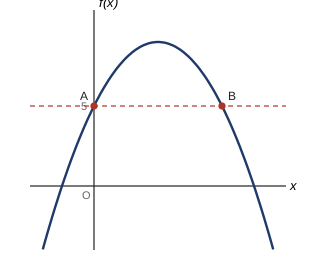
Diagram 3 shows the graph of the quadratic function f(x) = −x² + 4x + 5. The line y = 5 meets the curve at A and B.
[2 marks]
(a)Write the coordinates of A and B.
Show answerHide answer
A is on the y-axis, so x = 0 and f(0) = c = 5. Solving −x² + 4x + 5 = 5 gives x = 0 or x = 4.
Tick each point you got.
[1 mark]
(b)State the equation of the axis of symmetry.
Show answerHide answer
Halfway between 0 and 4. Or x = −4 ÷ (2 × −1) = 2.
Tick each point you got.
[2 marks]
(c)Find the coordinates of the maximum point.
Show answerHide answer
Tick each point you got.
[2 marks]
(d)State the roots of −x² + 4x + 5 = 0.
Show answerHide answer
These are the x-intercepts of the graph.
Tick each point you got.
14
Question 14
Solve each quadratic equation by factorisation.
[2 marks]
(a)x² − 3x − 10 = 0
Show answerHide answer
Tick each point you got.
[2 marks]
(b)3x² − 5x + 2 = 0
Show answerHide answer
Tick each point you got.
[3 marks]
(c)2h + 6/h = 7, where h ≠ 0
Show answerHide answer
Remove the fraction first, then write the equation with 0 on the right.
Tick each point you got.
15
Question 15
The quadratic function f(x) = kx² + 8x + h has a maximum point at (2, 11), where k and h are constants.
[2 marks]
(a)The axis of symmetry is x = 2. Using x = −b ÷ 2a, find the value of k.
Show answerHide answer
a = k is negative, which agrees with a maximum point.
Tick each point you got.
[2 marks]
(b)Find the value of h.
Show answerHide answer
Tick each point you got.
[1 mark]
(c)State the y-intercept of the graph.
Show answerHide answer
The y-intercept equals c, which is h = 3.
Tick each point you got.
16
Question 16
A box has a square base of side x cm and a height of (x + 10) cm. The total surface area of the box is 1 000 cm². The box needs a frame made from rods that cost RM5 per metre. The budget is RM6.
[2 marks]
(a)Show that the total surface area is 6x² + 40x cm².
Show answerHide answer
Tick each point you got.
[3 marks]
(b)Form a quadratic equation and solve it to find x.
Show answerHide answer
Tick each point you got.
[3 marks]
(c)The frame uses the 12 edges of the box. Does the budget cover the cost of the rods? Show your calculation.
Show answerHide answer
Height = 10 + 10 = 20 cm. Convert to metres before using RM5 per metre.
Tick each point you got.
17
Question 17
Sketch information for the graph of f(x) = x² − 2x − 8.
[1 mark]
(a)State the shape of the graph and give a reason.
Show answerHide answer
Tick each point you got.
[1 mark]
(b)State the y-intercept.
Show answerHide answer
Tick each point you got.
[2 marks]
(c)Find the x-intercepts.
Show answerHide answer
Tick each point you got.
[2 marks]
(d)Find the equation of the axis of symmetry and the coordinates of the minimum point.
Show answerHide answer
Tick each point you got.