Number Bases
What this chapter covers
- Represent and explain numbers in various bases in terms of numerals, place values, digit values and number values (2.1.1)
- Convert numbers from one base to another using division by place value, division by the base, and direct conversion between base two and base eight (2.1.2)
- Perform addition and subtraction of numbers in various bases using vertical form or conversion to base ten (2.1.3)
- Solve problems involving number bases (2.1.4)
2.1Number bases
Digits, bases and place values
| Base | Digits that can be used |
|---|---|
| 2 | 0, 1 |
| 5 | 0, 1, 2, 3, 4 |
| 8 | 0, 1, 2, 3, 4, 5, 6, 7 |
| 10 | 0, 1, 2, 3, 4, 5, 6, 7, 8, 9 |
We write the base as a small number at the bottom right: 325 means "the number 32 in base five". Read it "three two, base five". The base sign for base ten may be left out.
In base a, the place values from the right are a0, a1, a2, a3, … Each place is worth a times the place on its right.
| Base | a4 | a3 | a2 | a1 | a0 |
|---|---|---|---|---|---|
| 2 | 16 | 8 | 4 | 2 | 1 |
| 5 | 625 | 125 | 25 | 5 | 1 |
| 8 | 4 096 | 512 | 64 | 8 | 1 |
| 10 | 10 000 | 1 000 | 100 | 10 | 1 |
Digit value and number value
So 3417 = 17610.
Show answerHide answer
Converting a number in base ten to another base
Divide by the new base again and again until the quotient is 0. Write the remainders from the bottom upwards.
| Division | Quotient | Remainder |
|---|---|---|
| 563 ÷ 5 | 112 | 3 |
| 112 ÷ 5 | 22 | 2 |
| 22 ÷ 5 | 4 | 2 |
| 4 ÷ 5 | 0 | 4 |
The other method divides by the place values: 563 ÷ 125 = 4 remainder 63, 63 ÷ 25 = 2 remainder 13, 13 ÷ 5 = 2 remainder 3, 3 ÷ 1 = 3. The digits 4, 2, 2, 3 are the same.
Converting between two bases that are not ten
Change to base ten first, then to the base wanted.
Step 2: 105 ÷ 9 = 11 remainder 6; 11 ÷ 9 = 1 remainder 2; 1 ÷ 9 = 0 remainder 1
So 2536 = 10510 = 1269.
Base two and base eight directly
One digit in base eight stands for exactly three digits in base two (because 23 = 8).
| Base 8 | 0 | 1 | 2 | 3 | 4 | 5 | 6 | 7 |
|---|---|---|---|---|---|---|---|---|
| Base 2 | 000 | 001 | 010 | 011 | 100 | 101 | 110 | 111 |
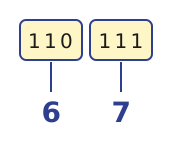
- Base 2 to base 8: group the digits in threes from the right; add zeros on the left to complete the last group; change each group to one digit. 11011012 → 1 | 101 | 101 → 1558.
- Base 8 to base 2: change each digit to three binary digits. 5178 → 101 | 001 | 111 → 1010011112.
Show answerHide answer
6 = 110 and 4 = 100, so 648 = 1101002.
2.2Addition and subtraction in various bases
Two methods: (a) work in vertical form in the given base; (b) change both numbers to base ten, calculate, then change the answer back.
Answer: 11012.
Check by base ten: 6 + 7 = 13 = 11012.
Answer: 2738. Check: 250 − 63 = 187 = 2738.
Show answerHide answer
Answer: 63137. Check in base ten: 1 539 + 676 = 2 215 = 63137.
2.3Problems involving number bases
Follow the textbook steps: understand the problem, plan the strategy, carry it out, then conclude (and check). Work in base ten for percentages and money, and change only the final answer to the base required.
Summary
| Task | Method |
|---|---|
| Digit value | digit × place value |
| Base a to base ten | add the digit values |
| Base ten to base a | divide by a repeatedly, read remainders upwards |
| Base 2 to base 8 | group in threes from the right |
| Base 8 to base 2 | each digit becomes three digits |
| Add / subtract | vertical form (carry or borrow the base), or via base ten |
Content and examples follow Mathematics Form 4 KSSM (DLP) textbook, Chapter 2, pp. 32–53.