Mathematics notes, chapter 3
Logical Reasoning
Textbook Mathematics Form 4 KSSM (DLP), pages 54–93
What this chapter covers
- Explain the meaning of a statement and determine whether it is true or false (3.1)
- Negate a statement and compare the truth values of a statement and its negation (3.1)
- Form compound statements using "and" and "or" and determine their truth values (3.1)
- Construct implications "if p, then q" and "p if and only if q" (3.1)
- Write the converse, inverse and contrapositive of an implication and compare their truth values (3.1)
- Give a counter-example to show that a statement is false (3.1)
- Differentiate deductive and inductive arguments (3.2)
- Decide whether a deductive argument is valid and sound, and form valid deductive arguments (3.2)
- Decide whether an inductive argument is strong and cogent, form strong inductive arguments, and solve problems (3.2)
3.1Statements
A statement is a sentence whose truth value can be decided: it is either true or false, but not both. Questions, exclamations and commands are not statements.
Example 1 (textbook p. 56): statement or not?
(a) Please send the workbook. Not a statement (a command).(b) Kuala Lumpur Tower is the tallest tower in Malaysia. A statement (true).
(c) How do you come to school? Not a statement (a question).
(d) x + 3 = 5. Not a statement: it is true only for some values of x, so the truth value cannot be decided.
(e) −6 < −8. A statement, because it is false. A false sentence is still a statement.
A statement does not have to be true. "A cuboid has 12 vertices" is a statement; its truth value is false.
An equation with an unknown, such as x + 3 = 5, is not a statement until x is given a value.
Quantifiers: all and some
| Quantifier | Meaning | To show it is false |
|---|---|---|
| All | Every case, without exception | One case that fails |
| Some | At least one case | Show that no case works |
Example 3 (textbook p. 58)
"All polygons have diagonals" is false: a triangle has no diagonal."Some straight lines intersect the y-axis" is true.
Negation
The negation of a statement p is written ~p (read "tilde p"). Use the word "no" or "not". The truth value of ~p is always the opposite of the truth value of p.
Example 4 (textbook p. 59)
p: 41 is a prime number (true). ~p: 41 is not a prime number (false).p: All multiples of 5 are multiples of 10 (false). ~p: Not all multiples of 5 are multiples of 10 (true).
The negation of "All multiples of 5 are multiples of 10" is not "No multiples of 5 are multiples of 10". It only needs to fail once, so write "Not all …".
Write ~p and its truth value for p: "A cone has one curved surface."
Show answerHide answer
~p: A cone does not have one curved surface. p is true, so ~p is false.
Compound statements: and, or
A compound statement joins two statements p and q with and (both are meant) or or (one of them, or both).
| p | q | p and q | p or q |
|---|---|---|---|
| True | True | True | True |
| True | False | False | True |
| False | True | False | True |
| False | False | False | False |
"and" is true only when both are true. "or" is false only when both are false.
Example 7 (textbook p. 62)
(a) "81 is a perfect square and 6 is a factor of 18": true and true, so true.(b) "2 and −5 are greater than 4": false and false, so false.
(c) "The sum of interior angles of a triangle or a quadrilateral is 360°": false or true, so true.
p: 8 is a perfect cube. q: 8 is a perfect square. State the truth value of "p and q" and "p or q".
Show answerHide answer
p is true (2³ = 8). q is false. p and q: false. p or q: true.
Implications
"If p, then q": p is the antecedent and q is the consequent.
"p if and only if q" means two implications at once: if p, then q and if q, then p.
"p if and only if q" means two implications at once: if p, then q and if q, then p.
Examples 9 and 11 (textbook p. 64)
If x is a factor of 16, then x is a factor of 64. Antecedent: x is a factor of 16. Consequent: x is a factor of 64."√r = 15 if and only if r = 225" gives: (1) If √r = 15, then r = 225. (2) If r = 225, then √r = 15.
Converse, inverse and contrapositive
| Name | Form | How it is made |
|---|---|---|
| Implication | If p, then q | Given |
| Converse | If q, then p | Swap p and q |
| Inverse | If ~p, then ~q | Negate both |
| Contrapositive | If ~q, then ~p | Swap and negate |
| p | q | If p, then q | Converse | Inverse | Contrapositive |
|---|---|---|---|---|---|
| True | True | True | True | True | True |
| True | False | False | True | True | False |
| False | True | True | False | False | True |
| False | False | True | True | True | True |
"If p, then q" is false only when p is true and q is false. A statement and its contrapositive always have the same truth value; the converse and inverse also have the same truth value as each other.
Example 12(c) (textbook p. 66)
Implication: If x = 5, then x + 1 = 6.Converse: If x + 1 = 6, then x = 5.
Inverse: If x ≠ 5, then x + 1 ≠ 6.
Contrapositive: If x + 1 ≠ 6, then x ≠ 5.
Thinking the converse is always true when the implication is true. "If x > 4, then x > 1" is true but its converse "If x > 1, then x > 4" is false (x = 2).
Counter-examples
A counter-example is one case that makes a statement false. One is enough to disprove an "all" statement.
Example 14 (textbook p. 69)
"The sum of interior angles of all polygons is 180°." False: a pentagon has 540°."4 and 8 are factors of 20." False: 8 is not a factor of 20.
Give a counter-example for "All prime numbers are odd".
Show answerHide answer
2 is a prime number but it is even.
3.2Arguments
An argument reaches a conclusion from one or more premises (statements that give the information). A simple argument has at least two premises and one conclusion.
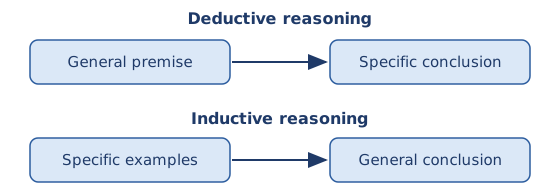
| Type | Direction | Example |
|---|---|---|
| Deductive | General premise to specific conclusion | All multiples of 6 are multiples of 2. 72 is a multiple of 6. So 72 is a multiple of 2. |
| Inductive | Specific premises to general conclusion | 2(1) = 2, 2(2) = 4, 2(3) = 6, … So the sequence 2, 4, 6, … is 2n. |
Is this deductive or inductive? "The supplement of 60° is 120°. The supplement of 45° is 135°. So the supplement of θ is 180° − θ."
Show answerHide answer
Inductive: specific cases lead to a general conclusion.
Valid and sound deductive arguments
| Form I | Form II | Form III | |
|---|---|---|---|
| Premise 1 | All A are B | If p, then q | If p, then q |
| Premise 2 | C is A | p is true | ~q is true |
| Conclusion | C is B | q is true | ~p is true |
A deductive argument is valid if it follows one of the three forms. It is sound if it is valid and its premises are true (so the conclusion is true).
Validity depends on the form, not on whether the statements are true. A valid argument can have a false premise (then it is valid but not sound).
Example 17 and the actress argument (textbook pp. 75-76)
(a) All multiples of 16 are even. 64 is a multiple of 16. So 64 is even: valid and sound (Form I).(b) All basketballs are spherical. The Earth is spherical. So the Earth is a basketball: not valid, because "C is B, so C is A" is not a valid form.
(c) (p. 75) All actresses are good at dancing. Jasmine is an actress. So Jasmine is good at dancing: valid, but not sound because Premise 1 is false.
Affirming the consequent: "If k is even, then k + 1 is odd. 8 + 1 is odd. So 8 is even" copies Form II backwards, so it is not valid. Denying the antecedent ("If p, then q. ~p. So ~q") is also not valid.
Valid or not? "If x is a multiple of 8, then x is a multiple of 4. 12 is not a multiple of 8. So 12 is not a multiple of 4."
Show answerHide answer
Not valid. It denies the antecedent, which is not one of the three forms. The conclusion is in fact false (12 is a multiple of 4).
Forming valid arguments
Examples 19 and 20 (textbook pp. 78-79)
Premise 1: If a straight line y = mx + c is parallel to the x-axis, then m = 0. Premise 2: m ≠ 0. Conclusion: The line is not parallel to the x-axis (Form III).Premise 1: All prime numbers have only two factors. Premise 2: 37 is a prime number. Conclusion: 37 has only two factors (Form I).
Strong and cogent inductive arguments
An inductive argument is strong if, with all premises assumed true, the conclusion is probably true. It is cogent if it is strong and all its premises are true. A weak argument is never cogent.
| Premises | Conclusion probably | Argument |
|---|---|---|
| All true | True | Strong and cogent |
| All true | False | Weak and not cogent |
| At least one false | Probably true | Strong but not cogent |
Example 21 (textbook p. 81)
(a) The chairs in the living room, dining room, study room and bedroom are red, so all chairs in the house are red: weak and not cogent (the premises are true, but the conclusion is probably false).(b) 11 × 5 = 55 and 12 × 5 = 60, so all multiples of 5 end with 0 or 5: strong and cogent.
(c) 1, 2, 3 and 5 are prime, so every prime number is divisible by 1 and itself: strong but not cogent, because "1 is a prime number" is false.
Forming a strong inductive argument
A specific statement is about one case; a general statement describes a whole concept. Look at the specific cases, find the common pattern, then write a general formula.
Example 22 (textbook p. 83)
Sequence 0, 9, 24, 45, …0 = 3(1)² − 3, 9 = 3(2)² − 3, 24 = 3(3)² − 3, 45 = 3(4)² − 3
General formula: 3n² − 3; n = 1, 2, 3, 4, …
Form a general formula for 270, 520, 770, 1 020, … (toy cars per hour).
Show answerHide answer
The difference is 250, and 270 = 250(1) + 20. So 250n + 20; n = 1, 2, 3, …
Problems
Example 23 (textbook p. 84): cell growth P(t) = 2t
(a) Day 8: P(8) = 28 = 256 new cells (deduction).(b) 2t = 2 048 = 211, so t = 11: the 11th day.
Example 24 (textbook pp. 85-86): TOY Factory, 250n + 20
The factory runs from 7 a.m. to 10 p.m., which is 15 hours a day, so n = 15: 250(15) + 20 = 3 770 cars a day. In 5 days: 3 770 × 5 = 18 850, which is less than 25 000, so the order is late.Suggestion: run 20 hours a day: 250(20) + 20 = 5 020; 5 020 × 5 = 25 100 ≥ 25 000.
Say which type of reasoning you use: "by deduction" when you substitute into a given formula, "by induction" when you build a formula from a pattern.