Mathematics questions, chapter 10
Nama / NameKelas / ClassTarikh / Date
Consumer Mathematics: Financial Management
43 marks. Use Practice to check each answer as you go, or Exam to answer everything first. Show your working for Section B.
Section A: objective questions
12 marksChoose the correct answer. Each question carries 1 mark.
1
Question 1
What is the first step in the financial management process?
Show answerHide answer
A
The order is: setting goals, evaluating financial status, creating a plan, carrying out the plan, reviewing and revising.
2
Question 2
A short-term financial goal is usually achieved in
Show answerHide answer
B
Short-term goals take less than a year, for example buying a laptop. Goals of more than five years are long-term.
3
Question 3
Which one is a passive income?
Show answerHide answer
D
Passive income is earned without working for it, such as rent, interest and dividends. Salary, allowance and commission are active income.
4
Question 4
Which of the following is a fixed expense?
Show answerHide answer
C
A car instalment must be paid and is the same each month. Petrol, groceries and electricity change with spending behaviour, so they are variable.
5
Question 5
In the SMART concept, the letter A stands for
Show answerHide answer
A
SMART means Specific, Measurable, Attainable, Realistic, Time-bound.
6
Question 6
Encik Lim earns a salary of RM3 800 and receives RM500 rent. His fixed expenses are RM1 400 and his variable expenses are RM1 100. What is his monthly cash flow?
Show answerHide answer
B
Income = 3 800 + 500 = 4 300. Expenses = 1 400 + 1 100 = 2 500. Cash flow = 4 300 − 2 500 = RM1 800 (positive). RM4 300 is the income only.
7
Question 7
Hani wants to buy a laptop for RM9 000 in 18 months. How much must she save each month?
Show answerHide answer
D
9 000 ÷ 18 = RM500. RM900 would use 10 months instead of 18.
8
Question 8
Syafiq's income is RM2 800 a month and his total expenses are RM2 400. His expenses then increase by 25%. What is his new cash flow?
Show answerHide answer
B
New expenses = 125% × 2 400 = RM3 000. Cash flow = 2 800 − 3 000 = −RM200, a deficit. A surplus of RM400 is the cash flow before the increase.
9
Question 9
Aini's total monthly income is RM5 800. How much should she set aside as fixed monthly savings if she follows the 10% guide?
Show answerHide answer
D
10% × 5 800 = RM580. RM5 220 is the amount left after saving.
10
Question 10
A family has a negative cash flow every month. Which action is the most suitable?
Show answerHide answer
C
Variable expenses can be cut and extra income can be added without touching fixed expenses. Using credit or paying late adds debt, interest and penalties.
11
Question 11
A couple needs a down payment of RM60 000 in 5 years. How much must they save each month?
Show answerHide answer
A
60 000 ÷ 5 = RM12 000 a year. 12 000 ÷ 12 = RM1 000 a month. RM12 000 is the yearly amount.
12
Question 12
Mr Hamid's financial plan was feasible last year. This year the inflation rate rises and his salary stays the same. What is the effect on the plan?
Show answerHide answer
C
Inflation raises prices and the cost of living, so total expenses rise while income does not. The plan must be reviewed.
Section B: structured questions
31 marksAnswer all questions. Show your working.
13
Question 13
Answer these questions about financial goals.
[2 marks]
(a)Name the first step and the last step of the financial management process.
Show answerHide answer
Tick each point you got.
[2 marks]
(b)Give one example of a short-term goal and one example of a long-term goal.
Show answerHide answer
Tick each point you got.
14
Question 14
Puan Rina earns an active income of RM3 200 and a passive income of RM450 a month. Her fixed expenses are RM1 500 and her variable expenses are RM1 250.
[2 marks]
(a)Calculate her monthly cash flow.
Show answerHide answer
Tick each point you got.
[1 mark]
(b)State whether the cash flow is positive or negative.
Show answerHide answer
Tick each point you got.
[2 marks]
(c)Her total expenses increase by 40%. Calculate her new cash flow and explain what it means.
Show answerHide answer
Tick each point you got.
15
Question 15
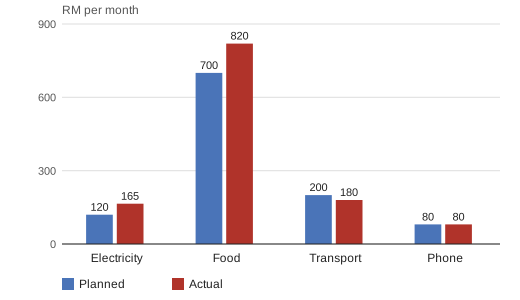
Diagram 1 compares the planned and the actual expenses of Encik Yasir in his first month.
[2 marks]
(a)Calculate the total planned expenses and the total actual expenses.
Show answerHide answer
Tick each point you got.
[1 mark]
(b)Which expense increased by the largest amount? State the amount.
Show answerHide answer
Tick each point you got.
[2 marks]
(c)Calculate the percentage increase in his total expenses, correct to 1 decimal place.
Show answerHide answer
Tick each point you got.
[1 mark]
(d)Give one suggestion to help him follow his plan.
Show answerHide answer
Tick each point you got.
16
Question 16
Mr Hassan wants to save RM180 000 for his children's education in 15 years. At present he saves RM700 a month. His monthly variable expenses include RM1 500 for entertainment.
[2 marks]
(a)Calculate the monthly savings he needs.
Show answerHide answer
Tick each point you got.
[1 mark]
(b)How much more must he save each month?
Show answerHide answer
Tick each point you got.
[2 marks]
(c)He cuts the entertainment expenses by 20%. Calculate the amount saved and state whether it is enough.
Show answerHide answer
Tick each point you got.
[1 mark]
(d)Give one reason why the money saved over 15 years may be more than RM180 000.
Show answerHide answer
Tick each point you got.
17
Question 17
Encik Zul has a monthly net income of RM4 500 and no passive income. He saves 10% of his income and puts RM100 into an emergency fund. His fixed expenses are RM1 600 and his variable expenses are RM2 300. He wants to buy a RM3 000 laptop in 10 months.
[1 mark]
(a)Calculate his income balance.
Show answerHide answer
Tick each point you got.
[1 mark]
(b)Calculate his monthly surplus.
Show answerHide answer
Tick each point you got.
[2 marks]
(c)Can he buy the laptop in 10 months using his fixed monthly savings? Show your working.
Show answerHide answer
Tick each point you got.
[1 mark]
(d)His surplus is small. State one risk and one way to reduce it.
Show answerHide answer
Tick each point you got.
18
Question 18
Hana's monthly income is RM2 000. She wants to buy a RM1 800 tablet in 9 months.
[1 mark]
(a)Calculate the amount she must save each month.
Show answerHide answer
Tick each point you got.
[3 marks]
(b)Write her goal as a SMART goal. State what each letter means for her goal.
Show answerHide answer
Tick each point you got.
[1 mark]
(c)Hana's goal of buying the tablet in 9 months is a short-term goal.
Show answerHide answer
True
A short-term goal is achieved in less than a year, and 9 months is less than a year.