Mathematics notes, chapter 10
Consumer Mathematics: Financial Management
Textbook Mathematics Form 4 KSSM (DLP), pages 270–292
What this chapter covers
- {'Describe the five steps of the financial management process': 'setting goals, evaluating financial status, creating a financial plan, carrying out the plan, and reviewing and revising progress (10.1.1)'}
- Set short-term and long-term financial goals using the SMART concept (10.1.1)
- Calculate cash flow from income (active and passive) and expenses (fixed and variable), and explain a surplus or a deficit (10.1.1)
- Construct a personal financial plan, calculate the monthly savings needed for a goal and evaluate whether the plan is feasible (10.1.2)
10.1Financial planning and management
Financial management is the process of managing money from its sources of income into savings, expenses, protection and investment.
The five steps of the process
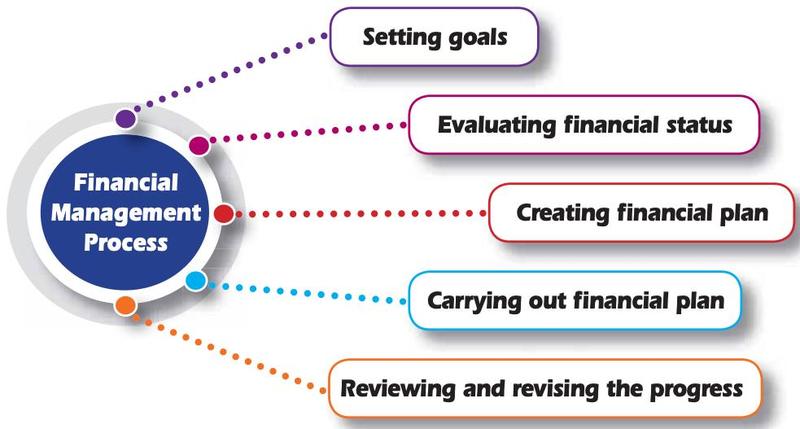
Figure: textbook, p. 272.
| Step | What you do |
|---|---|
| 1. Setting goals | Decide what you want and when. Put needs before wants. Goals must be specific and prioritised. |
| 2. Evaluating financial status | List assets (cash, savings, fixed deposits, unit trusts, shares, property) and liabilities (bank loans, credit card debt, unpaid bills). |
| 3. Creating a financial plan | List income and expenses, then work out the monthly savings needed for each goal. |
| 4. Carrying out the plan | Follow the plan early. Compare planned and actual expenses and cut waste. Pay fixed expenses first. |
| 5. Reviewing and revising | Check progress from time to time so cash flow stays positive. Change goals that are not realistic. |
Short-term and long-term goals
| Short-term goal | Long-term goal | |
|---|---|---|
| Time | Less than a year | Usually more than five years |
| Amount | Not a large amount | A large amount |
| Examples | Laptop, furniture, cell phone | Retirement, children's education, medical expenses, a house |
Put basic needs (food, housing, clothing) before wants. Spending on wants makes you spend more than you earn.
SMART goals
A SMART goal is Specific, Measurable, Attainable, Realistic and Time-bound.
Example 1 (textbook p. 273): is the goal SMART?
Encik Yusuf will hold a Family Day in Port Dickson in 6 months. It costs RM1 500. He saves RM250 a month from an income of RM2 500.Specific: a named trip. Measurable: the cost is RM1 500. Attainable: RM250 a month is possible from RM2 500. Realistic: 6 × RM250 = RM1 500. Time-bound: 6 months. Yes, it is SMART.
Cash flow
| Types | Examples | |
|---|---|---|
| Income (cash inflow) | Active income: earned by working Passive income: earned without working | Salary, allowance, commission Rent received, interest, dividends |
| Expenses (cash outflow) | Fixed: must be paid, same each month Variable: change with spending behaviour | Rent, insurance, housing loan, car instalment Petrol, groceries, electricity, water |
Cash flow = total income − total expenses.
Positive cash flow (surplus): income is more than expenses. Negative cash flow (deficit): income is less than expenses.
Positive cash flow (surplus): income is more than expenses. Negative cash flow (deficit): income is less than expenses.
Example 2 (textbook p. 276)
Mr Derrick: active income RM3 000, passive income RM1 000, fixed expenses RM1 350, variable expenses RM650.(a) Cash flow = 3 000 + 1 000 − 1 350 − 650 = RM2 000 (positive).
(b) With no passive income and expenses up by 60%: expenses = 160% × 2 000 = RM3 200, cash flow = 3 000 − 3 200 = −RM200 (negative).
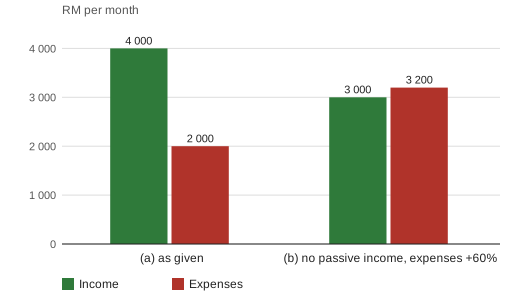
"Total expenses increase by 60%" means the new expenses are 160% of the old ones, not 60% of them. Do not forget the original amount.
Making and carrying out a plan
- Set aside 10% of total income as savings first, before fixed and variable expenses.
- Set an emergency fund. As a guide, keep money for basic needs for at least six months.
- Income balance = total income − savings − emergency fund. Surplus = income balance − fixed expenses − variable expenses.
- If cash flow is negative, cut variable expenses or add a source of income. Fixed expenses are paid first because late payment brings extra interest and penalties.
Example 4 (textbook pp. 278-280): a family financial plan
Puan Aminah and her husband earn net salaries of RM3 500 and RM3 000, with no passive income. Total income = RM6 500.Fixed monthly savings (10%) = RM650. Emergency fund = RM100. Income balance = 6 500 − 650 − 100 = RM5 750.
Fixed expenses = RM2 500 (housing loan, car instalment, insurance). Variable expenses = RM3 130.
Surplus = 5 750 − 2 500 − 3 130 = RM120. Savings in one year = 650 × 12 = RM7 800, which covers the RM7 500 down payment for the car.
Worked example: monthly savings needed
Goal: RM6 000 in one year. Monthly savings = 6 000 ÷ 12 = RM500. Income RM5 000, so 500 ÷ 5 000 = 10%: realistic.Quick check. Puan Mala earns RM3 600 (active) and RM400 (rent). Her fixed expenses are RM1 500 and variable expenses RM1 900. Find her cash flow.
Show answerHide answer
Income = 3 600 + 400 = RM4 000. Expenses = 1 500 + 1 900 = RM3 400. Cash flow = RM600, positive.
Long-term plans and feasibility
Long-term goals take more than five years, so the plan must consider the inflation rate, the interest rate and personal health. Inflation is a continuing rise in the general price level. Starting to save early helps you reach the goal faster.
Example 6 (textbook p. 285)
Down payment of RM72 000 needed in 6 years. Annual savings = 72 000 ÷ 6 = RM12 000. Monthly savings = 12 000 ÷ 12 = RM1 000. With a household income of RM8 000 and expenses of RM6 500, this is possible, but a RM720 000 house means a large loan instalment, so it may not be wise.Example (textbook pp. 286–288): Mr Wong
Goal: RM150 000 in 15 years. Annual = 150 000 ÷ 15 = RM10 000. Monthly = 10 000 ÷ 12 ≈ RM833.33. He saves RM650, so he needs RM183.33 more.Cut travel by 25%: 25% × 500 = RM125. Cut petrol by RM100. Extra savings = RM225, so total = 650 + 225 = RM875 a month. In 15 years: 875 × 12 × 15 = RM157 500, more than the goal.
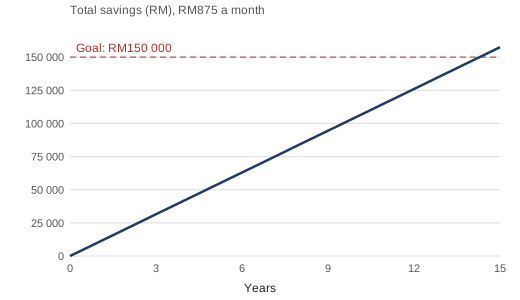
A plan is feasible only if the facts it assumes stay true: pay rises keep up with inflation, rent is still received, you stay healthy and no large unexpected costs appear.
Quick check. Why must a financial plan be reviewed from time to time?
Show answerHide answer
To keep cash flow positive, to adjust to changes such as inflation or a pay rise, and to change goals that are no longer realistic.