myUASARevision for UASA
Mathematics notes, chapter 9

Probability of Combined Events

Textbook Mathematics Form 4 KSSM (DLP), pages 242–269

What this chapter covers

  • Describe combined events and list the possible outcomes as a sample space (9.1.1)
  • Differentiate dependent from independent events, and use the multiplication rule P(A and B) = P(A) × P(B) for independent events (9.2.1, 9.2.2, 9.2.3)
  • Differentiate mutually exclusive from non-mutually exclusive events and use the addition rule (9.3.1, 9.3.2, 9.3.3)
  • Solve problems on the probability of combined events using lists, Venn diagrams and tree diagrams (9.4.1)

9.1Combined events

A combined event joins two or more events into one outcome. The outcomes are written as ordered pairs, for example (Head, 5). The sample space S is the set of all possible outcomes.

A combined event may come from one experiment done twice (two coins) or from two different experiments (a die and a coin).

Example 1 (textbook p. 245): sample spaces
(a) Two cards are taken one by one from five cards T, E, K, U, N without replacement: the first card can be any of 5 letters and the second any of the other 4, so there are 5 × 4 = 20 pairs: (T, E), (T, K), (T, U), (T, N), (E, T) and so on.
(b) Two coins tossed: S = {(T, T), (T, H), (H, T), (H, H)}.
For two stages that do not affect each other, n(S) = n(A) × n(B). A die and a coin: 6 × 2 = 12 outcomes. Always write the pair in order: (H, T) and (T, H) are different outcomes.
Write the sample space when a coin is tossed and a card is chosen from cards labelled 1, 2 and 3.
Show answerHide answer
S = {(H, 1), (H, 2), (H, 3), (T, 1), (T, 2), (T, 3)}. n(S) = 2 × 3 = 6.

9.2Dependent and independent events

Events A and B are independent if the occurrence of A has no effect on the occurrence of B. They are dependent if A does affect B.
SituationTypeWhy
Two coins tossedIndependentThe first toss does not change the second
Cards chosen one by one with replacementIndependentThe box is back to its original state
Cards chosen one by one without replacementDependentThe first card removed changes what is left in the box
Do not decide by the numbers alone. Ask: does the first result change the contents or the chances for the second? If yes, dependent.

Multiplication rule

For independent events: P(A and B) = P(A) × P(B). For three: P(A ∩ B ∩ C) = P(A) × P(B) × P(C).
Example 4 (textbook p. 250): a factor of 9 and the letter Z
Box A has cards 3, 5, 7, 9 and box B has X, Y, Z. P(factor of 9) = 24 (3 and 9) and P(Z) = 13.
P(factor of 9 and Z) = 24 × 13 = 16.
Check by listing: {(3, Z), (9, Z)} out of n(S) = 4 × 3 = 12 gives 212 = 16.

Dependent events and tree diagrams

For dependent events, the probability of the second event is worked out after the first has happened. Multiply along the branches of a tree diagram, and add the outcomes you want.
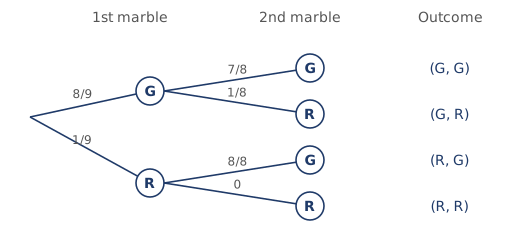
Example 5 (textbook p. 251): 8 green and 1 red marble, two chosen without replacement
Tree diagram. First marble: green 8/9 or red 1/9. After green: green 7/8, red 1/8. After red: green 8/8, red 0.
After a red marble is removed, only green marbles are left.
P(both green) = 89 × 78 = 79.
P(second is red) = 89 × 18 = 19. The red marble can only be second if the first was green.
Without replacement, the bottom number of the second fraction is one less. Using 8/9 for both draws is the commonest mistake. 8/9 × 8/9 is the answer for with replacement.
A box has 3 red and 2 blue pens. Two are taken without replacement. Find P(both red).
Show answerHide answer
P = 35 × 24 = 620 = 310.

9.3Mutually exclusive and non-mutually exclusive events
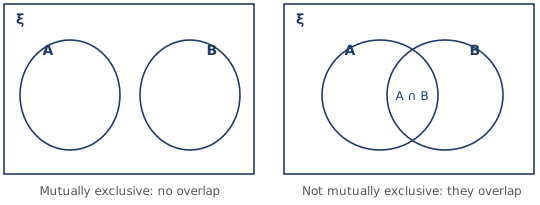
Events A and B are mutually exclusive if they cannot happen at the same time: A ∩ B = φ. If they can both happen (they share an outcome) they are non-mutually exclusive.
Two Venn diagrams: circles A and B apart (mutually exclusive) and overlapping circles with A intersection B shown (not mutually exclusive)
Mutually exclusive events have no common outcome.
Example 6 style: a fair die is rolled
P = number greater than 4 {5, 6}, Q = even number {2, 4, 6}, R = perfect square {1, 4}.
P and Q share 6, so non-mutually exclusive. P and R share nothing, so mutually exclusive. Q and R share 4, so non-mutually exclusive.

Addition rule

P(A or B) is P(A ∪ B).
Mutually exclusive: P(A ∪ B) = P(A) + P(B).
Non-mutually exclusive: P(A ∪ B) = P(A) + P(B) − P(A ∩ B).
Subtracting P(A ∩ B) stops the common outcomes being counted twice. If A ∩ B is empty, P(A ∩ B) = 0 and both formulas agree.
Example 8 (textbook p. 257): cards 4, 5, 6, 7, 8, 9, 10, 11
A = greater than 8 {9, 10, 11}, C = even {4, 6, 8, 10}. A ∩ C = {10}.
P(A or C) = 38 + 48 − 18 = 68 = 34.
Check: A ∪ C = {4, 6, 8, 9, 10, 11}, 6 outcomes out of 8, 68.

Independent events that are not exclusive

Two independent events can happen together, so they are not mutually exclusive. If P(Zalifah eats cendol) = 57 and P(Maran eats) = 35, then P(both) = 57 × 35 = 37, and P(Zalifah or Maran) = 57 + 35 − 37 = 3135 (textbook p. 259).

Mutually exclusive and independent are different ideas. Mutually exclusive events with non-zero probabilities are never independent, because if one happens the other cannot.

At least one

"At least one" means one or more. Use the complement: P(at least one) = 1 − P(none). With a defect probability of 213, P(at least one defect in two phones) = 1 − 1113 × 1113 = 48169 (textbook p. 260).

P(A) = 14, P(B) = 13 and A, B are mutually exclusive. Find P(A or B).
Show answerHide answer
14 + 13 = 712.

9.4Application

Use the four steps from the textbook: understand the problem (dependent or independent?), plan (list, Venn or tree diagram), implement, and check (for example by the complement method).

Example 12 (textbook p. 262): a die rolled twice, 540 times
Perfect squares on a die: 1 and 4, so P(K) = 13. P(at least one) = 1 − 23 × 23 = 59.
Expected number of times = 59 × 540 = 300.
To estimate how many times an event happens in many trials, multiply the probability by the number of trials.
Two fair coins are tossed 200 times. Estimate how many times at least one head appears.
Show answerHide answer
P(at least one head) = 1 − 14 = 34. 34 × 200 = 150 times.