Mathematics questions, chapter 9
Nama / NameKelas / ClassTarikh / Date
Probability of Combined Events
43 marks. Use Practice to check each answer as you go, or Exam to answer everything first. Show your working for Section B.
Section A: objective questions
15 marksChoose the correct answer. Each question carries 1 mark.
1
Question 1
A fair die is rolled and a fair coin is tossed. How many possible outcomes are there?
Show answerHide answer
B
n(S) = n(A) × n(B) = 6 × 2 = 12. 8 comes from adding 6 + 2.
2
Question 2
Cards labelled K, A, M are taken out one by one without replacement. How many ordered pairs are in the sample space?
Show answerHide answer
D
The first card has 3 choices and the second has 2, so 3 × 2 = 6 pairs. 9 is for choosing with replacement.
3
Question 3
Which pair of events is dependent?
Show answerHide answer
B
Without replacement the first pen changes what is left in the box, so the second probability changes. The other three are independent.
4
Question 4
A fair coin is tossed and a fair die is rolled. Find the probability of a tail and a number less than 3.
Show answerHide answer
C
P(tail) = 12, P(less than 3) = 26 = 13. Product = 16. 112 comes from using only one number.
5
Question 5
The probabilities that Ali and Bala pass a test are 0.7 and 0.8 respectively. Find the probability that both pass.
Show answerHide answer
B
Independent events: 0.7 × 0.8 = 0.56. 1.5 is the sum, which cannot be a probability.
6
Question 6
A bag contains 4 red and 3 blue balls. Two balls are taken out one by one without replacement. Find P(both red).
Show answerHide answer
C
P = 47 × 36 = 1242 = 27. 1649 is the answer with replacement.
7
Question 7
A fair die is rolled. Which pair of events is mutually exclusive?
Show answerHide answer
B
{4, 5, 6} and {1, 2} share no outcome. The other pairs share 2, 6 and 3 respectively.
8
Question 8
A and B are non-mutually exclusive events. Which is the correct formula for P(A or B)?
Show answerHide answer
A
Common outcomes are counted twice by P(A) + P(B), so P(A ∩ B) is subtracted. P(A) × P(B) is the rule for independent events 'and'.
9
Question 9
A and B are mutually exclusive events with P(A) = 25 and P(B) = 13. Find P(A or B).
Show answerHide answer
D
25 + 13 = 615 + 515 = 1115. 215 is the product, and 38 adds numerators and denominators.
10
Question 10
P(A) = 0.5, P(B) = 0.4 and P(A ∩ B) = 0.15. Find P(A ∪ B).
Show answerHide answer
A
0.5 + 0.4 − 0.15 = 0.75. 0.9 forgets to subtract the intersection.
11
Question 11
A box has 3 green and 2 red cards. Two cards are taken without replacement. Find the probability that at least one is red.
Show answerHide answer
D
P(none red) = 35 × 24 = 310. P(at least one red) = 1 − 310 = 710. 310 is the probability of no red card.
12
Question 12
A number is chosen from 1 to 12. A is a multiple of 3 and B is an even number. Find P(A or B).
Show answerHide answer
B
A = {3, 6, 9, 12}, B = {2, 4, 6, 8, 10, 12}. A ∩ B = {6, 12}. P = 412 + 612 − 212 = 812 = 23. 56 adds without subtracting.
13
Question 13
Two fair dice are rolled. Find the probability that the total is 7 or 11.
Show answerHide answer
A
The two totals cannot happen together. Total 7 has 6 outcomes and total 11 has 2: 636 + 236 = 836 = 29.
14
Question 14
Independent events: P(A) = 0.6 and P(B) = 0.25. Find the probability that A happens and B does not happen.
Show answerHide answer
C
P(B') = 1 − 0.25 = 0.75. P(A and B') = 0.6 × 0.75 = 0.45. 0.15 is P(A and B).
15
Question 15
Two fair coins are tossed 200 times. Estimate how many times at least one head is obtained.
Show answerHide answer
C
P(at least one head) = 1 − 14 = 34. 34 × 200 = 150. 50 is the number of times for two tails.
Section B: structured questions
28 marksAnswer all questions. Show your working.
16
Question 16
Cards labelled 2, 4 and 7 are in a box. A card is chosen, its number is recorded and it is put back. Then a second card is chosen.
[2 marks]
(a)List the sample space.
Show answerHide answer
With replacement, the second card has 3 choices every time. Award 1 mark if only 1 or 2 pairs are missing.
Tick each point you got.
[1 mark]
(b)State n(S).
Show answerHide answer
Tick each point you got.
[1 mark]
(c)The two events are dependent because the first card is recorded.
Show answerHide answer
False
The first card is put back, so the box is the same for the second draw. The events are independent.
17
Question 17
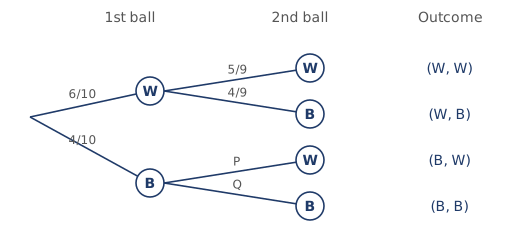
A bag has 6 white balls and 4 black balls. Two balls are taken out one by one without replacement. Diagram 1 shows the tree diagram.
[2 marks]
(a)Find the values of P and Q.
Show answerHide answer
Tick each point you got.
[3 marks]
(b)Calculate the probability that both balls are the same colour.
Show answerHide answer
Tick each point you got.
[2 marks]
(c)Calculate the probability that at least one ball is black.
Show answerHide answer
Tick each point you got.
18
Question 18
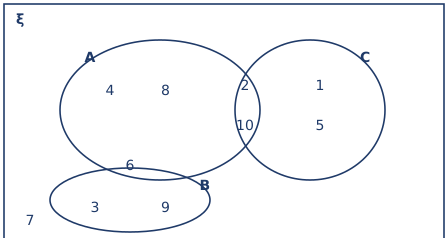
A card is chosen from cards numbered 1 to 10. A is the event of an even number, B is a multiple of 3 and C is a factor of 10. Diagram 2 shows the Venn diagram.
[1 mark]
(a)Which two events are mutually exclusive? Give a reason.
Show answerHide answer
Tick each point you got.
[2 marks]
(b)Find P(A or B).
Show answerHide answer
Tick each point you got.
[2 marks]
(c)Find P(A or C).
Show answerHide answer
Tick each point you got.
19
Question 19
The probability that Aini goes to a camp is 34 and the probability that Bala goes is 23. Their decisions are independent.
[1 mark]
(a)Find the probability that both go.
Show answerHide answer
Tick each point you got.
[2 marks]
(b)Find the probability that Aini or Bala goes.
Show answerHide answer
Tick each point you got.
[2 marks]
(c)Find the probability that exactly one of them goes.
Show answerHide answer
Tick each point you got.
20
Question 20
The probability that a bulb made by a factory is defective is 0.1. Two bulbs are chosen at random.
[2 marks]
(a)Calculate the probability that at least one bulb is defective.
Show answerHide answer
Tick each point you got.
[1 mark]
(b)500 pairs of bulbs are chosen. Estimate the number of pairs with at least one defective bulb.
Show answerHide answer
Tick each point you got.
[2 marks]
(c)A pupil says that the probability of two defective bulbs is 0.2. Explain why the pupil is wrong.
Show answerHide answer
Tick each point you got.
21
Question 21
A fair die is rolled. Event A is getting 1, 2 or 3.
[1 mark]
(a)Write one event C that is mutually exclusive with A.
Show answerHide answer
Tick each point you got.
[1 mark]
(b)Write one event D that is non-mutually exclusive with A and state the common outcome.
Show answerHide answer
Tick each point you got.