Physics questions, chapter 6
Nama / NameKelas / ClassTarikh / Date
Light and Optics
46 marks. Use Practice to check each answer as you go, or Exam to answer everything against the clock first.
Section A: objective questions
14 marksChoose the best answer for each question.
1
Question 1
What causes light to refract when it moves from one medium to another?
Show answerHide answer
B
Refraction is caused by the change in speed of light between mediums of different optical densities.
2
Question 2
A ray of light travels from air into a glass block at an oblique angle. Which statement is correct?
Show answerHide answer
C
Glass is optically denser than air, so the speed decreases and the ray bends towards the normal (i > r).
3
Question 3
The speed of light in a liquid is 2.0 × 10⁸ m s−1. What is its refractive index? (c = 3.0 × 10⁸ m s−1)
Show answerHide answer
A
n = c / v = 3.0 × 10⁸ ÷ 2.0 × 10⁸ = 1.5.
4
Question 4
A ray in air strikes a glass block (n = 1.5) at an angle of incidence of 40°. What is the angle of refraction?
Show answerHide answer
D
sin r = sin 40° ÷ 1.5 = 0.6428 ÷ 1.5 = 0.4285, so r = 25.4°.
5
Question 5
A transparent material has a refractive index of 2.0. What is its critical angle in air?
Show answerHide answer
B
sin c = 1/n = 1/2.0 = 0.5, so c = 30.0°.
6
Question 6
Which conditions are needed for total internal reflection to occur?
Show answerHide answer
C
Total internal reflection needs light to travel from a denser to a less dense medium and the angle of incidence to be larger than the critical angle.
7
Question 7
The table shows the refractive index of four materials.
Which material has the smallest critical angle?
| Material | Refractive index |
|---|---|
| Water | 1.33 |
| Perspex | 1.50 |
| Crown glass | 1.52 |
| Diamond | 2.42 |
Show answerHide answer
A
n = 1/sin c, so the largest refractive index gives the smallest critical angle. Diamond: c = 24.4°.
8
Question 8
A coin lies at the bottom of a beaker containing water 12.0 cm deep (n = 1.33). At what depth does the coin appear to be, viewed from above?
Show answerHide answer
D
apparent depth = real depth / n = 12.0 ÷ 1.33 = 9.0 cm.
9
Question 9
An object is placed between the optical centre and the focal point of a convex lens. What are the characteristics of the image?
Show answerHide answer
B
When u < f, a convex lens forms a virtual, upright and magnified image (a magnifying glass).
10
Question 10
A convex lens has a focal length of 10 cm. An object is placed 15 cm from the lens. What is the image distance?
Show answerHide answer
C
1/v = 1/f − 1/u = 1/10 − 1/15 = 1/30, so v = 30 cm.
11
Question 11
A convex lens has a focal length of 15 cm. An object 2 cm high is placed 20 cm from the lens. What is the height of the image?
Show answerHide answer
A
1/v = 1/15 − 1/20 = 1/60, so v = 60 cm. m = v/u = 60/20 = 3, so image height = 3 × 2 = 6 cm.
12
Question 12
An astronomical telescope has an objective lens of focal length 80 cm and an eyepiece of focal length 4 cm. What is its magnification at normal adjustment?
Show answerHide answer
D
M = fo / fe = 80 ÷ 4 = 20.
13
Question 13
Why is a convex mirror, not a plane mirror, used as a blind spot mirror at a sharp corner?
Show answerHide answer
C
A convex mirror gives a much wider field of vision than a plane mirror of the same size (the image is virtual, upright and diminished).
14
Question 14
A concave mirror has a radius of curvature of 24 cm. What is its focal length?
Show answerHide answer
B
r = 2f, so f = 24 ÷ 2 = 12 cm.
Section B: structured questions
32 marksAnswer all questions. Show your working.
15
Question 15
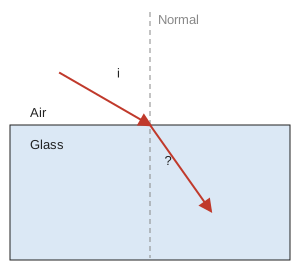
Diagram 1 shows a ray of light travelling from air into a glass block of refractive index 1.5. The angle of incidence is 60°.
[1 mark]
(a)Why does the ray bend towards the normal?
Show answerHide answer
Tick each point you got.
[2 marks]
(b)Calculate the angle of refraction.
Show answerHide answer
Tick each point you got.
[1 mark]
(c)Calculate the speed of light in the glass. (c = 3.0 × 10⁸ m s−1)
Show answerHide answer
Tick each point you got.
16
Question 16
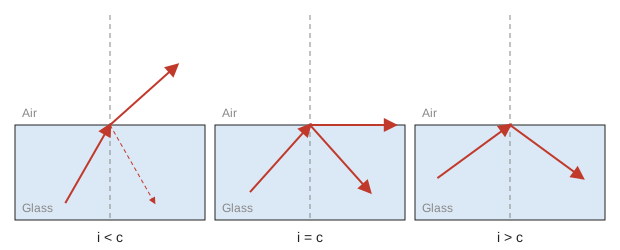
Diagram 2 shows three rays of light inside a glass block of refractive index 1.5 striking the glass-air boundary at different angles of incidence.
[1 mark]
(a)State the meaning of critical angle.
Show answerHide answer
Tick each point you got.
[2 marks]
(b)Calculate the critical angle of the glass.
Show answerHide answer
Tick each point you got.
[2 marks]
(c)A ray strikes the boundary inside the glass at 55°. State what happens to the ray and give a reason.
Show answerHide answer
Tick each point you got.
[1 mark]
(d)Name one natural phenomenon that involves total internal reflection.
Show answerHide answer
Any 1 points
Tick each point you got.
17
Question 17
An optical fibre has a core of refractive index 1.60 surrounded by cladding of refractive index 1.45.
[2 marks]
(a)Explain why the core must have a higher refractive index than the cladding.
Show answerHide answer
Tick each point you got.
[2 marks]
(b)Calculate the critical angle at the core-cladding boundary.
Show answerHide answer
Tick each point you got.
[1 mark]
(c)State one use of optical fibres.
Show answerHide answer
Any 1 points
Tick each point you got.
18
Question 18
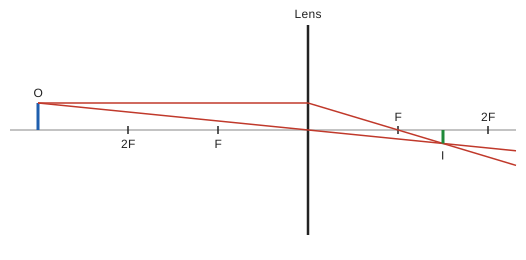
Diagram 3 shows the image of an object formed by a convex lens of focal length 10 cm. The object is 30 cm from the lens.
[3 marks]
(a)State three characteristics of the image.
Show answerHide answer
Tick each point you got.
[2 marks]
(b)Calculate the image distance.
Show answerHide answer
Tick each point you got.
[1 mark]
(c)Calculate the linear magnification.
Show answerHide answer
Tick each point you got.
19
Question 19
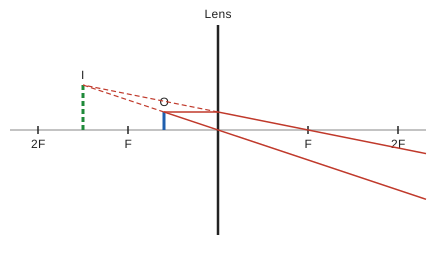
A magnifying glass is a convex lens of focal length 10 cm. A coin is held 6 cm from the lens, as shown in Diagram 4.
[2 marks]
(a)Use the lens formula to find the image distance. State the sign of your answer.
Show answerHide answer
Tick each point you got.
[2 marks]
(b)State two characteristics of the image.
Show answerHide answer
Any 2 points
Tick each point you got.
[1 mark]
(c)Calculate the linear magnification.
Show answerHide answer
Tick each point you got.
20
Question 20
A pupil has three convex lenses of focal lengths 5 cm, 10 cm and 60 cm. She wants to make an astronomical telescope with the largest magnification.
[2 marks]
(a)Which lens should be the objective and which the eyepiece? Give a reason.
Show answerHide answer
Tick each point you got.
[1 mark]
(b)How far apart should the lenses be at normal adjustment?
Show answerHide answer
Tick each point you got.
[1 mark]
(c)Calculate the magnification.
Show answerHide answer
Tick each point you got.
[2 marks]
(d)State two characteristics of the final image.
Show answerHide answer
Any 2 points
Tick each point you got.