Light and Optics
What this chapter covers
- Explain refraction of light and use refractive index, n = c/v, and Snell's law (6.1.1–6.1.4)
- Relate real depth and apparent depth to refractive index (6.1.5–6.1.6)
- Solve problems involving refraction of light (6.1.7)
- Explain total internal reflection and the critical angle, n = 1/sin c (6.2.1–6.2.2)
- Describe natural phenomena and applications of total internal reflection (6.2.3–6.2.4)
- Describe convex and concave lenses, draw ray diagrams and state image characteristics (6.3.1–6.3.3)
- Calculate linear magnification, m = hi/ho = v/u (6.3.4)
- Use the thin lens formula 1/f = 1/u + 1/v (6.4.1–6.4.2)
- Describe the compound microscope, telescope and small lenses in cameras (6.5.1–6.5.3)
- Describe image formation by concave and convex mirrors and their uses (6.6.1–6.6.2)
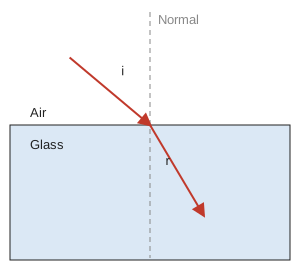
6.1Refraction of light
| Light travels from | Speed | Bends | Angles |
|---|---|---|---|
| Less dense to denser medium (air to glass) | Decreases | Towards the normal | i > r |
| Denser to less dense medium (glass to air) | Increases | Away from the normal | i < r |
Refractive index and Snell's law
| Medium | Refractive index | Medium | Refractive index |
|---|---|---|---|
| Vacuum / air | 1.00 | Perspex | 1.50 |
| Olive oil | 1.46 | Diamond | 2.42 |
Snell's law: n1 sin θ1 = n2 sin θ2. From air (n1 = 1) this becomes n = sin i / sin r. The incident ray, refracted ray and normal lie in the same plane.
sin r = sin 40° ÷ 1.50 = 0.4285, so r = 25.4°.
v = c / n = 3.0 × 10⁸ ÷ 1.50 = 2.0 × 10⁸ m s−1.
Real depth and apparent depth
An object under water looks nearer to the surface than it really is, because light bends away from the normal as it leaves the water.
The non-parallax method (Experiment 6.2) finds the image position accurately: a pin is moved until it stays in line with the image however the eye moves.
Show answerHide answer
6.2Total internal reflection
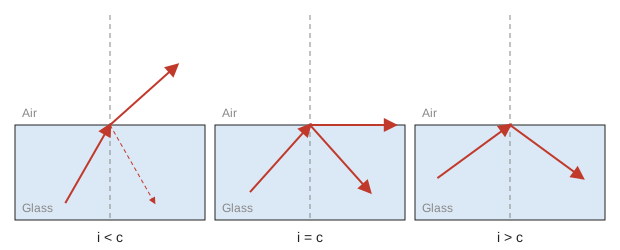
Total internal reflection needs both conditions: light goes from a denser to a less dense medium, and the angle of incidence is larger than the critical angle.
Natural phenomena and applications
| Phenomenon or device | How total internal reflection is involved |
|---|---|
| Rainbow | Sunlight is refracted and dispersed in a raindrop, totally reflected inside, then refracted again leaving the drop |
| Mirage | Hot air near the road is optically less dense; rays from the sky are refracted away from the normal until they are totally reflected towards the eye |
| Prism periscope | Light meets the long face at 45°, larger than the prism's critical angle (42°), so it is totally reflected twice; the image is upright and the same size |
| Optical fibre | A core of high n inside cladding of low n: light is totally reflected again and again along the core (telecommunication, endoscope) |
| Cat's eye reflector | Headlight rays are totally reflected from the back surface and return to the driver |
Show answerHide answer
6.3Image formation by lenses
| Convex lens | Concave lens | |
|---|---|---|
| Effect on parallel rays | Converges them to a real focal point | Diverges them, appearing to come from a virtual focal point |
| Focal length, f | Positive | Negative |
Key terms: optical centre O (rays pass straight through), principal axis, focal point F, object distance u, image distance v, focal length f (distance OF).
Three rays for a ray diagram (convex lens)
- A ray through the optical centre goes straight on.
- A ray parallel to the principal axis is refracted through the focal point.
- A ray through the focal point is refracted parallel to the principal axis.
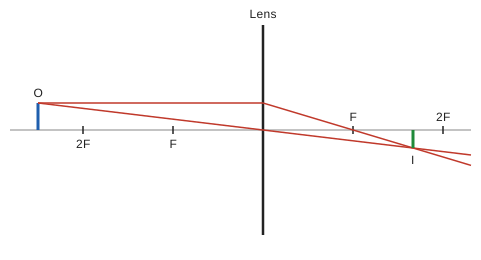
| Object position (convex lens) | Image position | Characteristics |
|---|---|---|
| At infinity | v = f | Real, inverted, diminished |
| Beyond 2F (u > 2f) | f < v < 2f | Real, inverted, diminished |
| At 2F | v = 2f | Real, inverted, same size |
| Between F and 2F | v > 2f | Real, inverted, magnified |
| At F | At infinity | Virtual, upright, magnified |
| Between F and O (u < f) | v > u, same side as object | Virtual, upright, magnified (magnifying glass) |
A concave lens always forms an image that is virtual, upright and diminished, between the optical centre and the focal point (v < f).
Show answerHide answer
6.4Thin lens formula
| Quantity | Positive (+) | Negative (−) |
|---|---|---|
| Focal length f | Convex (converging) lens | Concave (diverging) lens |
| Image distance v | Real image, opposite side to the object | Virtual image, same side as the object |
1/v = 1/12 − 1/18 = 1/36, so v = +36 cm and m = 36 ÷ 18 = 2. The image is real, inverted and magnified 2 times.
1/v = 1/(−30) − 1/60 = −3/60, so v = −20 cm. The image is virtual, upright and diminished, 20 cm from the lens on the object's side.
Show answerHide answer
6.5Optical instruments
| Compound microscope | Telescope | |
|---|---|---|
| Lenses | Two convex lenses of short focal length; objective fo < eyepiece fe | Two convex lenses; objective has a long fo, eyepiece a short fe |
| Object | Between fo and 2fo of the objective, close by | Distant object (parallel rays) |
| First image I1 (objective) | Real, inverted, magnified | Real, inverted, diminished |
| Final image I2 (eyepiece, used as a magnifying glass) | Virtual, magnified, inverted, at the near point (25 cm) | Virtual, magnified, inverted, at infinity (normal adjustment) |
| Lens separation | More than fo + fe | L = fo + fe |
Small convex lenses in smartphone cameras and CCTV form a real, diminished, inverted image on the sensor. The sensor must be at least one focal length from the lens, so the focal length limits how thin the phone can be.
Show answerHide answer
6.6Image formation by spherical mirrors
A concave mirror reflects from the inside of a sphere; a convex mirror reflects from the outside. Terms: pole P, centre of curvature C, radius of curvature r, focal point F. The radius is twice the focal length: r = 2f.
Rays for a ray diagram
- A ray through (or towards) C is reflected back along its own path.
- A ray parallel to the principal axis is reflected through (or as if from) F.
- A ray through (or towards) F is reflected parallel to the principal axis.
| Mirror and object position | Image |
|---|---|
| Concave: at infinity | At F; real, inverted, diminished |
| Concave: beyond C | Between F and C; real, inverted, diminished |
| Concave: at C | At C; real, inverted, same size |
| Concave: between F and C | Beyond C; real, inverted, magnified |
| Concave: at F | At infinity; virtual, upright, magnified |
| Concave: between F and P | Behind the mirror; virtual, upright, magnified |
| Convex: any position | Behind the mirror, between P and F; virtual, upright, diminished |
| Mirror | Uses |
|---|---|
| Concave | Cosmetic mirror and dental mirror (magnified upright image); reflector in car headlights |
| Convex | Blind spot mirror, vehicle rear mirror, security mirror in shops: a wide field of vision |
Show answerHide answer
Content and figures from the Physics Form 4 (DLP) textbook, Chapter 6, pp. 230–282, redrawn and summarised.