Waves
What this chapter covers
- Explain how waves are produced and that waves transfer energy without transferring matter; classify waves (5.1)
- Compare transverse and longitudinal waves; define amplitude, period, frequency, wavelength and wave speed (5.1)
- Sketch and interpret displacement-time and displacement-distance graphs; use v = fλ (5.1)
- Explain damping and resonance with examples from daily life (5.2)
- Describe reflection of waves, draw wavefront diagrams and solve problems involving echoes (5.3)
- Describe refraction of waves, draw diagrams and use v₁/λ₁ = v₂/λ₂ (5.4)
- Describe diffraction and the effect of slit size and wavelength (5.5)
- Explain superposition and interference, and use λ = ax/D (5.6)
- State the characteristics, order and uses of electromagnetic waves (5.7)
5.1Fundamentals of waves
An oscillating system (for example an iron bob on a spring) or a vibrating system (for example a tuning fork) produces waves. Oscillation and vibration are repeated motions about an equilibrium position in a closed path.
Tie a ribbon to a slinky spring and shake one end: the energy travels along the spring, but the ribbon only vibrates on the spot. The ribbon does not travel in the direction of the energy.
Ways to classify waves
| Classified by | Types | Key idea |
|---|---|---|
| Wave profile | Progressive wave | The wave profile moves with time in the direction of propagation (water ripples). |
| Stationary wave | The wave profile does not move with time (a plucked guitar string). Made when two identical progressive waves travel in opposite directions and meet. | |
| Need for a medium | Mechanical wave | Needs a medium: water waves, sound waves, seismic waves. |
| Electromagnetic wave | Needs no medium. Oscillating electric and magnetic fields at right angles: radio waves, light, gamma rays. | |
| Direction of vibration | Transverse / longitudinal | See below. |
Transverse and longitudinal waves
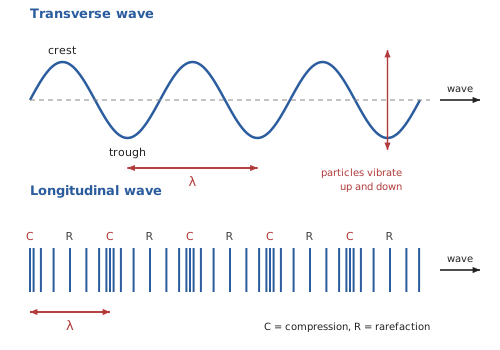
| Transverse wave | Longitudinal wave | |
|---|---|---|
| Vibration of particles | Perpendicular to the direction of propagation | Parallel to the direction of propagation |
| Made up of | Crests and troughs | Compressions and rarefactions |
| Examples | Water waves, light, radio waves | Sound waves |
Based on Physics Form 4 (DLP) textbook, Figures 5.10 and 5.11, p. 177.
Terms used to describe waves
| Term | Meaning | Unit |
|---|---|---|
| Amplitude, A | Maximum displacement of a particle from its equilibrium position | m or cm |
| Period, T | Time for one complete oscillation (or one complete wave cycle) | s |
| Frequency, f | Number of complete oscillations (or cycles) per second; f = 1/T | Hz |
| Wavelength, λ | Distance between two consecutive points that are in phase (crest to crest, compression to compression) | m |
| Wave speed, v | Distance travelled by the wave profile per second | m s⁻¹ |
In one period the wave profile moves forward by one wavelength, so v = λ/T = fλ.
f = 6 ÷ 3 = 2 Hz. v = fλ = 2 × 0.50 = 1.0 m s⁻¹. T = 1 ÷ 2 = 0.5 s.
Wave graphs
Two graphs describe a wave. Read different things from each.
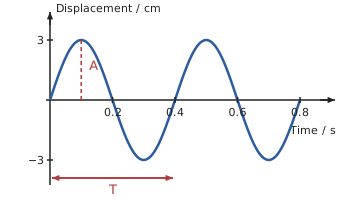 Displacement against time
Gives amplitude A and period T (so f = 1/T).
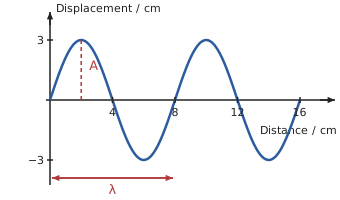 Displacement against distance
Gives amplitude A and wavelength λ.
v = λ/T = 8 ÷ 0.4 = 20 cm s⁻¹ (f = 1 ÷ 0.4 = 2.5 Hz).
Ripple tank
A ripple tank shows water waves. A plane dipper makes plane waves; a spherical dipper makes circular waves. A stroboscope flashes at the same frequency as the wave so the pattern looks frozen; measure the distance between bright fringes to get λ.
Show answerHide answer
5.2Damping and resonance
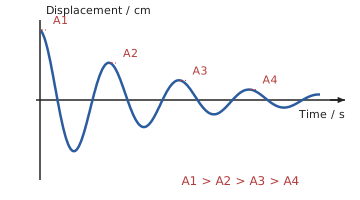
| Type | Energy is lost to |
|---|---|
| External damping | Overcoming friction or air resistance |
| Internal damping | Stretching and compression of the particles in the system itself |
The damping can be overcome by a periodic external force that supplies energy to replace the energy lost. The system is then in forced oscillation.
- Tuning forks: when fork P is struck, fork Q of the same natural frequency vibrates and gives out sound without being touched.
- Barton's pendulum: the pendulum with the same length (same natural frequency) as the driver pendulum swings with the largest amplitude.
| Effect of resonance | Example |
|---|---|
| Harmful | The Tacoma Narrows bridge (1940) collapsed when wind made it oscillate with large amplitude; the Millennium Footbridge in London swayed when about 2 000 people walked on it. |
| Useful | Tuning of musical instruments. |
Show answerHide answer
5.3Reflection of waves
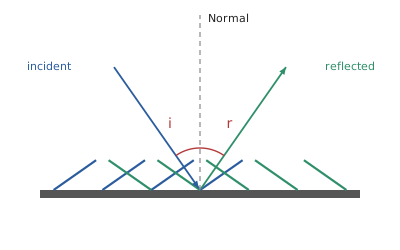
| Characteristic | After reflection |
|---|---|
| Angle | Angle of incidence = angle of reflection |
| Wavelength | No change |
| Frequency | No change |
| Speed | No change |
| Direction of propagation | Changes |
Drawing a reflection
- Draw the incident ray perpendicular to the incident wavefronts.
- Draw the normal at the point where the ray meets the reflector.
- Draw the reflected ray so that r = i.
- Draw reflected wavefronts perpendicular to the reflected ray, with the same spacing (wavelength) as the incident ones.
Uses
- Ultrasound scanning of a foetus or internal organs.
- Parabolic dish of a satellite reflects radio waves onto the antenna.
- SONAR: finds fish and the depth of the sea from echoes. Seismic reflection finds oil and gas under the seabed.
The distance travelled is 2d: 2d = vt = 1 500 × 0.120 = 180 m, so depth d = 90 m.
λ = v/f = 1 500 ÷ 25 000 = 0.06 m.
Show answerHide answer
5.4Refraction of waves
Water wave speed depends on depth: faster in deep water, slower in shallow water. Sound speed depends on air density (temperature); light speed depends on optical density.
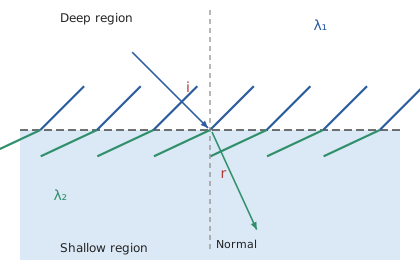
| Characteristic | Deep to shallow | Shallow to deep |
|---|---|---|
| Speed | Decreases | Increases |
| Wavelength | Decreases | Increases |
| Frequency | No change | No change |
| Direction | Towards the normal (i > r) | Away from the normal (i < r) |
8/2 = 12/λ₂, so λ₂ = 12 × 2 ÷ 8 = 3 cm.
Refraction in daily life
- Day: air near the ground is hotter, sound travels faster there and bends away from the ground, so distant sound is weak.
- Night: air near the ground is colder, sound bends towards the ground and is heard more clearly.
- Sea waves: shallow water at a cape slows the waves and bends the wavefronts to follow the shore; energy converges at the cape, so amplitude is larger there than in the bay.
Show answerHide answer
5.5Diffraction of waves
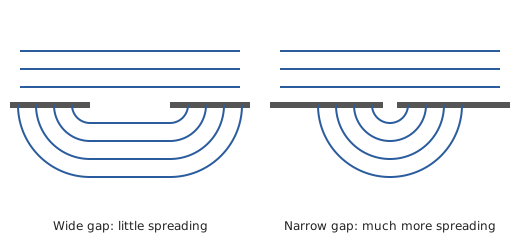
| Characteristic | After diffraction | Reason |
|---|---|---|
| Wavelength | No change | Speed and frequency are the same |
| Frequency | No change | Same source |
| Speed | No change | Same medium |
| Amplitude | Decreases | Energy is spread over a wider region |
| Direction | One direction to many directions | Wavefronts spread out |
Factors: diffraction is more obvious when the gap is narrower (close to the wavelength) and when the wavelength is longer.
Examples
- Water: a gap in an embankment makes a calm region, good for docking ships and recreation.
- Light: holograms on bank cards use diffraction of light.
- Sound: you hear someone round a corner, even though you cannot see them; elephants use long-wavelength infrasound to communicate over long distances.
Show answerHide answer
5.6Interference of waves
| Superposition of | Result | Type |
|---|---|---|
| Crest + crest (A + A) | Displacement 2A | Constructive interference |
| Trough + trough (−A − A) | Displacement −2A | Constructive interference |
| Crest + trough (A − A) | Displacement 0 | Destructive interference |
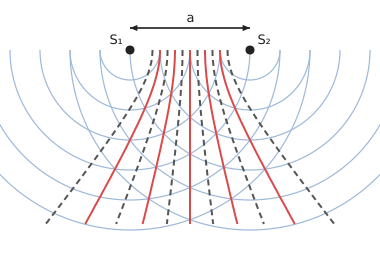
| Water | Light | Sound | |
|---|---|---|---|
| Constructive | Large amplitude (bright area on screen) | Bright fringe | Loud sound |
| Destructive | Zero amplitude (dark / grey area) | Dark fringe | Soft sound |
The formula λ = ax / D
- a = distance between the two coherent sources (or double slits)
- x = distance between two adjacent antinodal (or nodal) lines, or adjacent bright fringes
- D = perpendicular distance from the sources to where x is measured
- x is larger when λ is larger or D is larger.
- x is smaller when a is larger.
λ = ax/D = (0.4 × 10⁻³)(4.5 × 10⁻³) ÷ 3.0 = 6.0 × 10⁻⁷ m.
Uses of destructive interference
- The bulbous bow of a ship makes waves that cancel the hull waves, so there is less drag.
- Anti-reflection coatings on spectacle lenses cancel reflected light.
- Noise-cancelling headphones make sound that cancels the surrounding noise.
Show answerHide answer
5.7Electromagnetic waves
Young showed in 1801 that light is a wave; Maxwell proposed in 1862 that light is an electromagnetic wave; Hertz produced radio waves in 1887.
- Need no medium; can travel through a vacuum.
- Speed in vacuum c = 3.00 × 10⁸ m s⁻¹; slower in any other medium.
- Can be reflected, refracted, diffracted and show interference.
- Use c = fλ (in vacuum or air).
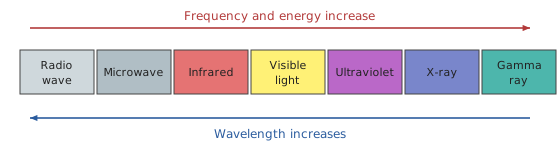
From radio waves to gamma rays: wavelength decreases while frequency and energy increase. Gamma rays and X-rays carry large amounts of energy and must be handled carefully.
| Wave | Applications |
|---|---|
| Radio wave | Radio and TV broadcasting, long-distance communication, Wi-Fi and Bluetooth, airport body scanning |
| Microwave | Satellite communication, mobile phones, radar and speed traps, microwave ovens |
| Infrared | Grills and toasters, night vision, TV remote controls, drying paint, treating muscle pain |
| Visible light | Seeing, photography, photosynthesis, lasers and optical fibres |
| Ultraviolet | Hardening tooth fillings, checking banknotes, treating jaundice, sterilising, purifying water |
| X-ray | Finding broken bones, checking welds, airport baggage scanning |
| Gamma ray | Killing cancer cells, sterilising medical equipment and food |
The frequency is unchanged: f = 3.00 × 10⁸ ÷ 700 × 10⁻⁹ = 4.29 × 10¹⁴ Hz.
λ in glass = v/f = 2.00 × 10⁸ ÷ 4.29 × 10¹⁴ = 4.67 × 10⁻⁷ m (467 nm). Equivalent: λ₂ = 700 × (2.00 ÷ 3.00) = 467 nm.
Show answerHide answer
Summary
| Remember | Key fact |
|---|---|
| Wave speed | v = fλ; f = 1/T; c = fλ for electromagnetic waves |
| Wave types | Vibration perpendicular / parallel to wave direction |
| Damping | Amplitude falls, frequency constant |
| Resonance | Driving frequency = natural frequency |
| Reflection | i = r; λ, f and v unchanged |
| Refraction | f unchanged; v and λ change; v₁/λ₁ = v₂/λ₂ |
| Diffraction | λ, f, v unchanged; amplitude falls |
| Interference | Constructive: crest + crest; destructive: crest + trough |