Heat
What this chapter covers
- Explain thermal equilibrium and use it to calibrate a liquid-in-glass thermometer with two fixed points (4.1)
- Define heat capacity and specific heat capacity, and solve problems using Q = mcΔθ and Pt = mcΔθ (4.2)
- Explain applications of specific heat capacity in daily life, materials and nature (4.2)
- Explain latent heat, specific latent heat of fusion and of vaporisation, and read heating and cooling curves (4.3)
- Solve problems using Q = ml and describe applications such as the refrigerator and cooling by evaporation (4.3)
- Explain gas pressure, temperature and volume with the kinetic theory of gas (4.4)
- State and apply Boyle's, Charles' and Gay-Lussac's laws, using absolute temperature in kelvin (4.4)
4.1Thermal equilibrium
When a hot object P touches a cold object Q, heat flows from P to Q faster than from Q to P. The temperature of P falls and the temperature of Q rises, until both are equal. After that, heat still moves in both directions but at the same rate, so there is no net flow.
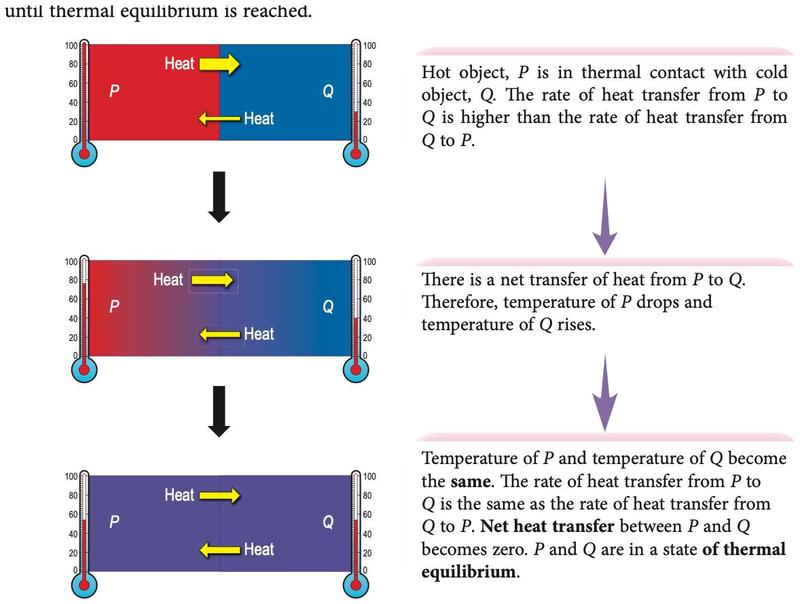
Textbook figure: Physics Form 4 KSSM (DLP), Figure 4.2, p. 121.
| Situation | How thermal equilibrium is used |
|---|---|
| Clinical thermometer under the tongue | Heat flows from the body to the thermometer until both have the same temperature, so the reading is the body temperature |
| Food in a refrigerator | Heat flows from the food to the cold air until they reach the same temperature, so the food stays fresh longer |
| Ice cubes in a drink | Ice absorbs heat from the drink and melts; the drink cools until equilibrium |
Calibrating a liquid-in-glass thermometer
A thermometer with no scale is calibrated with two fixed points of distilled water: the melting point of ice, 0 °C (lower fixed point) and the boiling point of water, 100 °C (upper fixed point). The thermometric property used is the length of the liquid column, which changes with temperature.
2. Put the bulb in boiling distilled water. When the column stops moving, mark it as 100 °C. Measure this length as L100.
3. For an unknown liquid, measure the length from the 0 °C mark as Lθ. Then θ = (Lθ ÷ L100) × 100 °C.
θ = (10 ÷ 25) × 100 = 40 °C.
Show answerHide answer
4.2Specific heat capacity
Specific heat capacity, c is the heat needed to raise the temperature of 1 kg of a substance by 1 °C: c = Q ÷ (mΔθ), unit J kg−1 °C−1 (or J kg−1 K−1).
Heat capacity depends on the mass of the object, while specific heat capacity depends only on the material. The heat absorbed or released is Q = mcΔθ. For an electric heater of power P switched on for time t, Q = Pt, so Pt = mcΔθ.
| Substance | c / J kg−1 °C−1 | Substance | c / J kg−1 °C−1 |
|---|---|---|---|
| Water | 4 200 | Aluminium | 900 |
| Sea water | 3 900 | Iron | 450 |
| Cooking oil | 1 850 | Copper | 390 |
| Wood | 1 700 | Gold | 300 |
| Sand | 800 | Lead | 130 |
Values selected from Table 4.2, p. 128.
Worked examples
Δθ = 50 − 20 = 30 °C. c = Pt ÷ (mΔθ) = (80 × 90) ÷ (0.60 × 30) = 400 J kg−1 °C−1.
Assumption: all the heat from the heater is absorbed by the block and none is lost to the surroundings.
Heat released = heat absorbed: 0.02 × 4200 × (100 − y) = 0.20 × 4200 × (y − 28).
Cancel 4200: 2 − 0.02y = 0.20y − 5.6, so 7.6 = 0.22y and y = 34.5 °C.
Assumption: no heat is lost to the surroundings or the glass.
Applications
| Example | Reason |
|---|---|
| Water in a car radiator | High c: absorbs a large amount of engine heat with a small rise in temperature |
| Metal wok and aluminium pot body | Low c: heats up quickly |
| Plastic handle, clay pot, wooden houses | High c: heats up slowly, so it is safe to touch or keeps heat in or out |
| Space capsule outer layer | High specific heat capacity and high melting point resist the heat from air friction |
| Sea breeze (day) | Land has a lower c than sea, so land gets hotter; hot air above land rises and cooler sea air moves inland |
| Land breeze (night) | Land cools faster than sea; warmer air over the sea rises and cooler air from land moves out to sea |
Show answerHide answer
4.3Specific latent heat
Specific latent heat of fusion, lf: solid and liquid. Specific latent heat of vaporisation, lv: liquid and gas.
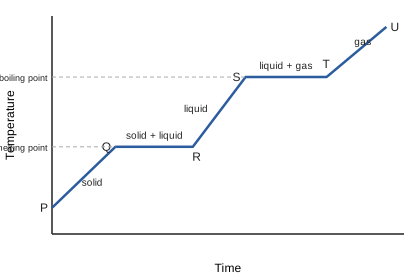
On the flat parts of the curve the heat supplied does not raise the average kinetic energy of the molecules. It is used to weaken the bonds (melting) or break the bonds and separate the molecules far apart (boiling). So the temperature stays constant. On a cooling curve the flat parts show heat being released as bonds form again.
| Water | Value |
|---|---|
| lf of ice | 3.34 × 10⁵ J kg−1 |
| lv of water | 2.26 × 10⁶ J kg−1 |
For the same substance lv is larger than lf, because the molecules must be completely separated when a liquid boils.
Pt = mlf → 480 × 120 = 0.172 × lf → lf = 57 600 ÷ 0.172 = 3.35 × 10⁵ J kg−1.
Stage 1: Q1 = mcΔθ = 0.75 × 4200 × 70 = 220 500 J.
Stage 2: Q2 = mlv = 0.75 × 2.26 × 106 = 1 695 000 J.
Total Q = Q1 + Q2 = 1.92 × 10⁶ J.
Applications
- Evaporation cools: liquid molecules absorb latent heat from the surroundings (for example sweat takes heat from the body; air flow speeds up evaporation).
- Ice cubes cool a drink: melting ice absorbs lf from the drink.
- Steaming food: steam condenses on the food and releases lv, which heats the food.
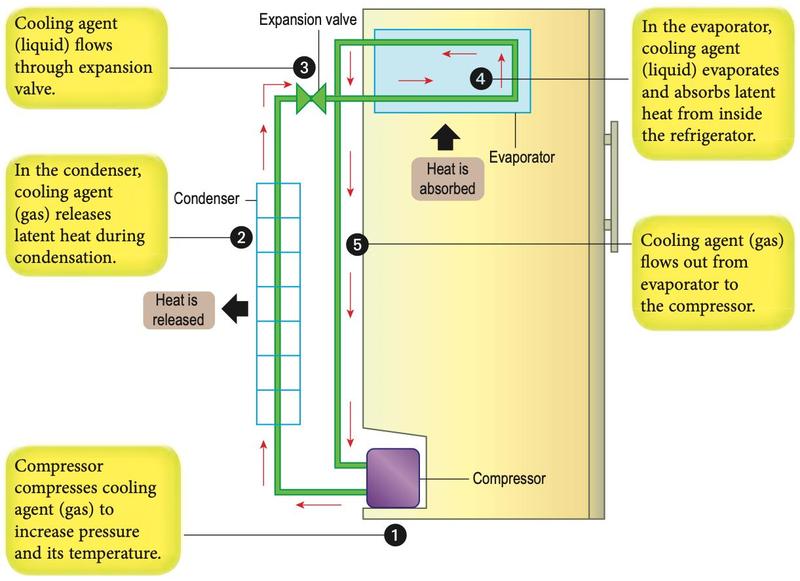
Textbook figure: Physics Form 4 KSSM (DLP), Figure 4.21, p. 145.
Show answerHide answer
4.4Gas laws
Gas molecules move randomly and fill their container. Pressure is the force per unit area produced when molecules collide with the walls. A higher temperature means a greater average kinetic energy. Volume of a gas is the volume of its container.
| Quantity | S.I. unit | Other units |
|---|---|---|
| Pressure, P | pascal (Pa) | cm Hg, kPa |
| Temperature, T | kelvin (K) | °C |
| Volume, V | m3 | cm3, ml |
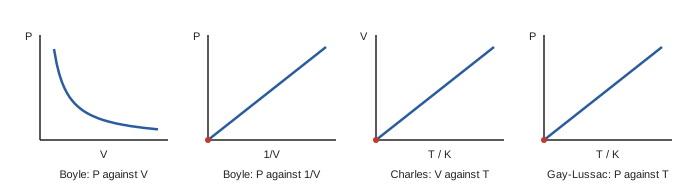
| Law | Statement | Constant | Formula | Kinetic theory explanation |
|---|---|---|---|---|
| Boyle | P is inversely proportional to V | Mass and temperature | P1V1 = P2V2 | Smaller volume: more molecules per unit volume, more frequent collisions, so more force per area |
| Charles | V is directly proportional to T (kelvin) | Mass and pressure | V1/T1 = V2/T2 | Hotter: faster molecules, so volume must increase to keep the collision rate and pressure unchanged |
| Gay-Lussac | P is directly proportional to T (kelvin) | Mass and volume | P1/T1 = P2/T2 | Hotter: faster molecules hit the walls more often and harder, so pressure increases |
P2 = (108 × 60) ÷ 48 = 135 kPa.
V2 = (1.2 × 320) ÷ 300 = 1.28 cm3.
P2 = (180 × 325) ÷ 298 = 196 kPa (196.3).