Gravitation
What this chapter covers
- State Newton's Universal Law of Gravitation and use F = Gm₁m₂/r² (3.1)
- Relate g to G and calculate g on the Earth, at a height h and on other bodies (3.1)
- Explain centripetal force and use F = mv²/r and a = v²/r for satellites and planets (3.1)
- Calculate the mass of the Earth or the Sun from an orbit using M = 4π²r³/GT² (3.1)
- State Kepler's three laws and use T₁²/T₂² = r₁³/r₂³ (3.2)
- Find the linear speed of a satellite, v = √(GM/r), and compare geostationary and non-geostationary satellites (3.3)
- Define escape velocity, calculate it with v = √(2GM/R) and explain its benefits and implications (3.3)
3.1Newton's universal law of gravitation
In 1687 Isaac Newton showed that the gravitational force, F, between two bodies depends on two things: it is directly proportional to the product of their masses and inversely proportional to the square of the distance between their centres.
- Larger masses give a larger force.
- Doubling the distance makes the force one quarter.
- Two people standing 1 m apart feel almost no pull on each other (50 kg and 70 kg gives only about 2.3 × 10⁻⁷ N) because their masses are tiny.
F = (6.67 × 10⁻¹¹)(5.97 × 1024)(2.0) ÷ (6.37 × 10⁶)2 = 19.6 N (this is its weight, mg with g = 9.81).
Show answerHide answer
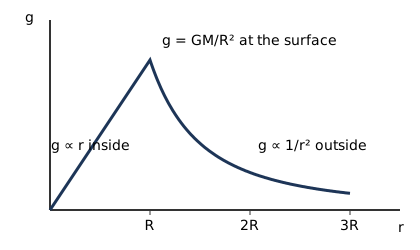
Gravitational acceleration, g
Weight is a gravitational force, so mg = GMm/r2. The mass m of the object cancels:
- g depends on the mass of the planet and the distance from its centre, not on the mass of the object.
- Earth's surface: 6.67 × 10−11 × 5.97 × 1024 ÷ (6.37 × 10⁶)2 = 9.81 m s−2.
- A satellite at h = 480 km: g = GM/(R + h)2 = 8.49 m s−2, a little less than at the surface.
Show answerHide answer
Centripetal force and satellites
Even at constant speed the direction keeps changing, so the body accelerates. In the textbook activity the tension in the string is the centripetal force: more weights on the string means a faster whirl, and a smaller radius needs a larger force. For a satellite or planet, gravitational force acts as the centripetal force.
F = mv2/r = 7.2 × 202 ÷ 1.8 = 1 600 N.
Mass of the Earth or the Sun
Equate gravitational force and centripetal force for an orbiting body, then use v = 2πr/T:
M = 4π2(3.83 × 10⁸)3 ÷ [(6.67 × 10⁻¹¹)(2.36 × 10⁶)2] = 5.97 × 1024 kg.
3.2Kepler's Laws
| Law | Statement | What it means |
|---|---|---|
| First (law of orbits) | Planets move in elliptical orbits with the Sun at one focus | The distance to the Sun changes; most planetary orbits are almost circular |
| Second (law of areas) | A line joining a planet to the Sun sweeps out equal areas in equal times | A planet moves faster when it is nearer the Sun |
| Third (law of periods) | T2 is directly proportional to r3 | Planets further from the Sun take longer to orbit (Earth 1 year, Saturn 29.5 years) |
From gravitational force = centripetal force: T2 = (4π2/GM)r3. The same law applies to satellites around the Earth, with M the Earth's mass. To compare two orbits around the same body:
r23 = r13 × (T2/T1)2, so r2 = 1.50 × 1011 × 1.882/3 = 2.28 × 10¹¹ m.
Show answerHide answer
3.3Man-made satellites
Higher orbits mean slower satellites. GPS satellite at 20 200 km: r = 2.657 × 10⁷ m, v = 3.87 × 10³ m s−1. If a satellite's speed drops below the required value, it falls to a lower orbit and may burn up in the atmosphere.
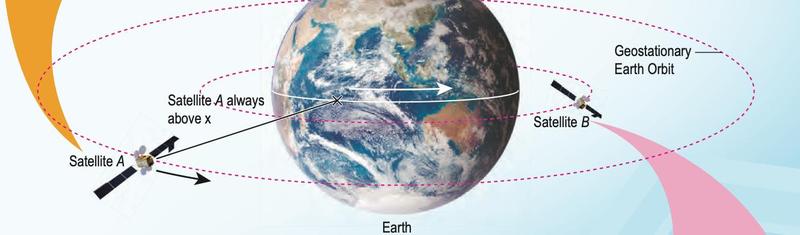
Geostationary and non-geostationary satellites: textbook Figure 3.36, p. 105.
| Geostationary | Non-geostationary | |
|---|---|---|
| Orbital period | 24 hours (same as Earth's rotation) | Shorter or longer than 24 hours |
| Direction | Same as Earth's rotation | Need not be the same |
| Position | Always above the same place | Above different places at different times |
| Examples and uses | MEASAT, communication | GPS, ISS, weather and imaging (e.g. RazakSAT) |
Escape velocity
- It depends on the mass and radius of the planet, not on the mass of the object. Escape velocity from the Earth is 11.2 km s−1 (11 200 m s−1).
- Benefit: air molecules (about 500 m s−1) cannot escape, so the Earth keeps its atmosphere; aircraft fly high without leaving the Earth.
- Implication: rockets need huge amounts of fuel to reach this speed.
- Mars has a low escape velocity (about 5.0 km s−1) and thin air; Jupiter's is about 60 km s−1.