Physics questions, chapter 3
Nama / NameKelas / ClassTarikh / Date
Gravitation
43 marks. Use Practice to check each answer as you go, or Exam to answer everything against the clock first. G = 6.67 × 10⁻¹¹ N m² kg⁻², mass of the Earth = 5.97 × 10²⁴ kg, radius of the Earth = 6.37 × 10⁶ m.
Section A: objective questions
13 marksChoose the best answer for each question.
1
Question 1
Which statement is Newton's Universal Law of Gravitation?
Show answerHide answer
B
F = Gm₁m₂/r²: proportional to m₁m₂ and inversely proportional to r² (textbook p. 80).
2
Question 2
The distance between two bodies is doubled while their masses stay the same. The gravitational force becomes
Show answerHide answer
D
F ∝ 1/r². Doubling r divides F by 2² = 4.
3
Question 3
Which quantity does the gravitational acceleration, g, at a point near a planet NOT depend on?
Show answerHide answer
C
g = GM/r². The mass of the object cancels out.
4
Question 4
A piece of space junk of mass 24 kg is 7.00 × 10⁶ m from the centre of the Earth. What is the gravitational force between the junk and the Earth?
Show answerHide answer
A
F = (6.67 × 10⁻¹¹)(5.97 × 10²⁴)(24) ÷ (7.00 × 10⁶)² = 195 N.
5
Question 5
A satellite is 4.20 × 10⁷ m from the centre of the Earth. What is the gravitational acceleration at this position?
Show answerHide answer
B
g = GM/r² = (6.67 × 10⁻¹¹)(5.97 × 10²⁴) ÷ (4.20 × 10⁷)² = 0.226 m s⁻². It is small but not zero.
6
Question 6
What is the orbital period of a geostationary satellite?
Show answerHide answer
D
A geostationary satellite has the same period as the Earth's rotation, 24 hours.
7
Question 7
Which force provides the centripetal force that keeps a satellite in orbit around the Earth?
Show answerHide answer
A
Gravitational force acts towards the centre of the Earth and acts as the centripetal force. The satellite needs no engine in orbit.
8
Question 8
A satellite of mass 400 kg orbits at radius 8.2 × 10⁶ m with linear speed 6.96 × 10³ m s⁻¹. What is the centripetal force on it?
Show answerHide answer
C
F = mv²/r = 400 × (6.96 × 10³)² ÷ 8.2 × 10⁶ = 2.36 × 10³ N ≈ 2.4 × 10³ N.
9
Question 9
The Earth orbits the Sun at r = 1.50 × 10¹¹ m in 1 year. Saturn's orbital radius is 1.43 × 10¹² m. What is Saturn's orbital period?
Show answerHide answer
B
T₂ = 1 × (1.43 × 10¹² ÷ 1.50 × 10¹¹)^(3/2) = 9.53^1.5 = 29.4 years.
10
Question 10
Escape velocity from a planet depends on
Show answerHide answer
C
v = √(2GM/R) contains only the mass and radius of the planet; the mass of the object does not appear.
11
Question 11
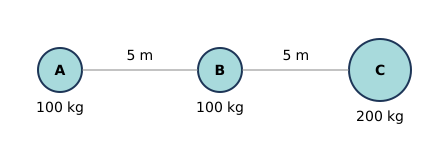
Diagram 1 shows three bodies in a line. The gravitational force between A and B is P. What is the gravitational force between B and C?
Show answerHide answer
D
B and C are the same 5 m apart as A and B, but C has twice the mass of A. F ∝ m₁m₂, so the force is 2P.
12
Question 12
Satellite Q orbits the Earth at four times the orbital radius of satellite P. Compared with P, the linear speed of Q is
Show answerHide answer
A
v = √(GM/r), so v ∝ 1/√r. Four times the radius gives 1/√4 = 1/2 of the speed.
13
Question 13
According to Kepler's second law, a planet in an elliptical orbit moves fastest when it is
Show answerHide answer
C
The line to the Sun sweeps equal areas in equal times, so the planet must move faster when it is closer to the Sun.
Section B: structured questions
30 marksAnswer all questions. Write your answers in the spaces provided.
14
Question 14
Mars (mass m) moves in a circular orbit of radius r around the Sun (mass M) with orbital period T and linear speed v.
[3 marks]
(a)Write the formula for the gravitational force on Mars, the centripetal force on Mars and its linear speed.
Show answerHide answer
Tick each point you got.
[2 marks]
(b)Derive an expression for the mass of the Sun in terms of r and T.
Show answerHide answer
Tick each point you got.
[2 marks]
(c)r = 2.28 × 10¹¹ m and T = 687 days. Calculate the mass of the Sun.
Show answerHide answer
Tick each point you got.
15
Question 15
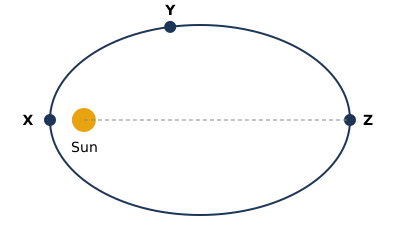
Diagram 2 shows a planet in an elliptical orbit around the Sun. X is the point nearest the Sun and Z is the furthest.
[1 mark]
(a)State Kepler's second law.
Show answerHide answer
Tick each point you got.
[1 mark]
(b)Compare the linear speed of the planet at X, Y and Z.
Show answerHide answer
Tick each point you got.
[1 mark]
(c)Explain your answer to (b).
Show answerHide answer
Tick each point you got.
16
Question 16
A weather satellite orbits the Earth at a height of 560 km. Mass of the satellite is 1 200 kg.
[2 marks]
(a)Calculate the gravitational acceleration at the position of the satellite.
Show answerHide answer
Tick each point you got.
[2 marks]
(b)Another satellite, Proba-1, orbits at a height of 700 km. Calculate its linear speed.
Show answerHide answer
Tick each point you got.
[1 mark]
(c)Why does the linear speed of a satellite not depend on its mass?
Show answerHide answer
Tick each point you got.
17
Question 17
Escape velocity is calculated with v = √(2GM/R).
[1 mark]
(a)What is meant by escape velocity?
Show answerHide answer
Tick each point you got.
[2 marks]
(b)Planet Saturn has mass 5.68 × 10²⁶ kg and radius 6.03 × 10⁷ m. Calculate the escape velocity of Saturn.
Show answerHide answer
Tick each point you got.
[1 mark]
(c)Saturn's rings are made of small particles. Why do they not escape into outer space?
Show answerHide answer
Tick each point you got.
18
Question 18
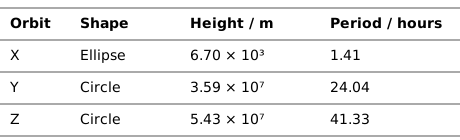
Table 1 shows three possible orbits X, Y and Z around the Earth. Satellite P is an Earth imaging satellite and satellite Q is a communication satellite.
[2 marks]
(a)Which orbit is suitable for satellite Q? Explain.
Show answerHide answer
Tick each point you got.
[2 marks]
(b)Which orbit is suitable for satellite P? Explain.
Show answerHide answer
Tick each point you got.
19
Question 19
The Moon orbits the Earth at radius 3.83 × 10⁸ m with a period of 27.3 days.
[1 mark]
(a)State Kepler's third law.
Show answerHide answer
Tick each point you got.
[2 marks]
(b)Calculate the orbital radius of a geostationary satellite (T = 1 day).
Show answerHide answer
Tick each point you got.
[1 mark]
(c)What is the height of the satellite above the surface of the Earth?
Show answerHide answer
Tick each point you got.
20
Question 20
A space agency plans a communication satellite that stays above one point on Mars. Mars has mass 6.42 × 10²³ kg, radius 3.40 × 10⁶ m and one rotation takes 24.6 hours.
[1 mark]
(a)State the orbital period the satellite should have.
Show answerHide answer
Tick each point you got.
[2 marks]
(b)Calculate the orbital radius needed. Use r³ = GMT²/4π².
Show answerHide answer
Tick each point you got.