Physics questions, chapter 4
Nama / NameKelas / ClassTarikh / Date
Heat
46 marks. Use Practice to check each answer as you go, or Exam to answer everything against the clock first.
Section A: objective questions
10 marksChoose the best answer for each question.
1
Question 1
Which statement describes two objects in thermal equilibrium?
Show answerHide answer
C
At thermal equilibrium the two objects are at the same temperature. Heat flows both ways at the same rate, so the net heat transfer is zero (textbook p. 121).
2
Question 2
Which pair of fixed points is used to calibrate a liquid-in-glass thermometer?
Show answerHide answer
A
The two fixed points are the melting point of ice (0 °C) and the boiling point of distilled water (100 °C).
3
Question 3
An uncalibrated thermometer has a length of 20 cm between the ice point (0 °C) and the steam point (100 °C). When the bulb is put in a liquid, the liquid column is 6 cm long, measured from the ice point. What is the temperature of the liquid?
Show answerHide answer
B
θ = (6 ÷ 20) × 100 = 30 °C.
4
Question 4
Water is used as the cooling agent in a car radiator because water
Show answerHide answer
D
Water has a high specific heat capacity, so it absorbs a large amount of heat from the engine with only a small rise in temperature.
5
Question 5
Equal masses of water, aluminium, iron and copper receive the same amount of heat. Which one has the greatest rise in temperature? (Specific heat capacities: water 4 200, aluminium 900, iron 450, copper 390 J kg⁻¹ °C⁻¹)
Show answerHide answer
A
Δθ = Q ÷ mc. For the same Q and m, the substance with the smallest c has the largest Δθ, which is copper.
6
Question 6
A liquid boils at a constant temperature although heat is still supplied. What happens to the heat absorbed?
Show answerHide answer
B
The latent heat is used to break the bonds and separate the molecules, not to raise their average kinetic energy. So the temperature stays constant.
7
Question 7
The air in a sealed syringe has a volume of 30 cm³ and a pressure of 200 kPa. The temperature stays constant. What is the pressure when the volume is reduced to 15 cm³?
Show answerHide answer
C
Boyle's law: P₁V₁ = P₂V₂, so P₂ = (200 × 30) ÷ 15 = 400 kPa.
8
Question 8
A fixed mass of gas has a volume of 250 cm³ at 27 °C. It is heated to 87 °C at constant pressure. What is the new volume?
Show answerHide answer
A
Convert to kelvin: T₁ = 300 K, T₂ = 360 K. V₂ = 250 × 360 ÷ 300 = 300 cm³. Using °C directly would give a wrong value of about 805 cm³.
9
Question 9
A gas in a rigid container is at 27 °C. At what temperature will its pressure be twice the original value?
Show answerHide answer
B
At constant volume P ∝ T (kelvin). T₁ = 300 K, so T₂ = 600 K = 327 °C. Doubling the Celsius value (54 °C) is a common error.
10
Question 10
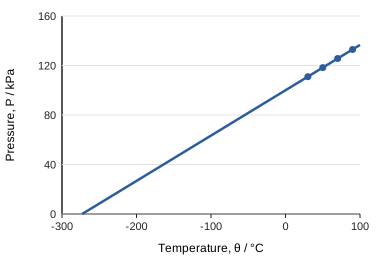
Diagram 1 shows the graph of pressure against temperature for a fixed mass of gas at constant volume. At what temperature does the straight line, extended, meet the axis where P = 0?
Show answerHide answer
D
Extrapolating the graph to P = 0 gives absolute zero, −273 °C (0 K).
Section B: structured questions
36 marksAnswer all questions. Write your answers in the spaces provided.
11
Question 11
A clinical thermometer is placed under the tongue of a patient.
[1 mark]
(a)What is meant by thermal equilibrium?
Show answerHide answer
Tick each point you got.
[2 marks]
(b)Explain why the thermometer must be left under the tongue for a short time before it is read.
Show answerHide answer
Tick each point you got.
12
Question 12
0.30 kg of water at 80 °C is mixed with 0.60 kg of water at 20 °C in an insulated container. [Specific heat capacity of water = 4 200 J kg⁻¹ °C⁻¹]
[1 mark]
(a)State the principle used to find the final temperature.
Show answerHide answer
Tick each point you got.
[3 marks]
(b)Calculate the final temperature of the mixture.
Show answerHide answer
Tick each point you got.
[1 mark]
(c)State one assumption you made.
Show answerHide answer
Tick each point you got.
13
Question 13
Explain each of the following using specific heat capacity.
[2 marks]
(a)The body of a cooking pot is made of aluminium but its handle is made of plastic.
Show answerHide answer
Tick each point you got.
[2 marks]
(b)A sea breeze blows from the sea to the land during the day.
Show answerHide answer
Tick each point you got.
14
Question 14
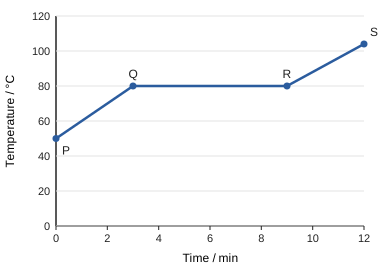
A solid of mass 0.20 kg is heated by a 50 W heater. Diagram 2 shows how its temperature changes with time. Assume all the heat from the heater is absorbed by the substance.
[1 mark]
(a)What is the melting point of the substance?
Show answerHide answer
Tick each point you got.
[2 marks]
(b)Explain why the temperature stays constant from Q to R although heat is still supplied.
Show answerHide answer
Tick each point you got.
[2 marks]
(c)Calculate the heat absorbed from Q to R.
Show answerHide answer
Tick each point you got.
[2 marks]
(d)Calculate the specific latent heat of fusion of the substance.
Show answerHide answer
Tick each point you got.
15
Question 15
An electric kettle of power 1.5 kW changes 0.40 kg of water at 25 °C into steam at 100 °C. [c of water = 4 200 J kg⁻¹ °C⁻¹; l_v of water = 2.26 × 10⁶ J kg⁻¹]
[2 marks]
(a)Calculate the heat needed to raise the temperature of the water to 100 °C.
Show answerHide answer
Tick each point you got.
[2 marks]
(b)Calculate the heat needed to change the water at 100 °C into steam.
Show answerHide answer
Tick each point you got.
[3 marks]
(c)Calculate the total heat and the time taken by the kettle.
Show answerHide answer
Tick each point you got.
16
Question 16
The end of a syringe is closed. It contains 60 cm³ of air at a pressure of 102 kPa. The piston is pushed in slowly until the volume is 24 cm³.
[1 mark]
(a)State Boyle's law.
Show answerHide answer
Tick each point you got.
[2 marks]
(b)Calculate the pressure of the compressed air.
Show answerHide answer
Tick each point you got.
[2 marks]
(c)Explain, using the kinetic theory of gas, why the pressure increases.
Show answerHide answer
Tick each point you got.
17
Question 17
Use the gas laws to answer the following.
[1 mark]
(a)Convert 17 °C to kelvin.
Show answerHide answer
Tick each point you got.
[2 marks]
(b)An air bubble under a leaf has a volume of 3.0 cm³ at 17 °C. Calculate its volume when the water warms to 37 °C. Pressure is constant.
Show answerHide answer
Tick each point you got.
[2 marks]
(c)A sealed gas cylinder at 27 °C has a pressure of 250 kPa. It is heated to 177 °C. Calculate the new pressure.
Show answerHide answer
Tick each point you got.