Physics questions, chapter 5
Nama / NameKelas / ClassTarikh / Date
Waves
46 marks. Use Practice to check each answer as you go, or Exam to answer everything against the clock first.
Section A: objective questions
12 marksChoose the best answer for each question.
1
Question 1
What does a wave transfer from one place to another?
Show answerHide answer
B
Waves transfer energy without transferring the matter of the medium (a ribbon on a slinky only vibrates on the spot).
2
Question 2
Which statement describes a stationary wave?
Show answerHide answer
D
In a stationary wave (e.g. a plucked guitar string) the wave profile does not propagate; particles still vibrate.
3
Question 3
Sound is a longitudinal wave. How do the air particles vibrate?
Show answerHide answer
A
In a longitudinal wave the particles vibrate parallel to the direction in which the wave moves, forming compressions and rarefactions.
4
Question 4
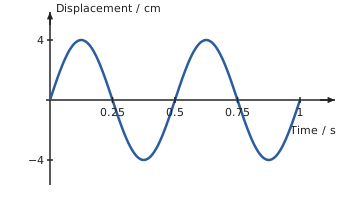
Diagram 1 shows a graph of displacement against time for a wave. What is the frequency of the wave?
Show answerHide answer
C
One cycle takes T = 0.50 s, so f = 1/T = 1 ÷ 0.50 = 2.0 Hz.
5
Question 5
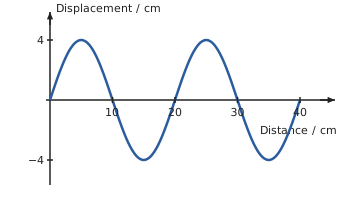
Diagram 2 shows two graphs for the same wave. What is the speed of the wave?
Show answerHide answer
B
λ = 20 cm and T = 0.50 s, so v = λ/T = 20 ÷ 0.50 = 40 cm s⁻¹ (or f = 2 Hz, v = 2 × 20).
6
Question 6
A driver pendulum of length 40 cm is hung on the same string as four other pendulums: P (20 cm), Q (30 cm), R (50 cm) and S (40 cm). It is set swinging. Which pendulum oscillates with the largest amplitude?
Show answerHide answer
D
S has the same length, hence the same natural frequency, as the driver. It is in resonance and oscillates with maximum amplitude.
7
Question 7
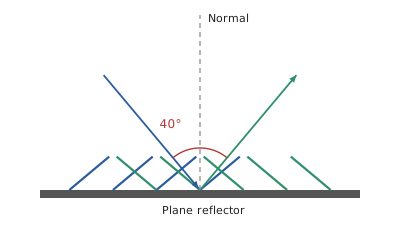
Plane water waves of wavelength 2 cm hit a plane reflector. The incident wavefronts make an angle of 30° with the reflector. What are the angle of reflection and the wavelength of the reflected waves?
Show answerHide answer
A
The angle between the wavefront and the reflector equals the angle of incidence, 30°. So r = i = 30°. Reflection does not change the wavelength (2 cm).
8
Question 8
Water waves of wavelength 3.0 cm travel at 24 cm s⁻¹ in a deep region. They enter a shallow region where the wavelength is 2.0 cm. What is the speed in the shallow region?
Show answerHide answer
C
Frequency is constant, so v₁/λ₁ = v₂/λ₂: 24/3.0 = v₂/2.0, hence v₂ = 16 cm s⁻¹.
9
Question 9
Plane water waves move from a deep region into a shallow region. Which is correct?
Show answerHide answer
B
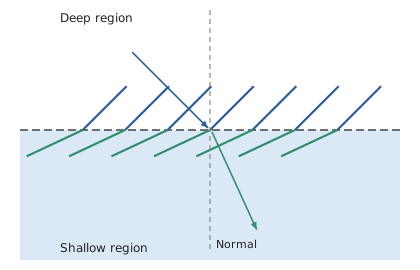
In shallow water the speed falls, so the wavelength decreases. Frequency is unchanged and the waves bend towards the normal.
10
Question 10
In which situation is the diffraction of water waves most obvious?
Show answerHide answer
D
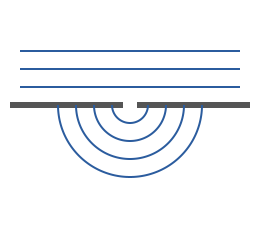
Diffraction is more obvious when the gap is narrower and when the wavelength is longer.
11
Question 11
In a Young's double-slit experiment the slit separation is 0.50 mm, the screen is 1.2 m from the slits and adjacent bright fringes are 1.5 mm apart. What is the wavelength of the light?
Show answerHide answer
C
λ = ax/D = (0.50 × 10⁻³)(1.5 × 10⁻³) ÷ 1.2 = 6.25 × 10⁻⁷ m. Convert mm to m first.
12
Question 12
Which electromagnetic wave carries the most energy?
Show answerHide answer
A
Energy is proportional to frequency. Gamma rays have the highest frequency in the spectrum.
Section B: structured questions
34 marksAnswer all questions. Write your answers in the spaces provided.
13
Question 13
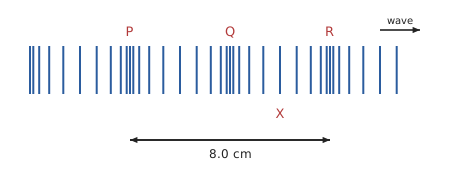
Diagram 3 shows a wave moving through a spring. P, Q and R are compressions.
[1 mark]
(a)What type of wave is shown?
Show answerHide answer
Longitudinal
The coils vibrate parallel to the direction of the wave.
[1 mark]
(b)Name the region marked X.
Show answerHide answer
Tick each point you got.
[2 marks]
(c)Find the wavelength of the wave.
Show answerHide answer
Tick each point you got.
[2 marks]
(d)The frequency of the wave is 50 Hz. Calculate its speed.
Show answerHide answer
Tick each point you got.
14
Question 14
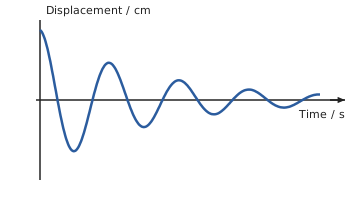
Diagram 4 shows the graph of displacement against time for a simple pendulum.
[1 mark]
(a)Name the phenomenon shown by the graph.
Show answerHide answer
Tick each point you got.
[2 marks]
(b)State what happens to (i) the amplitude and (ii) the frequency of the pendulum.
Show answerHide answer
Tick each point you got.
[1 mark]
(c)Explain why the amplitude decreases.
Show answerHide answer
Tick each point you got.
15
Question 15
Diagram 5 shows plane water waves of wavelength 2.0 cm and frequency 8.0 Hz striking a plane reflector. The angle of incidence is 40°.
[1 mark]
(a)State the angle of reflection.
Show answerHide answer
Tick each point you got.
[2 marks]
(b)Calculate the speed of the reflected waves.
Show answerHide answer
Tick each point you got.
[2 marks]
(c)A ship sends an ultrasonic pulse to the seabed and receives the echo 0.10 s later. The speed of the pulse in water is 1 500 m s⁻¹. Calculate the depth of the sea.
Show answerHide answer
Tick each point you got.
16
Question 16
Diagram 6 shows plane water waves of frequency 10 Hz moving from a deep region P into a shallow region Q. The wavelength in P is 3.0 cm and in Q is 1.8 cm.
[1 mark]
(a)Calculate the speed of the waves in region P.
Show answerHide answer
Tick each point you got.
[2 marks]
(b)Calculate the speed of the waves in region Q.
Show answerHide answer
Tick each point you got.
[2 marks]
(d)Explain why the waves bend towards the normal in region Q.
Show answerHide answer
Tick each point you got.
17
Question 17
Diagram 7 shows plane water waves passing through a narrow gap in a barrier.
[1 mark]
(a)Name the phenomenon shown.
Show answerHide answer
Tick each point you got.
[2 marks]
(b)Compare the wavelength of the waves before and after the gap. Give a reason.
Show answerHide answer
Tick each point you got.
[2 marks]
(c)State and explain what happens to the amplitude after the gap.
Show answerHide answer
Tick each point you got.
18
Question 18
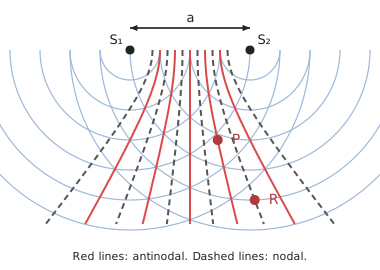
Diagram 8 shows the interference pattern formed by two coherent sources, S₁ and S₂, in a ripple tank. P lies on an antinodal line and R lies on a nodal line.
[1 mark]
(a)What is meant by coherent sources?
Show answerHide answer
Tick each point you got.
[2 marks]
(b)State the type of interference at P and explain how it is formed.
Show answerHide answer
Tick each point you got.
[2 marks]
(c)What is the displacement of the water at R? Explain your answer.
Show answerHide answer
Tick each point you got.
19
Question 19
Electromagnetic waves are used in many ways in medicine and daily life.
[1 mark]
(a)Arrange microwave, ultraviolet, X-ray and infrared in order of increasing frequency.
Show answerHide answer
Tick each point you got.
[2 marks]
(b)Green light of wavelength 540 nm in air (speed 3.00 × 10⁸ m s⁻¹) passes into a liquid where its speed is 2.25 × 10⁸ m s⁻¹. Calculate its wavelength in the liquid.
Show answerHide answer
Tick each point you got.
[1 mark]
(c)Hospital staff must leave the room while gamma rays sterilise surgical instruments. Explain why.
Show answerHide answer
Tick each point you got.