Force and Motion I
What this chapter covers
- Distinguish distance, displacement, speed, velocity and acceleration, and use ticker tape and photogates to measure them (2.1)
- Use the four equations of uniformly accelerated linear motion to solve problems (2.1)
- Interpret and sketch displacement-time, velocity-time and acceleration-time graphs, and use gradients and areas (2.2)
- Explain free fall and gravitational acceleration, and solve problems on objects thrown upwards or dropped (2.3)
- Explain inertia and its relationship with mass using Newton's First Law (2.4)
- Calculate momentum and apply the Principle of Conservation of Momentum to collisions and explosions (2.5)
- Use F = ma and Newton's Second Law to solve problems (2.6)
- Explain impulse and impulsive force, with Newton's Third Law, and their uses and safety applications (2.7)
- Distinguish mass and weight and use W = mg and gravitational field strength (2.8)
2.1Linear motion
| Distance | Displacement | |
|---|---|---|
| Meaning | Length of the route covered | Shortest distance from the initial to the final position, in a specific direction |
| Type of quantity | Scalar (size only) | Vector (size and direction) |
| Depends on the route? | Yes | No, only on the start and end points |
| Quantity | Formula | S.I. unit |
|---|---|---|
| Speed (scalar) | speed = distance travelled ÷ time taken | m s−1 |
| Velocity (vector) | v = s ÷ t (rate of change of displacement) | m s−1 |
| Acceleration (vector) | a = (v − u) ÷ t (rate of change of velocity) | m s−2 |
Distance = 60 + 20 = 80 m. Displacement = 60 − 20 = 40 m east.
Speed = 80 ÷ 40 = 2 m s−1. Velocity = 40 ÷ 40 = 1 m s−1 east.
Ticker timer and ticker tape
A ticker timer on a 50 Hz supply makes 50 dots every second, so 1 tick = 1/50 = 0.02 s. A tape pulled by a moving object records both displacement and time.
| Time | Number of ticks |
|---|---|
| 0.02 s | 1 tick |
| 0.10 s | 5 ticks |
| 0.20 s | 10 ticks |
- Dots equally spaced: uniform velocity. Spacing getting larger: acceleration. Spacing getting smaller: deceleration.
- Velocity = length of a strip ÷ (number of ticks × 0.02 s).
- Acceleration = (final velocity − initial velocity) ÷ time between the two strips.
- A photogate and electronic timer is more accurate than a ticker timer: there is no tape friction, and the timer reads to 0.001 s.
Equations of uniformly accelerated motion
s = ½(u + v)t (2)
s = ut + ½at2 (3)
v2 = u2 + 2as (4)
u = initial velocity, v = final velocity, a = acceleration, s = displacement, t = time. Write down the given values, choose the equation that contains the unknown and the quantities you know, then substitute.
u = 8, v = 0, s = 2. Use v2 = u2 + 2as: 0 = 64 + 4a, so a = −16 m s−2 (opposite to the motion).
Show answerHide answer
2.2Linear motion graphs
| Graph | Gradient gives | Area under graph gives |
|---|---|---|
| Displacement-time | Velocity | (not used) |
| Velocity-time | Acceleration | Displacement |
| Acceleration-time | (not used) | Change in velocity |
- Displacement-time: horizontal line = at rest; straight sloping line = uniform velocity; curve getting steeper = acceleration; downward slope = moving in the negative direction.
- Velocity-time: horizontal line = uniform velocity; sloping straight line = uniform acceleration; below the axis = moving in the negative direction.
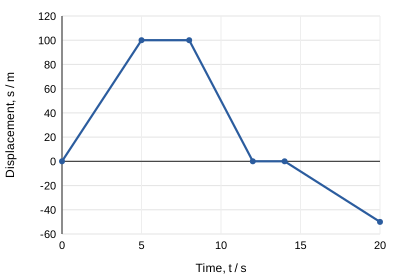
For this journey the distance is 100 + 100 + 50 = 250 m but the displacement is −50 m. Average speed = 250 ÷ 20 = 12.5 m s−1; average velocity = −50 ÷ 20 = −2.5 m s−1.
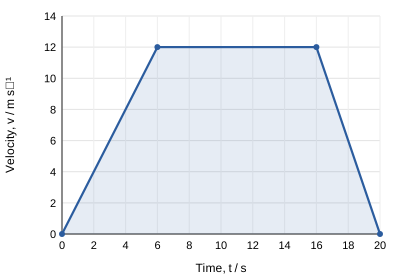
Show answerHide answer
2.3Free fall motion
- In air, a feather falls slower than a steel ball because of air resistance; in a vacuum they reach the floor together.
- g = 9.81 m s−2 on the Earth's surface in calculations. It is 9.78 at the equator and 9.83 at the poles because the Earth is not a perfect sphere (the poles are nearer the centre).
- In an experiment with two photogates, g = 2h ÷ (t22 − t12).
Use the linear motion equations with a = g. Take upward as positive, so g = −9.81 m s−2 for an object going up or down.
Time up: 0 = 10 − 9.81t, so t = 1.02 s. Maximum height: 0 = 102 + 2(−9.81)s, so s = 5.10 m.
Show answerHide answer
2.4Inertia
Newton's First Law: an object remains at rest or moves at uniform velocity unless acted on by an external force.
- Inertia and mass: the larger the mass, the larger the inertia. An inertial balance shows this: a larger mass oscillates with a longer period. It is used to measure mass in zero gravity (astronauts on the ISS).
- Effects: passengers lurch forward when a bus brakes; raindrops fly off a stopped umbrella; sauce leaves a bottle when it is jerked and stopped; tankers have separate tanks so the fuel does not surge; seat belts hold passengers back.
Show answerHide answer
2.5Momentum
The Principle of Conservation of Momentum: in a closed system with no external force, the total momentum before a collision equals the total momentum after it.
- Collision: bodies that stick together move with a common velocity: m1u1 + m2u2 = (m1 + m2)v.
- Explosion: an object at rest breaks into parts: 0 = m1v1 + m2v2, so the parts move in opposite directions (rockets, guns recoiling).
Show answerHide answer
2.6Force
- At constant mass, acceleration is directly proportional to the force: a ∝ F (straight line through the origin on an a–F graph).
- At constant force, acceleration is inversely proportional to mass: a ∝ 1/m (straight line through the origin on an a–1/m graph).
F = ma 1 N is the force that gives a 1 kg mass an acceleration of 1 m s−2.
2.7Impulse and impulsive force
Impulsive force is the rate of change of momentum in a collision over a short time: F = (mv − mu) ÷ t.
For the same change of momentum, F ∝ 1/t. A short impact time gives a large force; a long impact time gives a small force.
| Aim | How | Example |
|---|---|---|
| Large impulse | Follow-through (longer contact) | Kicking a football, golf swing |
| Small force | Longer impact time | Crumple zone, airbag, bending the knees on landing, cushion |
| Large force | Shorter impact time | Hammer, pestle on a mortar |
Newton's Third Law: for every action there is a reaction of equal magnitude in the opposite direction. The action and reaction act on different bodies (a rower pushes water back, water pushes the boat forward).
2.8Weight
| Mass | Weight | |
|---|---|---|
| Meaning | Amount of matter | Gravitational force on the object |
| Type | Scalar | Vector |
| Unit | kg | N |
| Changes with place? | No | Yes (depends on g) |