Physics questions, chapter 2
Nama / NameKelas / ClassTarikh / Date
Force and Motion I
43 marks. Use Practice to check each answer as you go, or Exam to answer everything against the clock first. Take g = 9.81 m s⁻² where needed.
Section A: objective questions
16 marksChoose the best answer for each question.
1
Question 1
Which of the following is a vector quantity?
Show answerHide answer
C
Displacement has both magnitude and direction. Distance, speed and time have magnitude only (textbook Table 2.1, p. 26).
2
Question 2
A ticker timer is connected to an alternating current supply of frequency 50 Hz. What is the time interval of one tick?
Show answerHide answer
B
50 ticks are made in 1 s, so one tick = 1/50 = 0.02 s.
3
Question 3
A runner moves 150 m due east and then 50 m due west. What is the displacement of the runner?
Show answerHide answer
B
Displacement = 150 − 50 = 100 m, in the east direction. (The distance is 200 m.)
4
Question 4
A car increases its velocity from rest to 24 m s⁻¹ in 8 s. What is its acceleration?
Show answerHide answer
D
a = (v − u) ÷ t = (24 − 0) ÷ 8 = 3.0 m s⁻².
5
Question 5
A car travelling at 20 m s⁻¹ brakes uniformly and stops after 40 m. What is its acceleration?
Show answerHide answer
A
v² = u² + 2as gives 0 = 20² + 2a(40), so 80a = −400 and a = −5.0 m s⁻². The negative sign shows deceleration.
6
Question 6
A strip of ticker tape with 5 ticks is 4.0 cm long. What is the average velocity of the object that pulled the tape?
Show answerHide answer
D
Time = 5 × 0.02 = 0.10 s. Velocity = 4.0 ÷ 0.10 = 40 cm s⁻¹.
7
Question 7
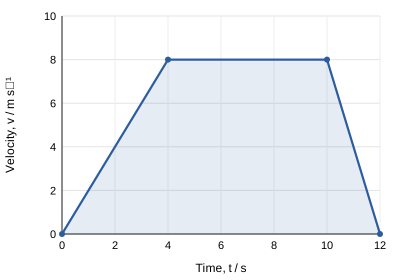
Diagram 1 shows the velocity-time graph of a toy car. What is the total displacement of the toy car in 12 s?
Show answerHide answer
C
Displacement = area under the graph = ½(6 + 12) × 8 = 72 m (a trapezium).
8
Question 8
What does the gradient of a displacement-time graph represent?
Show answerHide answer
A
Gradient of a displacement-time graph = change in displacement ÷ time = velocity. The gradient of a velocity-time graph is acceleration.
9
Question 9
What is meant by free fall?
Show answerHide answer
D
An object is in free fall when the only force acting on it is gravity, so there is no air resistance or friction.
10
Question 10
A stone is released from rest and falls freely for 3.0 s. What is its velocity just before it hits the ground? [g = 9.81 m s⁻²]
Show answerHide answer
C
v = u + gt = 0 + 9.81 × 3.0 = 29.4 m s⁻¹.
11
Question 11
A ball is thrown vertically upwards at 14 m s⁻¹. What is the maximum height it reaches? [Ignore air resistance, g = 9.81 m s⁻²]
Show answerHide answer
B
At the top v = 0. v² = u² + 2gs gives 0 = 14² − 2(9.81)s, so s = 196 ÷ 19.62 = 10.0 m.
12
Question 12
Passengers in a moving bus are thrown forward when the bus brakes suddenly. This happens because of
Show answerHide answer
A
Inertia is the tendency to keep the state of motion. The passengers continue to move forward while the bus slows down.
13
Question 13
A lorry of mass 1 200 kg moves at 15 m s⁻¹. What is its momentum?
Show answerHide answer
D
p = mv = 1 200 × 15 = 18 000 kg m s⁻¹.
14
Question 14
A trolley of mass 2 kg moving at 3 m s⁻¹ collides with a stationary trolley of mass 1 kg. They stick together. What is their common velocity?
Show answerHide answer
C
2(3) + 1(0) = (2 + 1)v, so v = 6 ÷ 3 = 2.0 m s⁻¹ (conservation of momentum).
15
Question 15
A resultant force of 600 N acts on a car of mass 1 500 kg. What is the acceleration of the car?
Show answerHide answer
B
a = F ÷ m = 600 ÷ 1 500 = 0.40 m s⁻².
16
Question 16
A cricketer pulls his hands backwards while catching a fast ball. How does this reduce the pain in his hands?
Show answerHide answer
A
The change of momentum is the same, but F = (mv − mu) ÷ t. A longer impact time gives a smaller impulsive force.
Section B: structured questions
27 marksAnswer all questions. Show your working.
17
Question 17
Dina walks 60 m due east and then 20 m back due west. The journey takes 40 s.
[1 mark]
(a)Calculate the distance travelled.
Show answerHide answer
Tick each point you got.
[1 mark]
(b)Calculate the displacement.
Show answerHide answer
Tick each point you got.
[1 mark]
(c)Calculate the average speed.
Show answerHide answer
Tick each point you got.
[1 mark]
(d)Calculate the average velocity.
Show answerHide answer
Tick each point you got.
[1 mark]
(e)Why are the average speed and the magnitude of the average velocity different?
Show answerHide answer
Any 1 points
Tick each point you got.
18
Question 18
A trolley pulls a ticker tape through a ticker timer of frequency 50 Hz. The tape is cut into strips of 5 ticks each. The first strip is 2.0 cm long and the fifth strip is 6.0 cm long.
[1 mark]
(a)What is the time taken for 5 ticks?
Show answerHide answer
Tick each point you got.
[1 mark]
(b)Calculate the initial velocity, using the first strip.
Show answerHide answer
Tick each point you got.
[1 mark]
(c)Calculate the final velocity, using the fifth strip.
Show answerHide answer
Tick each point you got.
[2 marks]
(d)The time between the first and the fifth strip is 0.40 s. Calculate the acceleration of the trolley.
Show answerHide answer
Tick each point you got.
19
Question 19
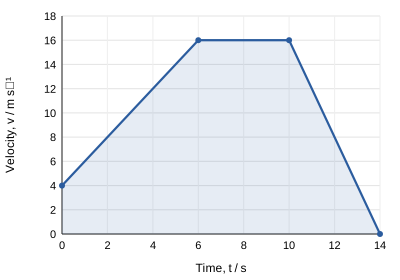
Diagram 2 shows the velocity-time graph of a lorry for 14 s.
[1 mark]
(a)Calculate the acceleration of the lorry from 0 s to 6 s.
Show answerHide answer
Tick each point you got.
[1 mark]
(b)Describe the motion of the lorry from 6 s to 10 s.
Show answerHide answer
Tick each point you got.
[2 marks]
(c)Calculate the total displacement of the lorry.
Show answerHide answer
Tick each point you got.
[1 mark]
(d)Calculate the average velocity of the lorry.
Show answerHide answer
Tick each point you got.
20
Question 20
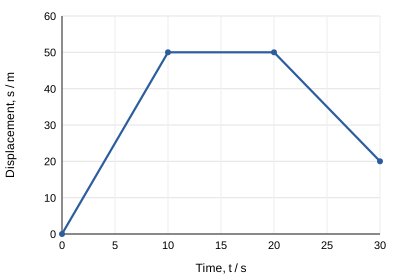
Diagram 3 shows the displacement-time graph of a cyclist.
[1 mark]
(a)Calculate the velocity of the cyclist from 0 s to 10 s.
Show answerHide answer
Tick each point you got.
[1 mark]
(b)What is the cyclist doing from 10 s to 20 s?
Show answerHide answer
Tick each point you got.
[1 mark]
(c)Calculate the velocity from 20 s to 30 s and state what the sign shows.
Show answerHide answer
Tick each point you got.
[1 mark]
(d)Calculate the total distance travelled in 30 s.
Show answerHide answer
Tick each point you got.
21
Question 21
Aiman drops a stone from rest from a bridge. The stone hits the water after 2.0 s. [Ignore air resistance, g = 9.81 m s⁻²]
[1 mark]
(a)Calculate the velocity of the stone just before it hits the water.
Show answerHide answer
Tick each point you got.
[1 mark]
(b)Calculate the height of the bridge above the water.
Show answerHide answer
Tick each point you got.
[2 marks]
(c)Aiman says, "A heavy stone always falls faster than a light stone." Evaluate his statement.
Show answerHide answer
Tick each point you got.
22
Question 22
In a crash test, a car of mass 1 000 kg moving at 20 m s⁻¹ hits a wall and stops in 0.50 s.
[1 mark]
(a)Calculate the momentum of the car before the crash.
Show answerHide answer
Tick each point you got.
[1 mark]
(b)Calculate the impulse acting on the car.
Show answerHide answer
Tick each point you got.
[1 mark]
(c)Calculate the average impulsive force.
Show answerHide answer
Tick each point you got.
[1 mark]
(d)Suggest one safety feature that you would design for the car to reduce the impulsive force on the passengers, and explain how it works.
Show answerHide answer
Tick each point you got.