Additional Mathematics notes, chapter 2
Differentiation
Textbook Additional Mathematics Form 5 (DLP), pages 28–79
What this chapter covers
- Find the limit of a function by direct substitution, factorisation and rationalisation, and relate limits to the gradient of a tangent (2.1)
- Find the first derivative of a function from first principles, by the power rule, chain rule, product rule and quotient rule (2.2)
- Find the second derivative of a function (2.3)
- Find the gradient, tangent and normal to a curve, and solve problems on turning points, maximum and minimum values (2.4)
- Solve problems on rates of change of related quantities, and use small changes to find approximate values and percentage changes (2.4)
2.1Limit and its relation to differentiation
Limit. If f(x) gets closer and closer to a number L as x gets closer to a (but x ≠ a), we write limx→a f(x) = L. The limit is the value the function approaches; f(a) itself need not exist.
Example from the textbook (p. 30): f(x) = x²+3xx cannot be evaluated at x = 0 (it gives 00), yet as x gets close to 0 from the left or the right, f(x) gets close to 3. So limx→0 f(x) = 3.
| Form of limx→a f(x) | What to do |
|---|---|
| f(a) is a number | Direct substitution: the limit is f(a) |
| 00 with polynomials | Factorise, cancel the common factor, then substitute |
| 00 with a square root | Multiply the top (or bottom) by its conjugate, simplify, then substitute |
Example (textbook p. 32 method): find each limit
(a) limx→2 x²−5x+6x−2: direct substitution gives 00. Factorise: (x−2)(x−3)x−2 = x − 3, so the limit is 2 − 3 = −1.(b) limx→0 √(x+9) − 3x: multiply by √(x+9)+3√(x+9)+3. The top becomes (x + 9) − 9 = x, which cancels with x, leaving 1√(x+9)+3. At x = 0 this is 16. The limit is 16.
Writing limx→a f(x) = 00 is a mistake. 00 only means "cannot decide yet": simplify first, then substitute.
Find limx→−3 x²−9x+3.
Show answerHide answer
(x+3)(x−3)x+3 = x − 3. At x = −3 the limit is −6.
First derivative by first principles
The gradient of a curve at a point is the gradient of the tangent there. Take B(x, y) and a nearby point C(x + δx, y + δy) on the curve. The gradient of the chord BC is δyδx. As C moves towards B, δx → 0 and the chord becomes the tangent.
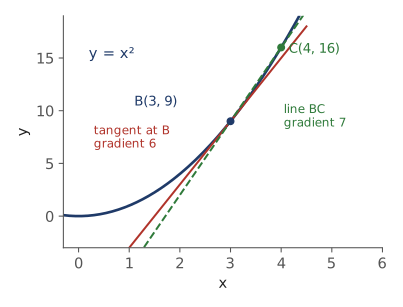
First derivative by first principles: dydx = limδx→0 δyδx = limδx→0 f(x+δx) − f(x)δx. It is the gradient function of the curve.
The four steps (textbook p. 36): (1) take two points on the curve; (2) find δy = f(x + δx) − f(x); (3) divide by δx; (4) let δx → 0.
Example (textbook p. 36 method): y = 4x² − x
δy = 4(x + δx)² − (x + δx) − (4x² − x) = 8x·δx + 4(δx)² − δxδyδx = 8x + 4δx − 1
dydx = limδx→0 (8x + 4δx − 1) = 8x − 1
dydx is one symbol for the limit. It is not "dy divided by dx" and you cannot cancel the d's.
2.2The first derivative
Power rule. If y = axn (a is a constant, n is an integer or a fraction), then dydx = anxn−1. Other notations: f′(x), ddx(axn).
| Function | Derivative | Why |
|---|---|---|
| y = c (a constant) | 0 | n = 0 |
| y = ax | a | n = 1 |
| y = 5x³ | 15x² | 5 × 3 · x3−1 |
| y = 3x² = 3x−2 | −6x−3 = −6x³ | Rewrite as a power first |
| y = √x = x1/2 | 12x−1/2 = 12√x | Fractional power |
Rewrite roots and fractions as powers of x before differentiating. Terms joined by + or − are differentiated one at a time.
Example (textbook p. 40–41): differentiate y = 2x⁴ − 6x + 5√x − 9
y = 2x⁴ − 6x−1 + 5x1/2 − 9dydx = 8x³ + 6x−2 + 52x−1/2 = 8x³ + 6x² + 52√x
x−2 is not the same as −x². And the derivative of a constant like 9 is 0, not 9.
Chain rule (composite functions)
Chain rule. If y is a function of u and u is a function of x, then dydx = dydu × dudx. For y = (ax + b)n: dydx = n·a(ax + b)n−1.
Example (textbook p. 43 method): y = (5 − 2x)⁴ and y = 1√(3x+1)
Let u = 5 − 2x. dydu = 4u³ and dudx = −2, so dydx = 4(5 − 2x)³ × (−2) = −8(5 − 2x)³.y = (3x + 1)−1/2, so dydx = −12(3x + 1)−3/2 × 3 = −32(3x+1)3/2.
After differentiating the bracket, do not forget to multiply by the derivative of what is inside it.
Product rule and quotient rule
| Rule | Formula (u and v are functions of x) |
|---|---|
| Product | ddx(uv) = udvdx + vdudx |
| Quotient | ddx(uv) = vdudx − udvdxv², v ≠ 0 |
Say the quotient rule as "bottom times derivative of top, minus top times derivative of bottom, over bottom squared". The order of the subtraction matters.
Example (textbook p. 46–47 method)
(a) y = x³(2x − 1)4. u = x³, v = (2x − 1)4: dydx = x³ · 8(2x − 1)³ + (2x − 1)⁴ · 3x² = x²(2x − 1)³[8x + 3(2x − 1)] = x²(2x − 1)³(14x − 3).(b) y = xx²+4. dydx = (x²+4)(1) − x(2x)(x²+4)² = 4 − x²(x²+4)².
Find dydx for y = 3xx+2 and its value at x = 1.
Show answerHide answer
dydx = (x+2)(3) − 3x(1)(x+2)² = 6(x+2)². At x = 1: 69 = 23.
2.3The second derivative
Second derivative. Differentiate dydx once more with respect to x: d²ydx² = ddx(dydx), also written f″(x).
Example (textbook p. 49): y = x³ + 8x
y = x³ + 8x−1dydx = 3x² − 8x−2
d²ydx² = 6x + 16x−3 = 6x + 16x³. At x = 2 it equals 12 + 2 = 14.
d²ydx² is not (dydx)². For y = 5x − 3, dydx = 5 so (dydx)² = 25, but d²ydx² = 0.
2.4Application of differentiation
Gradient, tangent and normal
| If f′(a) is | The tangent at x = a |
|---|---|
| positive | slants up to the right, the curve is rising |
| zero | is horizontal (a stationary point) |
| negative | slants down to the right, the curve is falling |
Tangent and normal at P(a, f(a)): tangent y − f(a) = f′(a)(x − a). The normal is perpendicular to the tangent, so its gradient is −1f′(a) (m₁m₂ = −1) and its equation is y − f(a) = −1f′(a)(x − a).
Example (textbook p. 53 method): f(x) = x³ − 2x² + 5 at P(2, 5)
f′(x) = 3x² − 4x, so f′(2) = 12 − 8 = 4.Tangent: y − 5 = 4(x − 2), so y = 4x − 3.
Normal gradient −14: y − 5 = −14(x − 2), so x + 4y = 22.
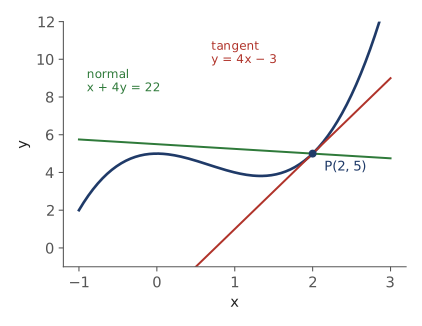
If f′(a) = 0 the tangent is horizontal and the normal is the vertical line x = a. Do not divide by zero.
Turning points and their nature
Stationary point: a point where dydx = 0. It is a maximum, a minimum or a point of inflection. Maximum and minimum points are the turning points.
| Test | Maximum | Minimum | Inflection |
|---|---|---|---|
| Sign of dydx as x increases | + then − | − then + | no change of sign |
| Second derivative at the point | d²ydx² < 0 | d²ydx² > 0 | d²ydx² = 0, so test the sign of dydx |
Example (textbook p. 59–60): y = x³ − 3x² − 9x + 11
dydx = 3x² − 6x − 9 = 3(x + 1)(x − 3) = 0, so x = −1 or x = 3.x = −1: y = 16. x = 3: y = −16.
d²ydx² = 6x − 6: at x = −1 it is −12 < 0 (maximum); at x = 3 it is 12 > 0 (minimum).
Turning points: (−1, 16) maximum and (3, −16) minimum.
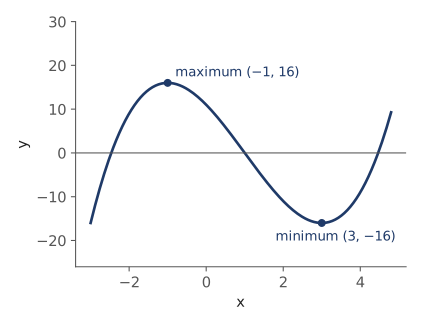
Finding x with dydx = 0 is only half the work. Substitute back into the original equation to get y, and state whether it is a maximum or minimum.
Maximum and minimum problems
- Draw a sketch and name the variables.
- Write the quantity to be maximised or minimised, and express it in one variable using the other given condition.
- Solve dAdr = 0 (or the matching derivative).
- Use the second derivative to confirm maximum or minimum, then answer in words with units.
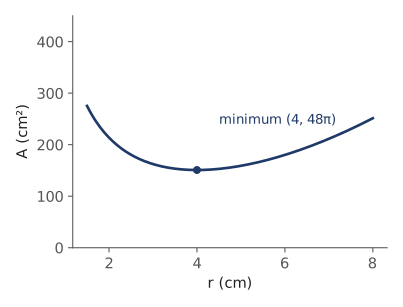
Example (textbook p. 63–64 method): open cylindrical tin, volume 64π cm³
Curved surface plus base: A = πr² + 2πrh with πr²h = 64π, so h = 64r² and A = πr² + 128πr.dAdr = 2πr − 128πr² = 0, so r³ = 64 and r = 4.
d²Adr² = 2π + 256πr³ = 6π > 0 at r = 4, so A is a minimum.
Minimum A = π(16) + 32π = 48π cm² (about 150.8 cm²) when r = 4 cm.
The sum of two positive numbers is 20. Find the largest value of their product.
Show answerHide answer
Numbers x and 20 − x: P = 20x − x². dPdx = 20 − 2x = 0, x = 10. d²Pdx² = −2 < 0, so maximum. P = 10 × 10 = 100.
Rates of change of related quantities
Chain rule for rates: if y = f(x) and x changes with time t, then dydt = dydx × dxdt. A negative rate means the quantity is decreasing.
Example (textbook p. 66 and 69 method): sphere
The radius of a sphere grows at 0.3 cm s⁻¹. Find the rate of change of its volume when r = 5 cm.V = 43πr³, so dVdr = 4πr². dVdt = 4π(5)² × 0.3 = 30π ≈ 94.25 cm³ s⁻¹.
Link the quantities with a formula first (volume, area, similar triangles). Use similar triangles to remove a variable, as in the cone problem on p. 68.
Small changes and approximations
Small change: δy ≈ dydx × δx. Hence the approximate value f(x + δx) ≈ f(x) + dydxδx. The smaller δx is, the better the approximation. Percentage change in x is δxx × 100%.
Example (textbook p. 71–73 method)
(a) Approximate √26. Take y = √x at x = 25: dydx = 12√x = 110, δx = 1, so √26 ≈ 5 + 110(1) = 5.1.(b) y = x² − 3x at x = 4 and x increases by 1%. δx = 0.04, dydx = 2x − 3 = 5, δy ≈ 5 × 0.04 = 0.2. y = 4, so the change in y is 0.24 × 100 = 5%.
The approximation only works for a small δx. Also check the sign: δy > 0 is an increase, δy < 0 is a decrease.
Summary
| Remember | Key fact |
|---|---|
| Limit | Substitute; if 00, factorise or use the conjugate |
| First principles | dydx = limδx→0 f(x+δx) − f(x)δx |
| Power rule | ddx(axn) = anxn−1 |
| Chain rule | dydx = dydu × dudx |
| Product / quotient | udvdx + vdudx ; vdudx − udvdxv² |
| Tangent | y − y₁ = f′(a)(x − a); normal gradient = −1f′(a) |
| Turning point | dydx = 0; d²ydx² < 0 max, > 0 min |
| Related rates | dydt = dydx × dxdt |
| Small change | δy ≈ dydxδx |
Content and methods follow the Additional Mathematics Form 5 (DLP) textbook, Chapter 2, pp. 28–73; examples use our own numbers.