Integration
What this chapter covers
- Explain integration as the reverse process of differentiation and find an integral from a known derivative (3.1)
- Find indefinite integrals of algebraic functions, including (ax + b)ⁿ, and find the equation of a curve from its gradient function (3.2)
- Evaluate definite integrals and use their properties (3.3)
- Find areas of regions under a curve, beside the y-axis, and between a curve and a line or another curve (3.3)
- Find the volume of revolution of a region about the x-axis or the y-axis (3.3)
- Solve problems involving integration in areas, volumes and rates (3.4)
3.1Integration as the inverse of differentiation
| Process | Starting from | Result |
|---|---|---|
| Differentiation | y = 4x² | dy/dx = 8x |
| Integration | dy/dx = 8x | y = 4x² (+ c) |
Idea from textbook p. 82-83. The symbol ∫ is a stretched letter "S" for "sum".
Integration undoes differentiation, so ∫ (5x⁴ + 3) dx = x⁵ + 3x + c.
18(2x + 1)² = 3 × 6(2x + 1)², so ∫ 18(2x + 1)² dx = 3(2x + 1)³ + c.
Show answerHide answer
3.2Indefinite integral
The basic rules
- Add 1 to the index.
- Divide by the new index.
- Add the constant c (only once for the whole expression).
Why c? Differentiating 5x, 5x + 2 and 5x − 3 all give 5, so integrating 5 can only tell us the answer is 5x + some constant.
| Integral | Working | Answer |
|---|---|---|
| ∫ 12 dx | constant | 12x + c |
| ∫ x³ dx | x3+1 ÷ (3 + 1) | x⁴4 + c |
| ∫ 2x−2 dx | 2x−1 ÷ (−1) | −2x−1 + c |
| ∫ √x dx = ∫ x1/2 dx | x3/2 ÷ 32 | 23x3/2 + c |
Sums and differences
Integrate term by term: ∫ [f(x) ± g(x)] dx = ∫ f(x) dx ± ∫ g(x) dx. Only one constant of integration is written for the whole answer.
∫ x(3 + 1x) dx = ∫ (3x + 1) dx = 3x²2 + x + c.
Show answerHide answer
Integrals of the form (ax + b)n
A bracket raised to a high power is hard to expand, so we do not expand it. Use the substitution u = ax + b, so du/dx = a and dx = du/a.
∫ 1(5x − 3)⁵ dx = ∫ (5x − 3)−5 dx = (5x − 3)−45 × (−4) + c = −120(5x − 3)⁴ + c.
Show answerHide answer
Equation of a curve from its gradient function
Integrate the gradient function dy/dx to get y. Then use a point on the curve to find c.
- y = ∫ (dy/dx) dx, with + c.
- Substitute the known x and y.
- Solve for c and write the equation.
y = 5x³ + 2x² − 3x + c. At x = −1, y = 2: 2 = −5 + 2 + 3 + c, so c = 2.
The curve is y = 5x³ + 2x² − 3x + 2. When x = 1, y = 5 + 2 − 3 + 2 = 6.
Show answerHide answer
3.3Definite integral
= [x² + x]13 = (9 + 3) − (1 + 1) = 10.
Properties
| Property | In words |
|---|---|
| ∫aa f(x) dx = 0 | Same limits give 0 |
| ∫ab f(x) dx = −∫ba f(x) dx | Swapping the limits changes the sign |
| ∫ab k f(x) dx = k ∫ab f(x) dx | A constant multiple comes outside |
| ∫ac f(x) dx + ∫cb f(x) dx = ∫ab f(x) dx | Joining two intervals |
| ∫ab [f(x) ± g(x)] dx = ∫ab f(x) dx ± ∫ab g(x) dx | Add or subtract integrals |
12h − [3x]25 = 51, so 12h − 9 = 51 and h = 5.
Show answerHide answer
Area under a curve
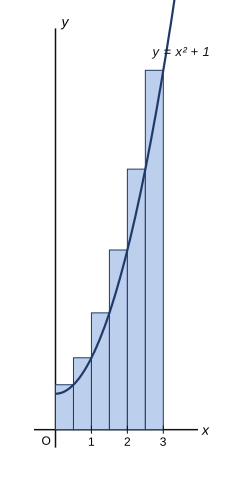
The area under y = f(x) from x = a to x = b is cut into n thin strips of width δx. The strip areas add up to Σ yi δx. As the strips become infinitely thin (n → ∞, δx → 0) the sum becomes the exact area:
Regions above and below the x-axis
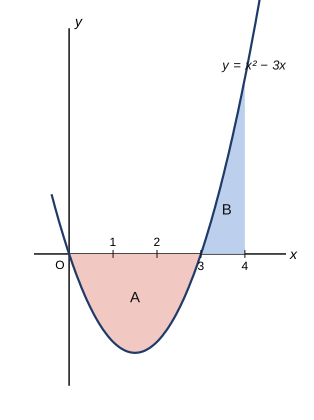
- A region above the x-axis gives a positive integral; below gives a negative integral.
- An area is always positive. Take the size (ignore the minus sign) of each part.
- If a region lies on both sides, find each part separately, then add the sizes.
B = ∫34 (x² − 3x) dx = 116.
Total area = 92 + 116 = 193 units². The single integral from 0 to 4 would give −83, which is wrong for the area.
Area between a curve and the y-axis
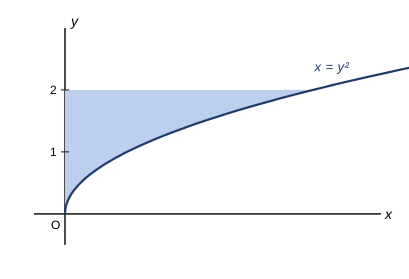
For a region between a curve x = g(y) and the y-axis from y = a to y = b, the area is ∫ab x dy. Write x in terms of y first. A region to the right of the y-axis is positive; to the left it is negative (use the size).
Area between a curve and a line, or two curves
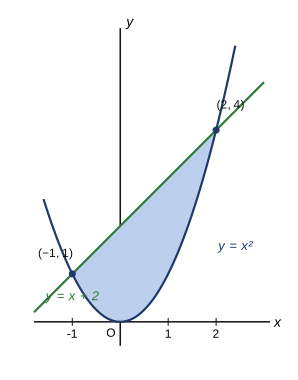
- Solve the two equations together to find where they meet. These give the limits.
- Area = ∫ (upper curve − lower curve) dx between the limits.
Show answerHide answer
Volume of revolution
Turn a region through 360° about an axis. Cut the solid into thin discs (cylinders) of thickness δx. Each has volume π y² δx, so the total volume is the limit of the sum.
About the y-axis: V = ∫ab π x² dy
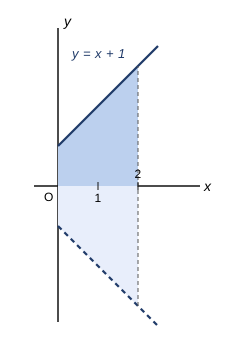
- Square y (or x) before integrating. (x + 1)² must be expanded or integrated as (ax + b)n.
- Volume is always positive, so give the answer in terms of π.
- For a region between a line and a curve revolved, find the volume for each, then subtract. Do not square the difference of the heights.
Show answerHide answer
3.4Applications of integration
Integration solves problems on areas, volumes, and quantities built up from a rate (growth, depreciation, flow, production). Use the 4-step approach from the textbook (p. 111): understand, plan, carry out, check.
V = ∫ (6t + 4) dt = 3t² + 4t + c, and c = 0 because V = 0 at t = 0.
Time for 64 litres: 3t² + 4t − 64 = 0, (3t + 16)(t − 4) = 0, so t = 4 minutes (the negative root is rejected).