Additional Mathematics notes, chapter 6
Trigonometric Functions
Textbook Additional Mathematics Form 5 (DLP), pages 188–231
What this chapter covers
- Represent positive and negative angles in a Cartesian plane, in degrees and radians, and state the quadrant of any angle (6.1)
- Relate secant, cosecant and cotangent with sine, cosine and tangent, use the complementary angle formulae, and find the ratios of any angle using a reference angle (6.2)
- Draw and sketch the graphs of y = a sin bx + c, y = a cos bx + c and y = a tan bx + c, and use them to find the number of solutions of an equation (6.3)
- Derive and use the basic identities sin²A + cos²A = 1, 1 + tan²A = sec²A and 1 + cot²A = cosec²A to prove identities (6.4)
- Use the addition and double angle formulae to find values, prove identities and solve trigonometric equations (6.5, 6.6)
6.1Positive angles and negative angles
Positive angles are measured anticlockwise from the positive x-axis. Negative angles are measured clockwise from the positive x-axis.
One full turn is 360° or 2π rad. The quadrant of an angle is found by taking away whole turns until the angle lies between 0° and 360° (or 0 and 2π rad).
| Quadrant | Angle in degrees | Angle in radians |
|---|---|---|
| I | 0° to 90° | 0 to π/2 |
| II | 90° to 180° | π/2 to π |
| III | 180° to 270° | π to 3π/2 |
| IV | 270° to 360° | 3π/2 to 2π |
To change units, use π rad = 180°. Degrees to radians: multiply by π/180°. Radians to degrees: multiply by 180°/π. Also 60′ = 1°.
Example 1 (textbook p. 192): quadrant of an angle
(a) 800° − 2(360°) = 80°, so 800° = 2(360°) + 80° and lies in Quadrant I.(b) 19π/6 − 2π = 7π/6, which is between π and 3π/2, so 19π/6 rad lies in Quadrant III.
For a negative angle, add whole turns instead. −735° + 3(360°) = 345°, so −735° is in Quadrant IV. Do not decide the quadrant from the minus sign alone.
State the quadrant of (a) 500° (b) −135°
Show answerHide answer
(a) 500° − 360° = 140°, Quadrant II
(b) −135° + 360° = 225°, Quadrant III
(b) −135° + 360° = 225°, Quadrant III
6.2Trigonometric ratios of any angle
Secant, cosecant and cotangent
For a right-angled triangle: sin θ = opposite/hypotenuse, cos θ = adjacent/hypotenuse, tan θ = opposite/adjacent. The reciprocals are cosec θ = 1/sin θ, sec θ = 1/cos θ and cot θ = 1/tan θ.
Example 2 (textbook p. 193)
A triangle ABC has a right angle at B, AB = 8 cm and BC = 6 cm, with θ at A. Then AC = √(6² + 8²) = 10 cm.cosec θ = 10/6 = 1.667 sec θ = 10/8 = 1.25 cot θ = 8/6 = 1.333
There is no calculator key for cosec, sec or cot. Use the reciprocal key: sec 56° = 1/cos 56° = 1.788.
Complementary angles
Angles A and B are complementary if A + B = 90°. Then each ratio of θ equals the "co-ratio" of 90° − θ.
| sin θ = cos (90° − θ) | cos θ = sin (90° − θ) | tan θ = cot (90° − θ) |
|---|---|---|
| sec θ = cosec (90° − θ) | cosec θ = sec (90° − θ) | cot θ = tan (90° − θ) |
Write sin 35° as the cosine of an angle, and find cosec 20° to 3 decimal places.
Show answerHide answer
sin 35° = cos (90° − 35°) = cos 55°
cosec 20° = 1/sin 20° = 2.924
cosec 20° = 1/sin 20° = 2.924
Ratios of any angle
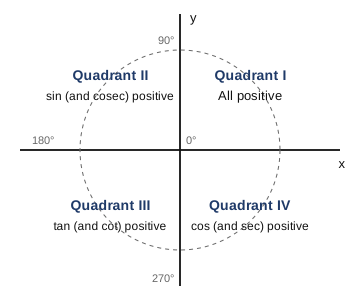
- Find the reference angle α: the acute angle between the line and the x-axis. Quadrant II: 180° − θ. Quadrant III: θ − 180°. Quadrant IV: 360° − θ.
- Find the ratio of α from the special angles or a calculator.
- Give the sign from the quadrant.
| θ | 0° | 30° | 45° | 60° | 90° |
|---|---|---|---|---|---|
| sin θ | 0 | 1/2 | √2/2 | √3/2 | 1 |
| cos θ | 1 | √3/2 | √2/2 | 1/2 | 0 |
| tan θ | 0 | √3/3 | 1 | √3 | undefined |
Example (textbook p. 197): exact values
(a) sin 210°: Quadrant III, reference angle 30°, sin is negative, so sin 210° = −1/2.(b) cos 315°: Quadrant IV, reference angle 45°, cos is positive, so cos 315° = √2/2.
(c) tan 120°: Quadrant II, reference angle 60°, tan is negative, so tan 120° = −√3.
Giving the reference angle's ratio without checking the sign. cos 240° is −1/2, not 1/2, because cosine is negative in Quadrant III.
Find the exact value of (a) cos 150° (b) tan 225° (c) cosec 300°
Show answerHide answer
(a) Quadrant II, reference 30°, cos negative: −√3/2
(b) Quadrant III, reference 45°, tan positive: 1
(c) Quadrant IV, sin 300° = −√3/2, so cosec 300° = −2/√3
(b) Quadrant III, reference 45°, tan positive: 1
(c) Quadrant IV, sin 300° = −√3/2, so cosec 300° = −2/√3
6.3Graphs of sine, cosine and tangent functions
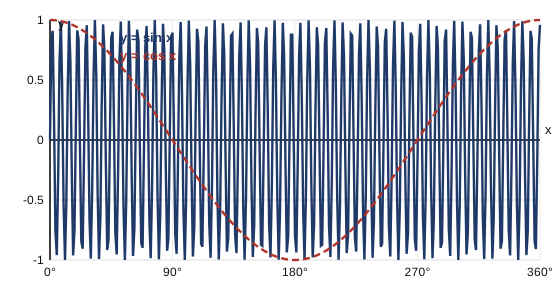
For y = a sin bx + c and y = a cos bx + c: amplitude = |a|, period = 360°/b (or 2π/b rad), maximum = c + |a|, minimum = c − |a|. For y = a tan bx the period is 180°/b (π/b rad) and there is no amplitude.
| Graph | Amplitude | Period | Maximum, minimum |
|---|---|---|---|
| y = 2 sin 3x | 2 | 120° | 2, −2 |
| y = 3 − 2 cos x | 2 | 360° | 5, 1 |
| y = 3 cos 2x + 2 | 3 | 180° (π rad) | 5, −1 |
| y = tan 2x | none | 90° | none |
b tells you how many complete cycles fit into 360°. y = sin 3x has 3 cycles in 0° to 360°. A negative a flips the graph upside down; c lifts the whole graph up by c.
Solving equations with graphs
- Rearrange the equation so one side is the given function.
- The other side becomes a straight line. Draw it on the same axes.
- The number of intersection points is the number of solutions.
Example (textbook p. 208 style)
To solve 3 cos 2x = 2x/π − 1 using y = 3 cos 2x + 2, add 2 to both sides: 3 cos 2x + 2 = 2x/π + 1. Draw the line y = 2x/π + 1 (through (0, 1) and (π, 3)). It meets the curve twice for 0 ≤ x ≤ π, so there are 2 solutions.Adding the constant on one side only. Whatever you do to make the curve y = 3 cos 2x + 2, do to the other side as well.
State the amplitude, period and minimum value of y = 4 sin 2x − 1.
Show answerHide answer
Amplitude 4, period 360°/2 = 180°, minimum −1 − 4 = −5
6.4Basic identities
For any angle A: sin²A + cos²A = 1, 1 + tan²A = sec²A, 1 + cot²A = cosec²A. Also tan A = sin A / cos A.
The second and third come from dividing sin²A + cos²A = 1 by cos²A and by sin²A.
Example: prove tan²x − sin²x = tan²x sin²x
LHS = sin²x/cos²x − sin²x= sin²x (1/cos²x − 1) = sin²x (1 − cos²x)/cos²x
= sin²x · sin²x/cos²x = sin²x tan²x = RHS
To prove an identity, work on one side only (usually the more complicated one). Change everything to sin and cos, or look for a basic identity to replace a squared term.
Treating the identity as an equation and moving terms across to the other side. Show LHS = RHS by working on one side.
Simplify (sec²x − 1)/tan x.
Show answerHide answer
sec²x − 1 = tan²x, so the expression = tan²x / tan x = tan x
6.5Addition formulae and double angle formulae
| Addition formulae | Double angle formulae |
|---|---|
| sin (A ± B) = sin A cos B ± cos A sin B | sin 2A = 2 sin A cos A |
| cos (A ± B) = cos A cos B ∓ sin A sin B | cos 2A = cos²A − sin²A = 2cos²A − 1 = 1 − 2sin²A |
| tan (A ± B) = (tan A ± tan B)/(1 ∓ tan A tan B) | tan 2A = 2 tan A/(1 − tan²A) |
Half-angle formulae follow from cos 2A = 2cos²A − 1 and cos 2A = 1 − 2sin²A. For example, cos²(A/2) = (1 + cos A)/2 and sin²(A/2) = (1 − cos A)/2.
sin (A + B) is not sin A + sin B. Try A = B = 30°: sin 60° = 0.866 but sin 30° + sin 30° = 1.
Example: exact value of sin 75°
sin 75° = sin (45° + 30°) = sin 45° cos 30° + cos 45° sin 30°= (√2/2)(√3/2) + (√2/2)(1/2) = (√6 + √2)/4 ≈ 0.966
Example: sin A = 4/5, cos B = 5/13, A and B acute
cos A = 3/5 and sin B = 12/13 (3-4-5 and 5-12-13 triangles).sin (A + B) = (4/5)(5/13) + (3/5)(12/13) = 56/65
cos (A − B) = (3/5)(5/13) + (4/5)(12/13) = 63/65
For a given ratio, sketch a right-angled triangle first to get the other sides, then check the signs from the quadrant.
Given tan A = 3/4 and A acute, find sin 2A and cos 2A.
Show answerHide answer
Hypotenuse 5: sin A = 3/5, cos A = 4/5
sin 2A = 2(3/5)(4/5) = 24/25
cos 2A = 16/25 − 9/25 = 7/25
sin 2A = 2(3/5)(4/5) = 24/25
cos 2A = 16/25 − 9/25 = 7/25
6.6Application of trigonometric functions
Trigonometric equations are solved by turning them into one ratio, finding the reference angle, then using the quadrant signs to list every angle in the given range.
Example: solve 2 sin²x + cos x − 1 = 0 for 0° ≤ x ≤ 360°
Replace sin²x with 1 − cos²x: 2 − 2cos²x + cos x − 1 = 02cos²x − cos x − 1 = 0, so (2 cos x + 1)(cos x − 1) = 0
cos x = −1/2: reference angle 60°, cosine negative, x = 120°, 240°
cos x = 1: x = 0°, 360°
Solutions: 0°, 120°, 240°, 360°
A double angle equation, such as cos 2x = sin x, is first rewritten with one angle (use cos 2x = 1 − 2sin²x). Never divide by a ratio that could be zero, because you lose solutions.
Stopping after the calculator's first answer. Use the quadrant signs to find all solutions in the range, and check the range includes both end values.
Solve 2 sin x = 1 for 0° ≤ x ≤ 360°.
Show answerHide answer
sin x = 1/2, reference angle 30°, sine positive in Quadrants I and II: x = 30°, 150°