Additional Mathematics notes, chapter 8
Kinematics of Linear Motion
Textbook Additional Mathematics Form 5 (DLP), pages 250–278
What this chapter covers
- Describe and determine the instantaneous displacement, velocity and acceleration of a particle moving along a straight line, and interpret their signs (8.1)
- Find the total distance travelled by a particle in a given period of time, using a number line or a displacement-time graph (8.1)
- Use differentiation to relate displacement, velocity and acceleration functions, and find stationary points, maximum and minimum values (8.2)
- Use integration to find velocity and displacement functions from an acceleration function, using the initial conditions (8.3)
- Solve problems of linear motion that involve differentiation and integration (8.4)
8.1Displacement, velocity and acceleration as functions of time
Kinematics studies the motion of an object without looking at the forces that cause it. A particle moving on a straight line has a displacement s, a velocity v and an acceleration a, and each one changes with the time t.
| Quantity | Meaning | Type | Sign |
|---|---|---|---|
| Displacement, s | Position from a fixed point O, in a direction | Vector | s > 0 right of O; s = 0 at O; s < 0 left of O |
| Distance | Total length of path travelled | Scalar | Never negative |
| Velocity, v | Rate of change of displacement | Vector | v > 0 moving right; v = 0 at rest; v < 0 moving left |
| Acceleration, a | Rate of change of velocity | Vector | a > 0 velocity increasing; a = 0 velocity momentarily not changing, often a maximum or minimum; a < 0 velocity decreasing |
Based on textbook pp. 252-257.
Take motion to the right as positive unless the question says otherwise. The sign of s, v and a only has meaning once you have decided this.
Instantaneous displacement
Example 1 (textbook p. 253)
A particle moves so that s = 4 + 8t − t² metres, t seconds after it starts. Find s when t = 0 and t = 10.t = 0: s = 4, so the particle is 4 m to the right of O.
t = 10: s = 4 + 80 − 100 = −16, so it is 16 m to the left of O.
Writing "4 m to the left" for s = 4. A positive displacement is on the right. The sign tells you the side.
Total distance travelled
Distance is not displacement. Find where the particle turns round (v = 0), then add the lengths of each stage.
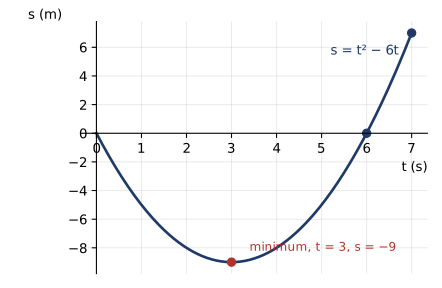
Example 5 (textbook p. 258): s = t² − 6t, first 7 seconds
Table: s = 0, −5, −8, −9, −8, −5, 0, 7 for t = 0, 1, …, 7.The particle goes left to s = −9 at t = 3, then comes back through O to s = 7.
Total distance = 9 + 9 + 7 = 25 m. (The displacement at t = 7 is only 7 m.)
A particle has s = 6t − t² + 7 and moves to the right of O until t = 3, then back. Find the total distance in the first 6 seconds.
Show answerHide answer
s(0) = 7. s(3) = 18 − 9 + 7 = 16. s(6) = 36 − 36 + 7 = 7.
Distance = (16 − 7) + (16 − 7) = 18 m
Distance = (16 − 7) + (16 − 7) = 18 m
Textbook Example 5 and Self-Exercise 8.2.
8.2Differentiation in kinematics
Differentiate to go down the chain, integrate to go up.
s → differentiate → v = ds/dt → differentiate → a = dv/dt = d²s/dt²
s → differentiate → v = ds/dt → differentiate → a = dv/dt = d²s/dt²
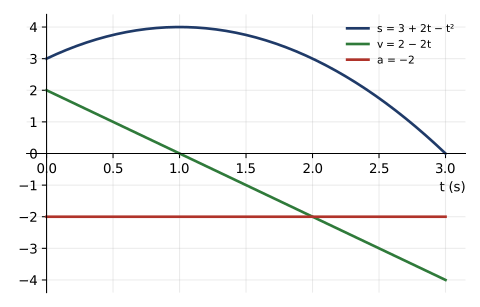
Example 6 (textbook p. 260): s = 3 + 2t − t²
v = ds/dt = 2 − 2t and a = dv/dt = −2.Initial: s = 3 m, v = 2 m/s, a = −2 m/s².
At t = 1: v = 0 and s = 4 m (maximum), so the particle turns round.
At t = 3: s = 0, so it is back at O with v = −4 m/s.
Distance in 0 ≤ t ≤ 3: (4 − 3) + 4 = 5 m.
Key conditions
| Condition | Meaning |
|---|---|
| t = 0 | Initial displacement, velocity or acceleration |
| v = 0 | Particle is instantaneously at rest; s is a maximum or minimum, the particle turns round |
| a = 0 | v is momentarily not changing, usually a maximum or minimum (v need not be zero) |
| s = 0 | Particle is at O |
| v < 0 | Particle moves to the left |
| a > 0 | Velocity is increasing; a < 0 means decelerating |
Example 7 (textbook p. 263): s = t³ − 9t² + 24t + 5
v = 3t² − 18t + 24.Initial velocity: v(0) = 24 m/s. At t = 3: v = 27 − 54 + 24 = −3 m/s.
At rest: 3(t − 2)(t − 4) = 0, so t = 2 or t = 4.
Moves left: v < 0, so 2 < t < 4 (the quadratic opens upward, so it is negative between its roots).
Example 10 (textbook p. 265): s = t³ − 3t² − 4t
v = 3t² − 6t − 4 and a = 6t − 6.Initial a = −6 m/s². At t = 5: a = 24 m/s².
s = 0: t(t + 1)(t − 4) = 0, so t = 0 or 4 (t = −1 is rejected because t ≥ 0). At t = 4, a = 18 m/s².
a > 0 when t > 1.
Keeping t = −1. Time cannot be negative, so reject it. Another common slip is to say "a = 0 means the particle is at rest": it only means the velocity is at its maximum or minimum.
Maximum or minimum of v: solve a = dv/dt = 0, then use d²v/dt². If it is negative, v is a maximum; if positive, v is a minimum.
A particle has s = 2t³ − 5t² + 4t. Find (a) v when t = 2, (b) the times when it stops instantaneously.
Show answerHide answer
v = 6t² − 10t + 4.
(a) v(2) = 24 − 20 + 4 = 8 m/s
(b) 6t² − 10t + 4 = 0, so 3t² − 5t + 2 = 0, (3t − 2)(t − 1) = 0, t = 2/3 s or t = 1 s
(a) v(2) = 24 − 20 + 4 = 8 m/s
(b) 6t² − 10t + 4 = 0, so 3t² − 5t + 2 = 0, (3t − 2)(t − 1) = 0, t = 2/3 s or t = 1 s
8.3Integration in kinematics
Going back up: v = ∫ a dt and s = ∫ v dt. Each integration gives a constant c. Find it from the information given, such as "initial velocity" (v at t = 0) or "passes through O" (s = 0 at t = 0).
Example 11 (textbook p. 267): a = 4 − 2t, initial velocity 4 m/s
v = 4t − t² + c. At t = 0, v = 4, so c = 4 and v = 4t − t² + 4.At t = 7: v = 28 − 49 + 4 = −17 m/s.
Maximum velocity: a = 0 gives t = 2, and d²v/dt² = −2 < 0, so v is a maximum: v = 8 − 4 + 4 = 8 m/s.
v = 7: t² − 4t + 3 = 0, so t = 1 s or t = 3 s.
Example 12 (textbook pp. 269-270): displacement from acceleration
Passes O with v = 12 m/s, a = 4 − 2t. Then v = 12 + 4t − t² and, with s = 0 at t = 0, s = 12t + 2t² − t³/3.Particle at rest: (t + 2)(t − 6) = 0, so t = 6 s (reject −2), s = 72 + 72 − 72 = 72 m.
Distance in the 7th second = |s₇ − s₆| = |67⅔ − 72| = 4⅓ m.
Forgetting "+ c", or using the initial condition in the wrong function. Use v(0) in the velocity function and s(0) in the displacement function.
Distance in the nth second is |sₙ − sₙ₋₁| (from t = n − 1 to t = n). Total distance in the first n seconds is from t = 0 to t = n, and must be split wherever v = 0.
a = 6 − 2t and the initial velocity is 5 m/s. Find v when t = 4.
Show answerHide answer
v = 6t − t² + c, c = 5. v(4) = 24 − 16 + 5 = 13 m/s
8.4Applications of kinematics
Use the four-step method from the textbook: understand the problem, plan (which of d/dt or ∫ dt?), implement, then check by substituting back.
Example 13 (textbook p. 272): Fariza runs, v = 0.9t − 0.03t²
Acceleration zero: a = 0.9 − 0.06t = 0, so t = 15 s.Distance in 30 s: s = 0.45t² − 0.01t³, and s(30) = 405 − 270 = 135 m.
Check: the area under the v-t graph from 0 to 30 is also 135 m.
| Wording | Do this |
|---|---|
| "Initial", "at the start" | Put t = 0 |
| "Stops instantaneously", "at rest" | v = 0 |
| "Maximum height", "furthest from O" | v = 0, then find s |
| "Returns to O", "passes O again" | s = 0 and reject t = 0 |
| "Uniform velocity", "constant acceleration" | a = 0 or the function does not contain t |
A rocket goes straight up with v = 20 − 10t m/s from ground level. Find the maximum height.
Show answerHide answer
v = 0 at t = 2 s. s = 20t − 5t², s(2) = 40 − 20 = 20 m