Additional Mathematics questions, chapter 8
Nama / NameKelas / ClassTarikh / Date
Kinematics of Linear Motion
44 marks. Use Practice to check each answer as you go, or Exam to answer everything first. Show your working for Section B. Take motion to the right as positive.
Section A: objective questions
12 marksChoose the correct answer. Each question carries 1 mark.
1
Question 1
Which expression gives the acceleration of a particle from its displacement function s?
Show answerHide answer
B
a = dv/dt and v = ds/dt, so a = d²s/dt². ds/dt is the velocity; the integrals go the other way.
2
Question 2
A particle moves along a straight line and motion to the right is positive. At a certain instant its velocity is negative. What does this show?
Show answerHide answer
C
v < 0 means the direction of motion is left. Position to the left of O is a negative displacement, not velocity; slowing down depends on the sign of a as well.
3
Question 3
The displacement of a particle is s = 4 + 8t − t² metres at t seconds. What is its displacement when t = 10?
Show answerHide answer
A
s = 4 + 80 − 100 = −16 m, which is 16 m to the left of O. 16 forgets the sign.
4
Question 4
A particle has velocity v = 2t² − 5t − 3 m/s at t seconds. Its initial velocity is
Show answerHide answer
D
Initial means t = 0: v = −3 m/s. The particle starts by moving to the left.
5
Question 5
A particle has displacement s = t³ − 9t² + 24t + 5 metres. Find its velocity when t = 3.
Show answerHide answer
C
v = 3t² − 18t + 24. At t = 3: 27 − 54 + 24 = −3 m/s.
6
Question 6
A particle starts at O with s = t² − 6t metres. Find the total distance travelled in the first 7 seconds.
Show answerHide answer
B
The particle turns at t = 3 (s = −9). Distance = 9 + 9 + 7 = 25 m. 7 m is the displacement at t = 7, not the distance.
7
Question 7
A particle has displacement s = t³ − 3t² − 4t metres. Find its acceleration when t = 5.
Show answerHide answer
A
v = 3t² − 6t − 4, a = 6t − 6 = 24 m/s². 41 is v(5), the velocity.
8
Question 8
At one instant, the acceleration of a moving particle is zero. Which statement must be true at that instant?
Show answerHide answer
D
a = dv/dt = 0 means the gradient of the velocity-time graph is zero, so v is momentarily not changing (often a maximum or minimum). It does not mean v = 0.
9
Question 9
The acceleration of a particle is a = 6 − 2t m/s² and its initial velocity is 5 m/s. Find its velocity when t = 4.
Show answerHide answer
C
v = 6t − t² + c and c = 5. v(4) = 24 − 16 + 5 = 13 m/s. 8 forgets the constant c.
10
Question 10
The velocity of a particle is v = t² − 4t + 3 m/s. For which values of t does the particle move to the left?
Show answerHide answer
B
v = (t − 1)(t − 3) is negative between the roots, so 1 < t < 3. Outside the roots v > 0 and the particle moves right.
11
Question 11
The velocity of a particle is v = 6t − 3t² m/s and it starts from O. Find its displacement from O when t = 2.
Show answerHide answer
D
s = ∫(6t − 3t²) dt = 3t² − t³ (s = 0 at t = 0). s(2) = 12 − 8 = 4 m. 0 is v(2), found by substituting into the wrong function.
12
Question 12
A particle has velocity v = t² − 4t + 7 m/s. Hafiz says: "The acceleration is zero at t = 2, so the particle is at rest at t = 2." Which judgement is correct?
Show answerHide answer
A
a = 2t − 4 = 0 gives t = 2. v(2) = 4 − 8 + 7 = 3, not zero. Since d²v/dt² = 2 > 0, 3 m/s is the minimum velocity.
Section B: structured questions
32 marksAnswer all questions. Show your working. Take motion to the right as positive.
13
Question 13
The velocity of a particle that moves along a straight line is v = t² − 8t + 7 m/s, t seconds after passing O.
[1 mark]
(a)Find the velocity when t = 3.
Show answerHide answer
Tick each point you got.
[2 marks]
(b)Find the times when the particle stops instantaneously.
Show answerHide answer
Tick each point you got.
[1 mark]
(c)Find the range of t when the particle moves to the left.
Show answerHide answer
Tick each point you got.
[2 marks]
(d)Find the acceleration when t = 5.
Show answerHide answer
Tick each point you got.
14
Question 14
The acceleration of a particle is a = 8 − 4t m/s², t seconds after passing O. Its initial velocity is 6 m/s.
[1 mark]
(a)Find the acceleration when t = 4.
Show answerHide answer
Tick each point you got.
[2 marks]
(b)Express the velocity v in terms of t.
Show answerHide answer
Tick each point you got.
[3 marks]
(c)Find the time when the velocity is a maximum, and the maximum velocity.
Show answerHide answer
Tick each point you got.
15
Question 15
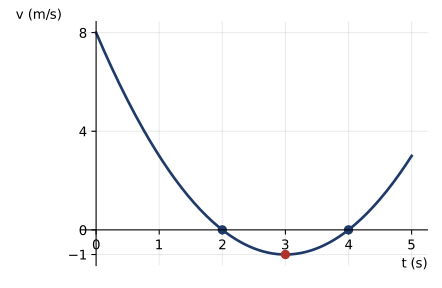
Diagram 1 shows the velocity-time graph v = t² − 6t + 8 of a particle that moves along a straight line, for 0 ≤ t ≤ 5.
[1 mark]
(a)State the times when the particle is instantaneously at rest.
Show answerHide answer
Tick each point you got.
[1 mark]
(b)State the minimum velocity.
Show answerHide answer
Tick each point you got.
[2 marks]
(c)Find the acceleration at t = 3 and explain why the velocity is not zero then.
Show answerHide answer
Tick each point you got.
[1 mark]
(d)Find the range of t when the velocity is increasing.
Show answerHide answer
Tick each point you got.
16
Question 16
A particle leaves O and moves along a straight line. Its velocity is v = 3t² − 12t + 9 m/s, t seconds after leaving O.
[2 marks]
(a)Find the displacement function s.
Show answerHide answer
Tick each point you got.
[2 marks]
(b)Find the times when the particle stops instantaneously and its displacement at those times.
Show answerHide answer
Tick each point you got.
[2 marks]
(c)Find the total distance travelled in the first 4 seconds.
Show answerHide answer
The displacement at t = 4 is only 4 m, but the particle moved 12 m in total because it turned twice.
Tick each point you got.
17
Question 17
A particle passes the fixed point O with velocity −8 m/s. Its acceleration is a = m + nt m/s², t seconds after passing O. At t = 0 the acceleration is 6 m/s² and at t = 3 the acceleration is zero.
[2 marks]
(a)Find the values of m and n.
Show answerHide answer
Tick each point you got.
[2 marks]
(b)Express the velocity v in terms of t.
Show answerHide answer
Tick each point you got.
[1 mark]
(c)Find the maximum velocity.
Show answerHide answer
Tick each point you got.
[4 marks]
(d)Find the total distance travelled in the first 4 seconds.
Show answerHide answer
The particle moves left for 0 < t < 2, then right for 2 < t < 4.
Tick each point you got.