Organisation of Plant Tissues and Growth
What this chapter covers
- Describe the organisation of plant tissues into meristematic and permanent tissues (1.1)
- State the structure and function of epidermal, ground (parenchyma, collenchyma, sclerenchyma) and vascular (xylem, phloem) tissues (1.1)
- Identify the apical and lateral meristems and where they are found (1.2)
- Describe the zones of cell division, cell elongation and cell differentiation at shoot and root tips (1.2)
- Explain primary and secondary growth, annual rings and why both are necessary (1.2)
- Compare primary and secondary growth in eudicots and state the economic importance of secondary growth (1.2)
- Classify plants as annual, biennial or perennial and interpret their growth curves (1.3)
1.1Organisation of plant tissues
A plant is built from two kinds of tissue: meristematic tissues, which keep dividing, and permanent tissues, which have finished dividing and have differentiated for a particular job.
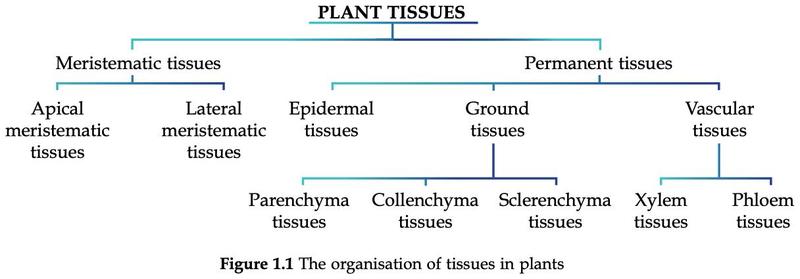
Textbook Figure 1.1, p. 4.
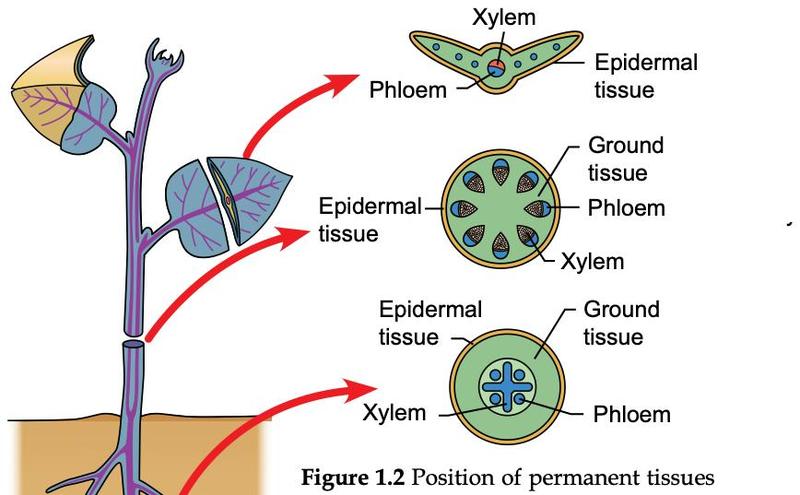
Textbook Figure 1.2, p. 4.
| Tissue | Cells and structure | Function |
|---|---|---|
| Epidermal | Outermost layer of young stems, leaves and roots; exposed walls have a waxy, waterproof cuticle. Modified cells: guard cells, root hair cells | Cuticle reduces water loss by evaporation (transpiration) and protects against injury and pathogens. Guard cells control the opening of the stoma; root hair cells increase the surface area for absorbing water and mineral salts |
| Parenchyma (ground) | Simplest living cells, thinnest walls, do not differentiate further; always turgid | Supports and keeps the shape of herbaceous plants; photosynthesis, storage of starch and sugar, gaseous exchange; repair and regeneration |
| Collenchyma (ground) | Living cells, walls of pectin and hemicellulose, thicker than parenchyma, flexible | Mechanical support and elasticity |
| Sclerenchyma (ground) | Dead when mature; thickest walls of the three ground tissues | Support and mechanical strength in mature parts; also helps transport water and nutrients |
| Xylem (vascular) | Dead cells without cytoplasm; walls contain lignin; elongated, hollow vessels joined end to end from root to leaf | Transports water and mineral salts to all parts of the plant |
| Phloem (vascular) | Living sieve tubes (cytoplasm, but no nucleus or ribosomes at maturity) arranged end to end, with companion cells | Transports sugars from photosynthesis from the leaves to storage organs such as roots, fruits and tubers |
Show answerHide answer
1.2Meristematic tissues and growth
| Meristem | Position | Growth it causes |
|---|---|---|
| Apical meristems | Tips of shoots and roots | Primary growth: longer stems and roots |
| Vascular cambium | Between xylem and phloem in the vascular bundles | Secondary growth: secondary xylem and secondary phloem |
| Cork cambium | Under the epidermis | Secondary growth: cork cells outwards, cortex inwards |
Vascular cambium and cork cambium together are the lateral meristems.
Zones of cell growth at a shoot or root tip
| Zone | What happens |
|---|---|
| 1. Cell division | Apical meristem cells divide actively by mitosis; older cells are pushed into the next zone |
| 2. Cell elongation | Cells increase in size: water enters by osmosis and nutrients are absorbed; small vacuoles fuse into one large vacuole (vacuolation); the pressure pushes against the wall and lengthens the cell |
| 3. Cell differentiation | Cells at full size become specialised and form permanent tissues such as epidermis, cortex, xylem and phloem. Examples: guard cells (from epidermal cells of the leaf), root hair cells (from epidermal cells of the root) |
Primary growth and secondary growth
At a shoot tip, leaf primordia and shoot primordia grow into new leaves and shoots, so the plant increases in height. At a root tip, the root cap is worn away as the root pushes through the soil and is replaced by new meristem cells.
Secondary growth thickens (increases the circumference of) stems and roots; it happens at the lateral meristems of woody eudicots and a few monocots such as Dracaena, Aloe and Agave.
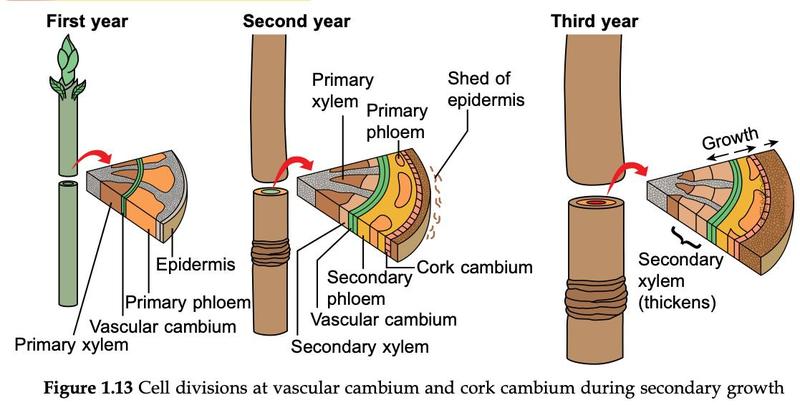
Textbook Figure 1.13, p. 11.
- The vascular cambium divides actively and forms a complete cambium ring.
- Cells divide inwards to form secondary xylem and outwards to form secondary phloem.
- The primary xylem is pushed towards the pith and the primary phloem towards the epidermis; xylem walls thicken with lignin, forming strong wood.
- The stem widens, so the epidermis stretches, cracks and is shed. Cork cambium divides to form cork on the outside and cortex on the inside; the cork protects the stem from insects and pathogens.
Roots thicken in the same way: the vascular cambium forms a complete ring that adds secondary xylem inwards and secondary phloem outwards, and the cork cambium under the epidermis forms cork cells that protect the root tissues. In temperate climates, annual growth rings record age: in spring the secondary xylem is large with thin walls (bright ring); in summer it is small with thick walls (dark ring). One bright plus one dark ring = one year.
Why both kinds of growth are needed
| Primary growth | Secondary growth |
|---|---|
| Plant reaches maximum height to absorb sunlight for photosynthesis | Wider stem and roots give stability and support for a tall plant |
| Primary xylem carries water and salts; primary phloem carries food | New xylem and phloem replace old and damaged tissue |
| Primary xylem supports young and herbaceous plants | Thicker bark protects against water loss, injury and pathogens; plant lives longer and can reproduce more |
Primary and secondary growth in eudicots compared
| Aspect | Primary growth | Secondary growth |
|---|---|---|
| Meristem | Apical meristem | Lateral meristem (vascular and cork cambium) |
| Direction | Longitudinal | Radial |
| Effect | Increases length | Increases thickness |
| Tissues formed | Epidermis, cortex, primary xylem and phloem | Bark, periderm, lenticels, secondary xylem and phloem |
| Woody tissue; bark; growth rings | No; thin; absent | Yes; thick; present |
Both increase the size of the plant permanently and both involve mitosis.
Economic importance of secondary growth
- Strong, hard timber such as meranti (Shorea) and cengal (Balanocarpus) for houseboats, furniture, fences and doors.
- Annual rings make furniture attractive.
- Resin and oil from wood and bark (e.g. Hopea, meranti) become varnish, adhesive, perfume and medicine.
- Decorative plants and fruits such as mango and mangosteen earn income.
Show answerHide answer
1.3Growth curves
| Life cycle | Description | Examples |
|---|---|---|
| Annual | One life cycle in one season or year, then dies after flowering or seed production | Paddy, pumpkin, watermelon |
| Biennial | Two years: vegetative growth in the first season, reproduction in the second | Cabbage, carrot, silver cock's comb |
| Perennial | Lives more than two years; woody or herbaceous; flowers and fruits many times | Grass, hibiscus, mango |
Annual plant: one sigmoid curve
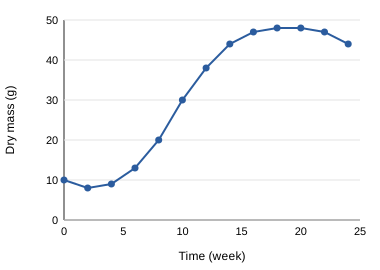
- Stage A, dry mass decreases: stored food in the cotyledon is used up for germination before leaves appear.
- Stage B, dry mass increases rapidly: leaves photosynthesise.
- Stage C, constant dry mass: growth rate is zero; the plant is mature.
- Stage D, dry mass decreases slowly: ageing, lower photosynthesis, leaves and flowers shed, seeds dispersed.
Biennial and perennial plants
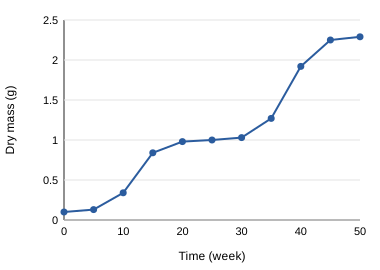 Biennial: two sigmoid curves joined. First season: leaves, photosynthesis, food stored in tubers. Second season: stored food used for flowers and seeds.
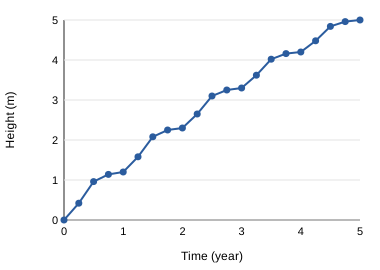 Perennial: a series of small sigmoid curves, one a year. Growth continues all life; fast in spring and summer (high light), slower in winter.