Biology questions, chapter 1
Nama / NameKelas / ClassTarikh / Date
Organisation of Plant Tissues and Growth
46 marks. Use Practice to check each answer as you go, or Exam to answer everything against the clock first.
Section A: objective questions
12 marksChoose the best answer for each question.
1
Question 1
Which plant tissue consists of actively dividing cells that divide by mitosis?
Show answerHide answer
B
Meristematic tissues are actively dividing tissues. The other three are permanent tissues, which have already differentiated.
2
Question 2
Which tissue has dead cells with lignin in the walls and transports water and mineral salts?
Show answerHide answer
D
Xylem is made of dead, hollow cells whose walls contain lignin; it carries water and mineral salts. Phloem is living.
3
Question 3
A tissue is made of living cells with walls of pectin and hemicellulose. It gives flexible support to the plant. What is this tissue?
Show answerHide answer
A
Collenchyma has walls of pectin and hemicellulose, thicker than parenchyma, giving support and elasticity. Sclerenchyma is dead and rigid.
4
Question 4
What is the main function of the sieve tubes in phloem?
Show answerHide answer
C
Phloem sieve tubes carry the sugars produced by photosynthesis from the leaves to storage organs. Water is carried by xylem.
5
Question 5
Guard cells and root hair cells are modified from which tissue?
Show answerHide answer
C
Guard cells and root hair cells are modified epidermal cells (textbook Table 1.1).
6
Question 6
Where are the apical meristems found?
Show answerHide answer
A
Apical meristems are at the shoot and root tips. Vascular cambium lies between xylem and phloem; cork cambium lies under the epidermis.
7
Question 7
How do the cells in the zone of cell elongation increase in size?
Show answerHide answer
D
Water diffuses in by osmosis, small vacuoles fuse into one large vacuole, and the pressure pushes the cell wall outwards and lengthens the cell.
8
Question 8
Where is the vascular cambium located in a stem?
Show answerHide answer
B
The vascular cambium lies between xylem and phloem. The cork cambium lies under the epidermis.
9
Question 9
A tree in a temperate country has dark rings in its stem. Which statement explains the formation of a dark ring?
Show answerHide answer
A
In spring there is enough water and sunlight, so large thin-walled xylem forms (bright). In summer growth is less suitable and small thick-walled xylem forms (dark).
10
Question 10
Which statement is true of secondary growth only, and not primary growth, in eudicots?
Show answerHide answer
C
Secondary growth is radial, thickens the stem and root, and forms growth rings. Mitosis and permanent growth are shared; apical meristems belong to primary growth.
11
Question 11
Which plant is a biennial plant?
Show answerHide answer
D
Carrot (also cabbage and silver cock's comb) is biennial. Paddy is annual; hibiscus and mango are perennial.
12
Question 12
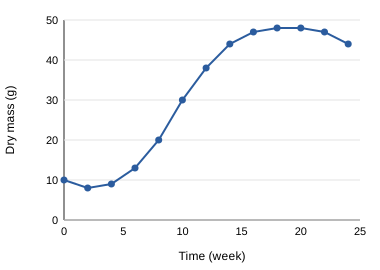
Diagram 1 shows the growth curve of an annual plant. Why does the dry mass decrease in the first two weeks?
Show answerHide answer
B
Before leaves emerge, the seedling uses the food stored in the cotyledon, so dry mass falls. Leaf shedding and seed dispersal cause the later decrease.
Section B: structured questions
34 marksAnswer all questions. Write your answers in the spaces provided.
13
Question 13
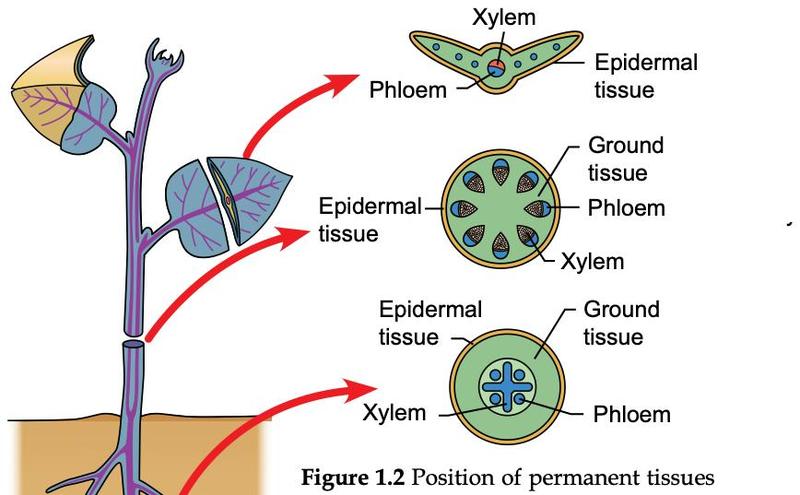
Diagram 2 shows the position of permanent tissues in a leaf, a stem and a root.
[1 mark]
(a)State one function of the cuticle on the epidermal tissue of a leaf.
Show answerHide answer
Any 1 points
Tick each point you got.
[2 marks]
(b)Name two modified epidermal cells and state the function of each.
Show answerHide answer
Tick each point you got.
[2 marks]
(c)Explain how the structure of xylem is adapted to its function.
Show answerHide answer
Tick each point you got.
14
Question 14
A root tip of a seedling has three zones of cell growth.
[2 marks]
(a)Name the zone where the cells divide by mitosis, and the zone where the cells become specialised.
Show answerHide answer
Tick each point you got.
[2 marks]
(b)Explain how the cells in the zone of cell elongation increase in size.
Show answerHide answer
Tick each point you got.
[1 mark]
(c)Give one specialised cell formed from the epidermis in the root.
Show answerHide answer
Tick each point you got.
15
Question 15
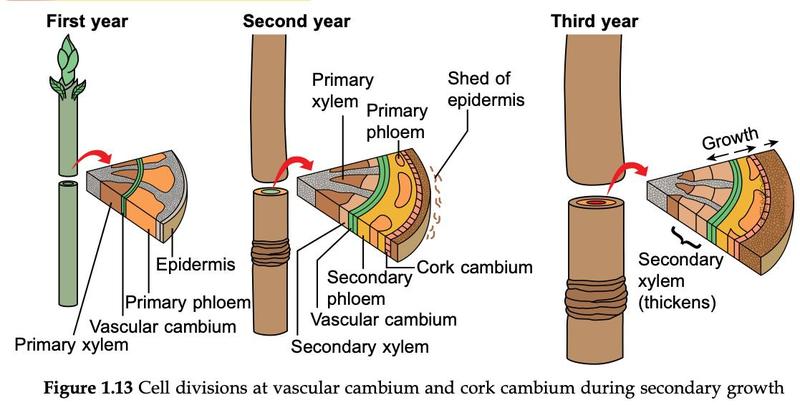
Diagram 3 shows the secondary growth of a eudicot stem over three years.
[1 mark]
(a)Name the lateral meristem that divides to form secondary xylem and secondary phloem.
Show answerHide answer
Tick each point you got.
[2 marks]
(b)Explain why the epidermis cracks and is shed.
Show answerHide answer
Tick each point you got.
[2 marks]
(c)State how the stem is protected after the epidermis is shed.
Show answerHide answer
Tick each point you got.
16
Question 16
A stem of a tree from a temperate climate shows 7 pairs of bright and dark rings.
[1 mark]
(a)Estimate the age of the tree.
Show answerHide answer
Tick each point you got.
[1 mark]
(b)Which season forms the bright ring?
Show answerHide answer
Tick each point you got.
[2 marks]
(c)Explain why the bright and dark rings are different.
Show answerHide answer
Tick each point you got.
17
Question 17
Compare primary growth and secondary growth in eudicots.
[2 marks]
(a)State two similarities.
Show answerHide answer
Any 2 points
Tick each point you got.
[2 marks]
(b)State two differences.
Show answerHide answer
Any 2 points
Tick each point you got.
18
Question 18
Diagram 4 shows the dry mass of an annual plant over 24 weeks.
[1 mark]
(a)State the shape of the growth curve.
Show answerHide answer
Tick each point you got.
[1 mark]
(b)Calculate the increase in dry mass from week 10 to week 18.
Show answerHide answer
Tick each point you got.
[2 marks]
(c)Explain why the dry mass is constant from week 18 to week 20.
Show answerHide answer
Tick each point you got.
[2 marks]
(d)Explain why the dry mass decreases after week 20.
Show answerHide answer
Tick each point you got.
19
Question 19
A farmer notices that paddy plants die after harvest, but the grass in the field keeps growing for many years.
[2 marks]
(a)Explain why the growth curve of a perennial plant consists of a series of small sigmoid curves.
Show answerHide answer
Tick each point you got.
20
Question 20
A forestry department wants to tell visitors why trees that undergo secondary growth are valuable. Write three points for its brochure.
[3 marks]
(a)Write three points.
Show answerHide answer
Any 3 points
Tick each point you got.