Biology questions, chapter 2
Nama / NameKelas / ClassTarikh / Date
Leaf Structure and Function
43 marks. Use Practice to check each answer as you go, or Exam to answer everything against the clock first.
Section A: objective questions
12 marksChoose the best answer for each question.
1
Question 1
Which part of the leaf connects the lamina to the stem?
Show answerHide answer
A
The petiole is the leaf stalk that joins the lamina to the stem (p. 28).
2
Question 2
Which layer of the leaf lamina contains the most chloroplasts and is the main site of photosynthesis?
Show answerHide answer
C
Palisade mesophyll cells are tall, closely packed and full of chloroplasts (p. 30).
3
Question 3
In the morning, sucrose builds up in the guard cells. What happens next?
Show answerHide answer
C
More sucrose lowers the water potential, so water enters by osmosis. The guard cells become turgid and curve, opening the stoma (p. 32).
4
Question 4
About what percentage of transpiration takes place through the stomata of the leaves?
Show answerHide answer
D
About 90% of the water vapour lost leaves through the stomata (p. 36).
5
Question 5
A potometer air bubble moves 3.6 cm in 12 minutes. What is the rate of water uptake?
Show answerHide answer
A
Rate = distance ÷ time = 3.6 ÷ 12 = 0.30 cm/min.
6
Question 6
Which condition gives the highest rate of transpiration?
Show answerHide answer
B
Higher temperature, lower humidity and faster air movement each increase transpiration (p. 37).
7
Question 7
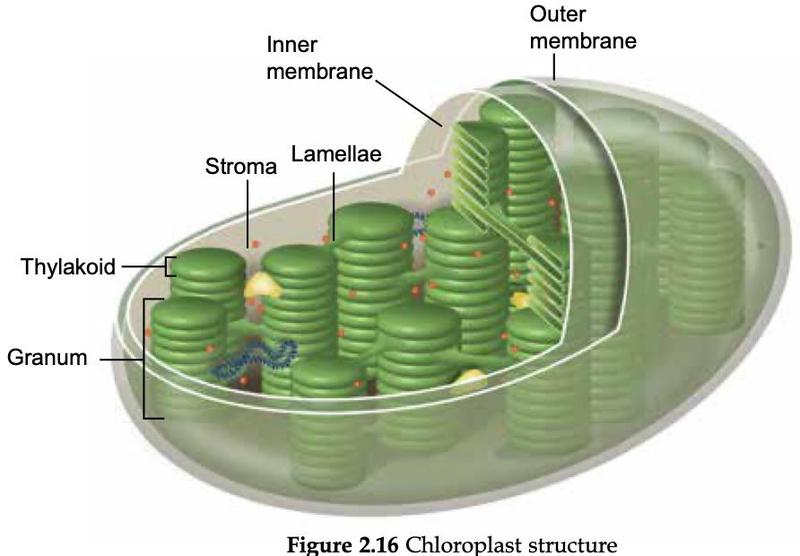
Diagram 1 shows a chloroplast. In which part does the light-independent reaction take place?
Show answerHide answer
D
The light-independent reaction takes place in the stroma, the colourless fluid around the grana (p. 42). The light-dependent reaction is in the thylakoids.
8
Question 8
What is the role of photolysis in photosynthesis?
Show answerHide answer
D
Photolysis splits water in the light, giving electrons to chlorophyll, H⁺ to NADP⁺ and releasing oxygen (p. 44).
9
Question 9
In paper chromatography a pigment moved 3.5 cm and the solvent moved 7.0 cm. What is the Rf value, and which pigment is it?
Show answerHide answer
A
Rf = 3.5 ÷ 7.0 = 0.50, which is chlorophyll b (Table 2.3, p. 43).
10
Question 10
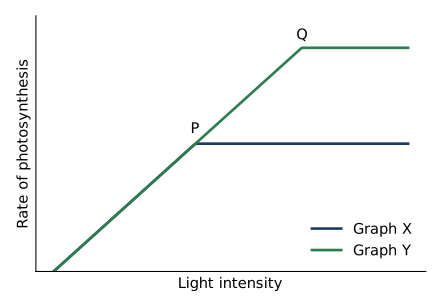
Diagram 2 shows the rate of photosynthesis against light intensity for two carbon dioxide concentrations, X (lower) and Y (higher). Why does graph X become level at P?
Show answerHide answer
B
At P, more light does not help because there is too little CO₂. Graph Y has more CO₂, so it keeps rising to a higher level (p. 46).
11
Question 11
A leaf looks green because chlorophyll mostly
Show answerHide answer
B
Chlorophyll absorbs mainly red and blue light and reflects green light (p. 51).
12
Question 12
At the compensation point of a plant,
Show answerHide answer
C
Compensation point is the light intensity at which the rate of photosynthesis equals the rate of respiration (p. 52).
Section B: structured questions
31 marksAnswer all questions.
13
Question 13
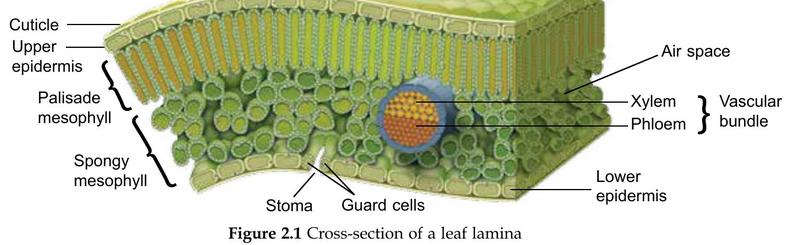
Diagram 3 shows a cross-section of a leaf lamina.
[1 mark]
(a)Name the layer of tall cells arranged closely and vertically beneath the upper epidermis.
Show answerHide answer
Tick each point you got.
[1 mark]
(b)Explain why the cuticle is transparent.
Show answerHide answer
Tick each point you got.
[2 marks]
(c)State the function of the xylem and the phloem in the leaf.
Show answerHide answer
Tick each point you got.
14
Question 14
A plant is left without water for three days. Its leaves wilt and the stomata close.
[1 mark]
(a)State the condition of the guard cells when the stomata are closed.
Show answerHide answer
Tick each point you got.
[3 marks]
(b)Explain why the guard cells change shape when the plant has enough water.
Show answerHide answer
Tick each point you got.
[1 mark]
(c)Why is it an advantage to the plant that the stomata close?
Show answerHide answer
Tick each point you got.
15
Question 15
A student used a potometer to compare the transpiration of a leafy twig in two conditions. The air bubble moved the distances shown in 10 minutes.
| Condition | Distance moved (cm) |
|---|---|
| Still air | 2.0 |
| In front of a fan | 5.5 |
[2 marks]
(a)Calculate the rate of transpiration in front of the fan.
Show answerHide answer
Tick each point you got.
[2 marks]
(b)Explain the difference between the two results.
Show answerHide answer
Tick each point you got.
[1 mark]
(c)Why must the twig be cut under water?
Show answerHide answer
Tick each point you got.
16
Question 16
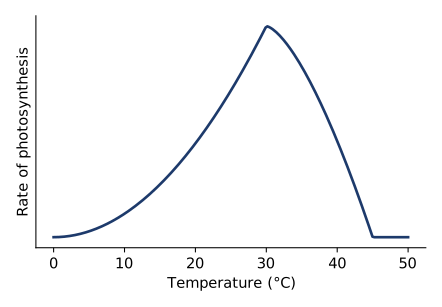
Diagram 4 shows how the rate of photosynthesis of a plant changes with temperature.
[1 mark]
(a)State the optimum temperature shown on the graph.
Show answerHide answer
Tick each point you got.
[2 marks]
(b)Explain why the rate increases from 0 °C to 30 °C.
Show answerHide answer
Tick each point you got.
[1 mark]
(c)Explain why the rate falls to zero at 45 °C.
Show answerHide answer
Tick each point you got.
17
Question 17
Photosynthesis has a light-dependent reaction and a light-independent reaction.
[2 marks]
(a)In which part of the chloroplast does each reaction take place?
Show answerHide answer
Tick each point you got.
[2 marks]
(b)Name two substances from the light-dependent reaction that are used in the light-independent reaction.
Show answerHide answer
Tick each point you got.
18
Question 18
A fern on the rainforest floor has its compensation point at 10.00 am. A tall ficus tree in the same forest receives much more light.
[1 mark]
(a)What is meant by compensation point?
Show answerHide answer
Tick each point you got.
[2 marks]
(b)Predict whether the ficus reaches its compensation point earlier or later than 10.00 am. Explain.
Show answerHide answer
Tick each point you got.
[2 marks]
(c)State the effect on the plant if it stayed at its compensation point every day.
Show answerHide answer
Tick each point you got.
19
Question 19
Complete the comparison of photosynthesis and respiration in plants.
[1 mark]
(a)Which process takes place only in cells that contain chlorophyll?
Show answerHide answer
Photosynthesis
[1 mark]
(b)Which process takes place in the mitochondria?
Show answerHide answer
Respiration
[1 mark]
(c)Which process needs light?
Show answerHide answer
Photosynthesis
[1 mark]
(d)Which process breaks down glucose to release energy?
Show answerHide answer
Respiration