Biology questions, chapter 3
Nama / NameKelas / ClassTarikh / Date
Nutrition in Plants
34 marks. Use Practice to check each answer as you go, or Exam to answer everything against the clock first.
Section A: objective questions
12 marksChoose the best answer for each question.
1
Question 1
Which of the following is a micronutrient needed by plants?
Show answerHide answer
D
Iron is a micronutrient. Magnesium, potassium and sulphur are macronutrients.
2
Question 2
Which three macronutrients are obtained easily from air and water?
Show answerHide answer
C
Carbon, hydrogen and oxygen come from air and water and make up most of the dry mass, so plants rarely lack them.
3
Question 3
Mature leaves of a plant turn yellow, starting with the older leaves, and growth is stunted. Which nutrient is lacking?
Show answerHide answer
A
Nitrogen deficiency causes chlorosis, mainly of mature leaves, with stunted growth, because nitrogen is needed for chlorophyll and proteins.
4
Question 4
Which nutrient forms the central part of the chlorophyll molecule?
Show answerHide answer
C
Magnesium is the main component of the structure of chlorophyll.
5
Question 5
In the NPK investigation, why are the culture bottles covered with black paper?
Show answerHide answer
B
Light would let green algae grow in the solution and compete with the seedlings for nutrients. The air pump supplies oxygen.
6
Question 6
In the NPK investigation, bottle B contains only distilled water. What is its purpose?
Show answerHide answer
A
Bottle B has no nutrients, so it is the control that is compared with the complete solution.
7
Question 7
Which part of the root protects it from damage as it grows through the soil?
Show answerHide answer
B
The root cap covers the tip of the root and protects it.
8
Question 8
Why does the cortex have loosely arranged cells?
Show answerHide answer
D
Spaces between loosely arranged parenchyma cells allow gases to exchange; the thin walls let water move through.
9
Question 9
What is the function of the Casparian strip in the endodermis?
Show answerHide answer
C
Casparian strips are suberin or lignin thickenings in endodermal cell walls that control what passes into the vascular cylinder.
10
Question 10
Which plant is an epiphyte?
Show answerHide answer
B
The bird's nest fern lives on a host to get sunlight and makes its own food. Rafflesia is parasitic; the other two are carnivorous.
11
Question 11
Why do carnivorous plants digest insects?
Show answerHide answer
A
They live in soil with little nitrogen, so insects supply nitrogen for growth.
12
Question 12
A plant grows on the stem of another plant, penetrates it up to the vascular bundles and the host eventually dies. Which statement describes this plant?
Show answerHide answer
D
Roots reaching the host's vascular bundles and a dying host describe a parasitic plant.
Section B: structured questions
22 marksAnswer all questions. Write your answers in the spaces provided.
13
Question 13
Two plants, X and Y, are grown in culture solutions that each lack one mineral. Their symptoms are described below.
[2 marks]
(a)Plant X has leaves that turn yellow, with older leaves falling off. State the mineral that is lacking and why the leaves are yellow.
Show answerHide answer
Tick each point you got.
[1 mark]
(b)Plant Y has poor root growth and red or purple spots on old leaves. Name the mineral that is lacking.
Show answerHide answer
Tick each point you got.
[1 mark]
(c)State one function of potassium in plants.
Show answerHide answer
Any 1 points
Tick each point you got.
[2 marks]
(d)Explain why magnesium deficiency affects photosynthesis.
Show answerHide answer
Tick each point you got.
14
Question 14
A student investigates the effect of nitrogen, phosphorus and potassium on the growth of corn seedlings using five culture bottles: A (complete solution), B (distilled water), C (without nitrogen), D (without phosphorus), E (without potassium).
[1 mark]
(a)State the manipulated variable.
Show answerHide answer
Tick each point you got.
[1 mark]
(b)Which bottle shows the healthiest seedling?
Show answerHide answer
A
Bottle A holds the complete culture solution with all nutrients.
[1 mark]
(c)Give one reason an air pump is connected to each bottle.
Show answerHide answer
Tick each point you got.
[1 mark]
(d)Why is the solution replaced every week?
Show answerHide answer
Tick each point you got.
15
Question 15
Diagram 1 shows the cross-section of a root.
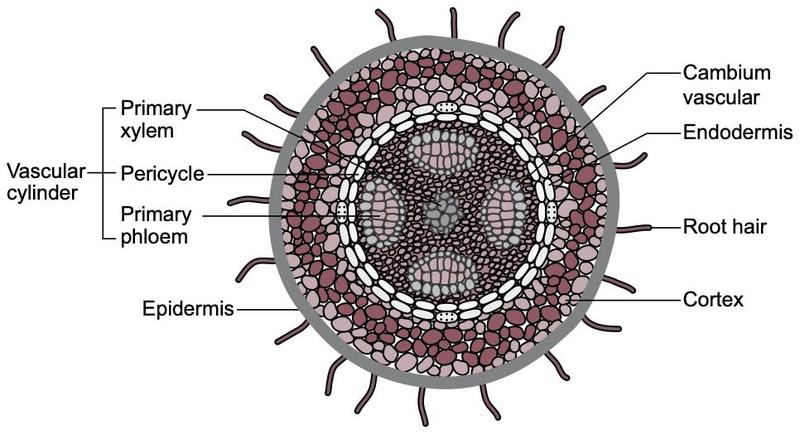
[1 mark]
(a)Which description matches the endodermis shown in Diagram 1?
Show answerHide answer
The ring of closely packed cells around the vascular cylinder
The endodermis separates the cortex from the vascular cylinder.
[1 mark]
(b)State the function of the xylem in the root.
Show answerHide answer
Tick each point you got.
[2 marks]
(c)Explain two adaptations of root hair cells for uptake of water and mineral salts.
Show answerHide answer
Any 2 points
Tick each point you got.
[2 marks]
(d)Explain the importance of the Casparian strip.
Show answerHide answer
Tick each point you got.
16
Question 16
Mrs Rodiah grows an epiphytic orchid in a vase of coconut fibre, brick shards and charcoal shards, placed at a corner of her house.
[1 mark]
(a)What is meant by an epiphytic plant?
Show answerHide answer
Tick each point you got.
[1 mark]
(b)Why does she not plant the orchid directly in the ground?
Show answerHide answer
Any 1 points
Tick each point you got.
[2 marks]
(c)State the main factor she must consider before choosing the corner, and explain.
Show answerHide answer
Tick each point you got.
[2 marks]
(d)Give two differences between an epiphyte and a parasitic plant.
Show answerHide answer
Any 2 points
Tick each point you got.