Biology notes, chapter 3
Nutrition in Plants
Textbook Biology Form 5 (DLP), pages 58–73
What this chapter covers
- Classify the main inorganic nutrients of plants into macronutrients and micronutrients (3.1)
- State the functions of the macronutrients and micronutrients and the effects of their deficiency (3.1)
- Describe the use of a culture solution and the NPK investigation on corn seedlings (3.1)
- Describe the external and internal structures of a root and how they are adapted to absorb water and mineral salts (3.2)
- Compare parasitic, epiphytic and carnivorous plants and their nutritional adaptations (3.3)
3.1Main inorganic nutrients
Nutrition is the process by which an organism obtains energy and nutrients from food for growth, maintenance and repair of damaged tissues. Plants take in inorganic nutrients and use them to make organic compounds such as carbohydrates and proteins.
Plant nutrients are grouped by the quantity the plant needs, not by how important they are.
| Group | Elements |
|---|---|
| Macronutrients (needed in large amounts) | Carbon (C), hydrogen (H), oxygen (O), nitrogen (N), phosphorus (P), potassium (K), calcium (Ca), magnesium (Mg), sulphur (S) |
| Micronutrients (needed in small amounts) | Chlorine (Cl), iron (Fe), manganese (Mn), boron (B), zinc (Zn), copper (Cu), nickel (Ni), molybdenum (Mo) |
Carbon, hydrogen and oxygen come from air and water, so plants rarely lack them. They make up most of the plant's dry mass. All the other nutrients are absorbed as mineral salts dissolved in soil water, which is why fertilisers supply them.
Functions of macronutrients and effects of deficiency
| Nutrient | Main function | Deficiency symptom |
|---|---|---|
| Nitrogen (N) | Makes chlorophyll (green colour); part of proteins, nucleic acids and enzymes | Chlorosis (yellowing), mainly of mature leaves; lower leaves fall off; stunted growth |
| Phosphorus (P) | Makes nucleic acids, ATP and phospholipids of the plasma membrane; coenzyme in photosynthesis and respiration | Poor root growth; dull dark green leaves; red or purple spots on older leaves |
| Potassium (K) | Protein synthesis and carbohydrate metabolism; enzyme cofactor; keeps plant cells turgid | Leaf edges turn yellow; protein synthesis disrupted; early death |
| Calcium (Ca) | Middle lamella, cell wall and spindle fibres in cell division | Stunted growth; distorted, lobed leaves; yellow patches between veins |
| Magnesium (Mg) | Central part of the chlorophyll molecule; activates some enzymes | Yellowing between the veins of mature leaves; red spots; lobed leaves |
| Sulphur (S) | Part of some amino acids, vitamin B and some coenzymes | Leaves or whole plant turn yellow |
| Carbon, oxygen, hydrogen | Carbon and oxygen cycles; part of all organic compounds and sugars | No photosynthesis; stunted growth, death |
Nitrogen deficiency and magnesium deficiency both cause yellow leaves. Nitrogen shortage yellows the whole older leaf first; magnesium shortage leaves the veins green and yellows the parts between the veins of mature leaves. Iron deficiency shows on young leaves.
Micronutrients
| Nutrient | Function | Deficiency symptom |
|---|---|---|
| Iron (Fe) | Cofactor in chlorophyll synthesis | Young leaves turn yellow |
| Chlorine (Cl) | Balances osmotic pressure in cells; photosynthesis | Wilting, slower root growth, less fruit |
| Manganese (Mn) | Activates photosynthetic enzymes; respiration and nitrogen metabolism | Dark green veins on a light green background; brown or grey spots |
| Boron (B) | Helps roots take up calcium and move sucrose; pollen germination | Terminal buds die; thick, rolled, brittle leaves |
| Zinc (Zn) | Leaf formation; makes auxin | Spotted chlorotic leaves; stunted growth |
| Copper (Cu) | Nitrogen metabolism, photosynthesis, flower formation | Young shoot tips die; brown spots on leaf tips |
| Nickel (Ni) | Enzyme that breaks urea down to ammonia | Burnt leaf tips from urea build-up |
| Molybdenum (Mo) | Nitrogen fixation and nitrate reduction | Yellowing between veins of mature leaves; pale leaves |
Culture solution and the NPK investigation
A culture solution (Knop's solution, prepared by Wilhelm Knop in 1859) contains all the nutrients a healthy plant needs, so it is used to study how each nutrient affects growth. It is made from calcium nitrate, potassium nitrate, potassium dihydrogen phosphate, magnesium sulphate, a trace of iron(III) phosphate and distilled water.
| Bottle | Content | Purpose |
|---|---|---|
| A | Complete culture solution | Shows healthy growth |
| B | Distilled water only | Control |
| C, D, E | Complete solution with one of N, P or K replaced by a compound that does not contain it | Shows the effect of lacking that nutrient |
- Manipulated variable: which of N, P, K is present. Responding variable: growth of the corn seedling (leaf colour, height, root length, stem strength). Constant variable: volume of solution.
- Black paper covers the bottles to stop green algae growing; an air pump gives the roots oxygen; the solution is renewed weekly.
- Result: the seedling in the complete solution (A) grows healthy; the other bottles show deficiency symptoms, so the hypothesis is accepted.
A plant grows poorly and its older leaves show red or purple spots. Which nutrient is lacking, and why does this hurt the roots and membranes?
Show answerHide answer
Phosphorus. It is needed to make nucleic acids, ATP and the phospholipids of the plasma membrane, so root growth is poor when it is lacking.
3.2Organ for water and mineral salts uptake
Roots anchor the plant in the soil and absorb water and mineral salts, passing them to the stem and leaves.
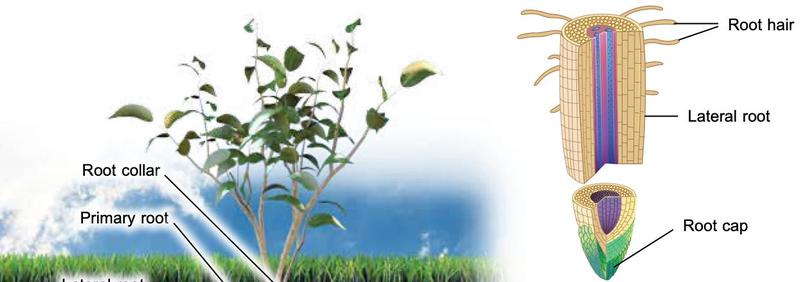
| External structure | Function |
|---|---|
| Root collar | Joins the root to the base of the stem |
| Root hairs | Elongated epidermal cells; greatly increase surface area for uptake of water and mineral salts |
| Root cap | At the tip; protects the root from damage as it pushes through soil |
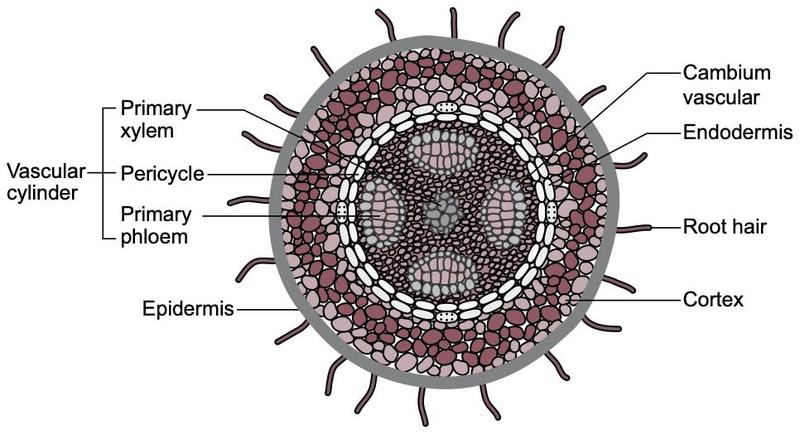
| Internal structure | Adaptation for its function |
|---|---|
| Epidermis | Closely packed cells with thin walls and water-permeable membranes; root hair cells have no cuticle and have large vacuoles to store water and mineral salts |
| Cortex | Mostly parenchyma cells with thin walls, loosely arranged: water moves easily and gases can exchange |
| Endodermis | One cell thick, closely packed; walls thickened with suberin or lignin form Casparian strips, so water and mineral salts enter the vascular cylinder but air bubbles do not |
| Pericycle | Surrounds the vascular tissue; forms lateral roots and takes part in secondary growth |
| Xylem | Transports water and mineral salts |
| Phloem | Transports organic substances such as sucrose and plant hormones |
The vascular cylinder is the root core: xylem and phloem, usually in a star-shaped pattern, surrounded by one layer of pericycle.
Why are root hair cells not covered by a cuticle?
Show answerHide answer
A waxy cuticle is waterproof. Without it, water can pass through the cell wall and membrane into the cell.
3.3Diversity in plant nutrition
| Type | How it feeds | Harm to host | Examples |
|---|---|---|---|
| Parasitic plant | Roots penetrate the host's stem to the vascular bundles and absorb organic substances, minerals and water | Host is malnourished, dries and may die | Rafflesia, dodder (Cuscuta) |
| Epiphytic plant | Lives on a taller host to get more sunlight; makes its own food by photosynthesis; roots absorb nutrients collected in gaps of the host's bark; many store water in swollen stems | None | Bird's nest fern (Asplenium nidus), orchids (Bulbophyllum) |
| Carnivorous plant | Photosynthesises, and traps insects in cups or traps using nectar; digests them with enzymes to get nitrogen that the soil lacks | Not applicable | Pitcher plant (Nepenthes), Venus fly trap (Dionaea) |
An epiphyte is not a parasite. It lives on the host only for support and light; it does not take food from it.
Worked exampleAn orchid is grown in coconut fibre and brick shards, not in ground soil. Why?
Epiphytic roots need air and good drainage and do not grow well in waterlogged soil; the fibre holds water and the shards allow air in, like the gaps in a tree's bark.
Epiphytic roots need air and good drainage and do not grow well in waterlogged soil; the fibre holds water and the shards allow air in, like the gaps in a tree's bark.
Why do pitcher plants trap insects although they photosynthesise?
Show answerHide answer
They grow in soil poor in nitrogen. Digesting insects gives them the nitrogen needed to make proteins and chlorophyll.
| Remember | |
|---|---|
| Macro vs micro | Quantity needed: 9 macronutrients, 8 micronutrients |
| Chlorophyll needs | Nitrogen and magnesium (iron for its synthesis) |
| Casparian strip | Endodermis; lets water in, keeps air out |
| Nitrogen source for carnivores | Digested insects |
Figures: Biology Form 5 (DLP) textbook, Chapter 3, pp. 65–66.