Leaf Structure and Function
What this chapter covers
- Describe the external structure of a leaf and the internal structure of a leaf lamina, and relate each to its function (2.1)
- Explain why plants need gaseous exchange and how guard cells open and close the stomata (2.2)
- Explain the importance of transpiration and the environmental factors that affect its rate (2.3)
- Relate the structure of the leaf and the chloroplast to photosynthesis; compare the light-dependent and light-independent reactions (2.4)
- Explain the effect of light intensity, carbon dioxide concentration, temperature and light colour on the rate of photosynthesis (2.4)
- Explain the compensation point and compare photosynthesis with respiration (2.5)
2.1Structure of a leaf
| External structure | Function |
|---|---|
| Lamina | Flat to give a wide surface that exposes chloroplasts to as much sunlight as possible; thin so that gases diffuse quickly through it |
| Petiole | Connects the lamina to the stem; its midrib and veins support the lamina |
Leaves are usually arranged so they do not overlap and shade each other. This is called a leaf mosaic.
Internal structure of the lamina
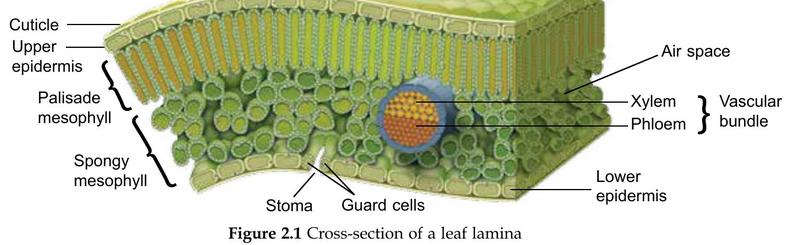
Leaf cross-section: textbook Figure 2.1, p. 29.
| Structure | Feature | Function |
|---|---|---|
| Cuticle | Waxy, waterproof, transparent | Reduces water loss; lets light through |
| Upper epidermis | Transparent, no chloroplasts | Lets light reach the mesophyll |
| Palisade mesophyll | Tall cells, packed closely and vertically, many chloroplasts | Main site of photosynthesis; absorbs maximum light |
| Spongy mesophyll | Irregular, loosely arranged, many air spaces, fewer chloroplasts | Large internal surface for gaseous exchange |
| Xylem | Thick lignified walls | Carries water and mineral salts from the roots; supports the leaf |
| Phloem | Part of the vascular bundle | Carries sucrose from the leaf to other parts |
| Lower epidermis | Has stomata, each with a pair of guard cells | Gaseous exchange and transpiration |
Show answerHide answer
2.2Gaseous exchange and the stomata
Plants make their own food, so they must exchange oxygen and carbon dioxide with the air. This happens through the stomata, mostly on the lower epidermis. Each stoma is guarded by two guard cells that contain chloroplasts and change shape to open or close it.
How a stoma opens and closes
| Step | Stoma opens (day, light) | Stoma closes (night, no light) |
|---|---|---|
| Potassium ions (K⁺) | K⁺ enter the guard cells | K⁺ leave the guard cells |
| Sucrose | Photosynthesis makes sucrose; concentration rises | No photosynthesis; sugar is changed to starch; concentration falls |
| Water potential in guard cells | Decreases | Increases |
| Water movement (osmosis) | Into the guard cells from the epidermal cells | Out of the guard cells to the epidermal cells |
| Guard cells | Turgid, curve outwards | Flaccid |
When a plant lacks water the guard cells become flaccid and the stomata close. This lowers water loss and helps the plant survive. Cacti open their stomata only at night, when it is cooler, to lose less water.
Show answerHide answer
2.3Transpiration
Why plants need it
- Water evaporating from the leaf takes up heat, which has a cooling effect.
- It creates a pulling force that draws water and mineral salts up the xylem from the roots to all cells.
- It keeps the roots absorbing water and mineral salts from the soil.
Factors that affect the rate
| Factor | Effect on rate | Reason |
|---|---|---|
| Light intensity | Higher light, higher rate (until it levels off) | Stomata open wider in light; the rate becomes constant when humidity, temperature or air movement becomes limiting |
| Temperature | Higher temperature, higher rate | Water molecules gain kinetic energy and evaporate faster |
| Relative air humidity | Lower humidity, higher rate | Drier air takes water vapour more quickly |
| Air movement | Faster air, higher rate | Moving air carries away water vapour near the leaf |
Potometer
A potometer measures the water taken in by a leafy twig, as the distance moved by an air bubble in the capillary tube. The twig is cut under water so no air enters the xylem, and joints are sealed with petroleum jelly.
Show answerHide answer
2.4Photosynthesis
Discovery
Van Helmont (1640s) grew a weighed seedling (2.3 kg) in 90 kg of dried soil and gave it only water for five years: the plant reached 77 kg but the soil mass hardly changed, so he concluded the plant grew from the water, not the soil. Priestley (1772) showed that a rat in a closed jar died, but lived when a plant was placed in the jar with it, so plants release oxygen.
Leaf structure and photosynthesis
- Transparent cuticle and epidermis let light through.
- Stomata allow CO₂ in and O₂ out.
- Palisade mesophyll is packed with chloroplasts, so it absorbs light at a maximum rate.
- Spongy mesophyll has air spaces for efficient gaseous exchange.
- Xylem brings water and mineral salts; phloem takes away sucrose.
The chloroplast
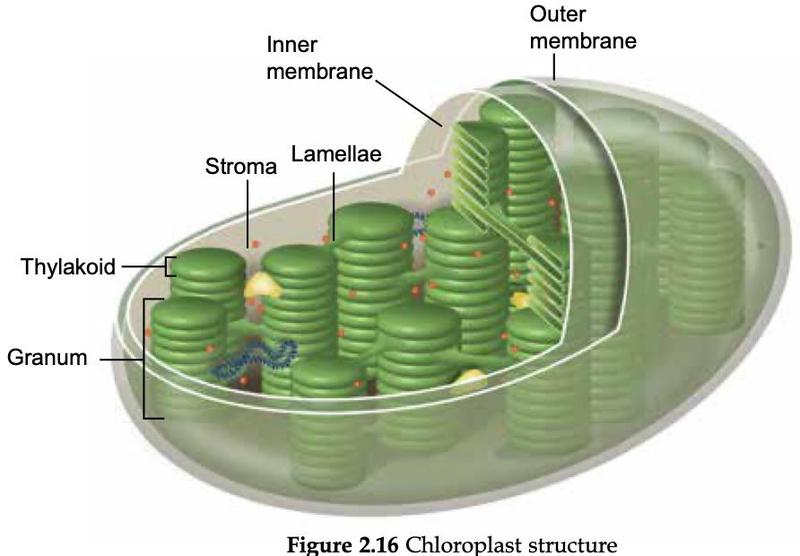
Chloroplast: textbook Figure 2.16, p. 42.
| Part | Description | Role |
|---|---|---|
| Thylakoid | Disc-shaped sac with chlorophyll in its membrane | Site of the light-dependent reaction |
| Granum | Stack of thylakoids | Increases surface area for light |
| Stroma | Colourless fluid around the grana | Site of the light-independent reaction |
Pigments and chromatography
Paper chromatography separates pigments in a leaf extract by how soluble they are in the solvent. Rf = distance moved by pigment ÷ distance moved by solvent. A pigment always has an Rf less than 1.
Two stages
| Light-dependent reaction | Light-independent reaction | |
|---|---|---|
| Site | Thylakoid | Stroma |
| Needs light? | Yes | No (uses the products of the first stage) |
| What happens | Chlorophyll absorbs light, electrons are excited; photolysis splits water into H⁺ and OH⁻; OH⁻ loses electrons to form O₂ and water; ATP and NADPH are made | CO₂ is fixed; ATP and NADPH reduce it to glucose; glucose joins into starch |
| Products | ATP, NADPH, oxygen | Glucose, then starch |
Factors that affect the rate of photosynthesis
| Factor | Effect |
|---|---|
| Light intensity | Rate rises until the light saturation point; after that, CO₂ or temperature becomes the limiting factor |
| Carbon dioxide concentration | Rate rises until light or temperature becomes limiting |
| Temperature | Optimum about 25 to 30 °C; very high temperatures denature the enzymes and the rate falls to zero |
| Colour of light | Highest in red and blue light; green is reflected, so leaves look green |
In the Hydrilla experiments, the rate is measured by counting the oxygen bubbles released in 5 minutes. Sodium hydrogen carbonate solution supplies carbon dioxide.
Show answerHide answer
2.5Compensation point
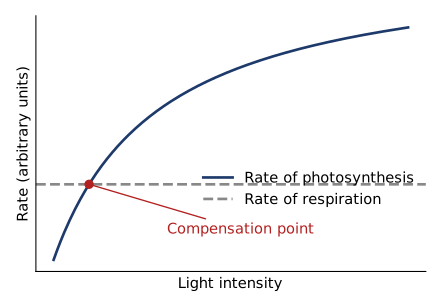
- Below it: respiration is faster, so there is a net loss of glucose and the plant takes in O₂.
- At it: no net gas exchange with the air; all glucose made is used in respiration.
- Above it: net gain of glucose (stored as starch), CO₂ is taken in and O₂ released.
A plant must stay above its compensation point for most of the day so there is surplus glucose for growth, flowers, fruit and seeds.
Photosynthesis and respiration
| Photosynthesis | Respiration | |
|---|---|---|
| Where | Cells with chloroplasts | All living cells |
| Metabolism | Anabolic (builds glucose) | Catabolic (breaks down glucose) |
| Site | Chloroplast | Mitochondria (and cytoplasm) |
| Reactants | CO₂ and water | Glucose and O₂ |
| Products | Glucose, O₂ | Energy (ATP), CO₂, water |
| Light | Needed | Not needed |